한국 해군이 추진 중인 차세대 잠수함 KSS-III 배치3는 소형모듈원자로(SMR) 탑재를 검토하고 있다. 이는 단순한 기술 도입이 아니라, 국가 전략과 외교, 산업 설계가 맞물린 총체적 실험에 가깝다. 본 기사는 Naval News(2024. 2. 5), IAEA SMR Status Report(2024 ed.), War on the Rocks(2025. 2., “South Korea and Nuclear-Powered Submarines”)의 기술 수치 및 전략 분석을 참조하고, 국내 전문가 인터뷰를 토대로 SMR 해양화가 던지는 기술·정치·윤리적 함의를 종합 분석한 한미일보의 탐사 기획이다. <편집자 주>
 An underwater reactor is a quietly beating heart. Can South Korea's KSS-III Batch 3 submarine house that heart? Hanmi Ilbo GraphicsWill the next chapter for South Korean submarines be a reactor? There are observations that the design for the Dosan Ahn Changho-class KSS-III Batch 3 is considering the integration of a Small Modular Reactor (SMR). Following U.S. President Donald Trump's remarks about "approving South Korea's construction of a nuclear-powered submarine," voices within the Navy are spreading, saying, "The technology is ready, the issue is the design." However, technology always demands a choice. The space for an SMR is not merely a mechanical compartment, but an abyss where strategy and ethics intersect.
Submarine designers in the Navy say, "Sound kills faster than weapons." A single 30Hz low-frequency hum from an SMR's cooling pump can be detected by underwater acoustic networks hundreds of nautical miles away. The IAEA's SMR report (2024) identifies 'vibration and noise suppression' as the biggest challenge for marine reactors. The real enemy of a South Korean nuclear submarine may not be technology, but 'sound'. A nuclear submarine must be quiet to be strong. Stealth is survival.
The lead and steel walls encasing a reactor protect humans but can upset the vessel's balance. For every ton added to shielding, the trim can shift by 2 degrees. In naval engineering, 2 degrees is the boundary between life and death. Naval News (2024.2.5) reported that "the KSS-III Batch II design changed the placement of shielding materials to compensate for stability." Engineers calculate gravity before radiation.
Minute differences of 2 degrees in cooling water temperature and 0.1 m/s in flow rate can create bubbles on the water's surface. Satellites' infrared sensors can capture these traces. The advantage of nuclear propulsion is 'unlimited diving,' but paradoxically, heat becomes evidence of submersion. War on the Rocks (2025) analyzed that "the biggest challenge for South Korea's nuclear submarines is thermal signature management." The first task in adapting SMRs for marine use is not the turbine, but 'technology to conceal heat'.
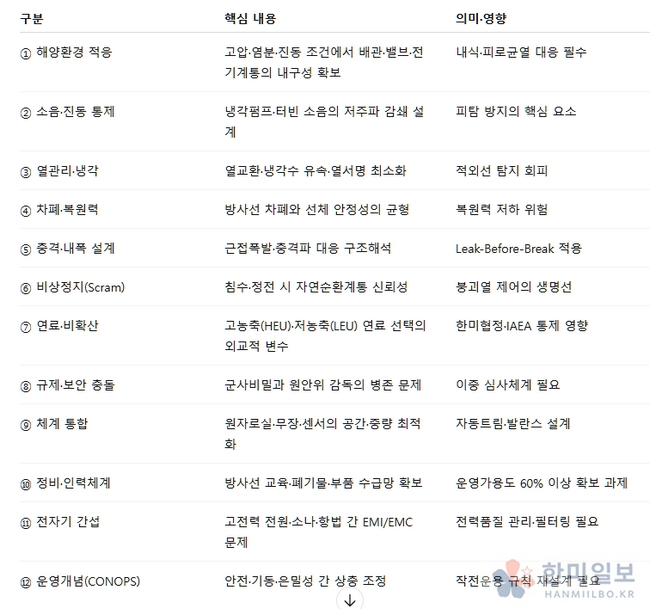
Experts point to at least 12 technical risks in the marine adaptation of SMRs. The most fundamental problem is adaptation to the marine environment (marinization). Unlike land-based structures, reactors are simultaneously exposed to high pressure, high humidity, salinity, and vibration. If piping, valves, and electrical systems cannot withstand these conditions with sufficient corrosion resistance and fatigue life, safety can crumble by a thread. SMRs are small, but because they are small, they are more complex. The higher the concentration of high temperatures and pressures within a small volume, the faster the limits are reached.
The second major challenge is the control of noise and vibration. The subtle low-frequency vibrations from cooling pumps and turbines are the most critical signals revealing a submarine's location. Underwater acoustic networks hundreds of nautical miles away can detect these tremors. The stealth of a nuclear submarine comes not from firepower, but from the technical ethic of 'silence'. Silencing sound is more difficult than building weapons.
The third is thermal management and cooling efficiency, as well as the thermal signature that emerges on the water's surface. If the heat generated during submersion cannot be concealed, the advantage of nuclear propulsion becomes a cause for detection. Minute errors in heat exchanger design, coolant flow rate, and heat dissipation patterns can be captured by enemy satellite imagery. The issue of cooling is not merely temperature control, but 'technology to hide one's presence'.
The fourth task is the balance between radiation shielding and buoyancy. Increasing shielding materials enhances safety but alters the vessel's center of gravity and reduces stability. A submarine's balance is paramount, and with a reactor on board, that balance must be recalculated at every moment. Designers calculate gravity before radiation, and human survival space before gravity.
Subsequent issues include shock, blast, and pressure resistance design, the reliability of emergency shutdown (Scram) systems, fuel cycle management and non-proliferation risks, and the conflict between international regulations and military security. Each element does not exist in isolation. When a single valve, a single sensor, or a single protocol fails, the rest of the system shakes in a chain reaction. The moment a reactor is brought inside the hull, the submarine is no longer just a vessel. It becomes a mobile nuclear facility.
Finally, there are the system integration and maintenance ecosystem. The reactor room, propulsion system, armament, sensors, and living quarters must achieve physical, thermal, and electromagnetic balance within a confined hull. Without a maintenance workforce, spare parts, and a waste management system, the technology will not last. The problem of nuclear submarines is more about personnel than reactors, and more about systems than machinery.
Ultimately, the marine adaptation of SMRs is not simply about moving a reactor to sea, but about launching a nation's responsibility onto the ocean. What is heavier than the pressure of the ocean is the pressure of ethics, because science, the military, and human safety must breathe in the same space.
During submersion, if power is lost, the reactor heats up instinctively. Decay heat rises slowly but relentlessly, like human fear. The safety design of an SMR depends on how it withstands this 'five minutes'. The triple barrier of diesel, batteries, and fuel cells is designed to withstand the duration of decay heat. If that barrier fails, seawater turns to steam, and the captain turns from hero to victim.
The moment enrichment exceeds 20%, technology becomes diplomacy. Highly Enriched Uranium (HEU) is power, but also a forbidden word. There is an invisible line between the lines of the U.S.-South Korea Atomic Energy Agreement. That '20%' is not a technical standard but a diplomatic convention. The issue of nuclear submarines shifts from uranium enrichment to the extent of alliance trust.
Military secrets require protection, while nuclear energy presupposes transparency. Nuclear submarines exist on the edge of this contradiction. The IAEA SMR report points out that "the biggest challenge for military application SMRs is the harmonization of secrecy and oversight." The Ministry of National Defense's 'secrecy' clashes with the Nuclear Safety and Security Commission's 'transparency' within the same hull. Scientists want data, while the military conceals locations. If this balance is lost, trust sinks before technology.
A nuclear submarine is not a single vessel but a maintenance ecosystem. Even if just one SMR is installed, without education, parts, and disposal systems, it is merely a floating reactor. The real weapon of a nuclear submarine is not fuel or silence, but 'people'. When people trust the technology, the vessel returns.
Experts interviewed by Hanmi Ilbo summarized the 'marinization of SMRs' as an 'experiment where science, military, and ethics breathe within a single body, not a simple reduction'.
What has not yet been drawn on the design blueprints of the KSS-III Batch 3 is 'resolve'. The issue of nuclear submarines is not technology, but choice. South Korea stands at the threshold of transitioning from an era of energy to an era of strategy. On that threshold, the question is posed.
"Can we control the reactor, or will it control us?"
12 Key Risks of SMR Marinization Identified by Experts
#KSSIII #SMR #NuclearSubmarine #DosanAhnChanghoClass #TrumpRemarks #IAEA #WarOnTheRocks #IndustrialSovereignty #MaritimeSecurity #HanmiIlbo

 Iranian Foreign Ministry: "Continuing Message Exchanges with the U.S. and Activities of Mediating Countries"
Esmaeil Baghaei, Spokesperson for the Iranian Ministry of Foreign Affairs [Xinhua, Yonhap News file photo]Esmaeil Baghaei, spokesperson for the Iranian Ministry of Foreign Affairs, stated on the 26th
Iranian Foreign Ministry: "Continuing Message Exchanges with the U.S. and Activities of Mediating Countries"
Esmaeil Baghaei, Spokesperson for the Iranian Ministry of Foreign Affairs [Xinhua, Yonhap News file photo]Esmaeil Baghaei, spokesperson for the Iranian Ministry of Foreign Affairs, stated on the 26th
 President Yoon: "Do You Think You Are Safe from the Special Counsel?"... Final Statement Video Released
President Yoon Suk Yeol rebuking the special prosecutor on the 24th. [Court video / @birds_justice X account subtitle GIF] A video of President Yoon Suk Yeol's closing statement at his trial rega
President Yoon: "Do You Think You Are Safe from the Special Counsel?"... Final Statement Video Released
President Yoon Suk Yeol rebuking the special prosecutor on the 24th. [Court video / @birds_justice X account subtitle GIF] A video of President Yoon Suk Yeol's closing statement at his trial rega
 President Yoon, regarding the first-instance ruling on the Public Official Election Act: “An excessive political verdict that distorts the facts… We will appeal immediately.”
The first-instance sentencing hearing for President Yoon Suk Yeol regarding violations of the Public Official Election Act is being broadcast live at Seoul Station on the 27th. [Photo=Yonhap News]Pres
President Yoon, regarding the first-instance ruling on the Public Official Election Act: “An excessive political verdict that distorts the facts… We will appeal immediately.”
The first-instance sentencing hearing for President Yoon Suk Yeol regarding violations of the Public Official Election Act is being broadcast live at Seoul Station on the 27th. [Photo=Yonhap News]Pres
 WSJ: "SK Hynix ADR Premium Is a Sign of AI Trading Overheat"
Advertisement for SK Hynix ADR listing in New York's Times Square [Reuters=Yonhap News file photo]The Wall Street Journal (WSJ) has pointed out that the price of SK Hynix’s American Depositary Recei
WSJ: "SK Hynix ADR Premium Is a Sign of AI Trading Overheat"
Advertisement for SK Hynix ADR listing in New York's Times Square [Reuters=Yonhap News file photo]The Wall Street Journal (WSJ) has pointed out that the price of SK Hynix’s American Depositary Recei
 'Godfather of Japanese Mystery Novels' Keigo Higashino Passes Away After Battle with Cancer at 68
Famous Japanese mystery novelist Keigo Higashino [AFP=Yonhap News]It has been belatedly reported that Keigo Higashino, the "godfather of Japanese mystery novels" and author of bestsellers such as "The
'Godfather of Japanese Mystery Novels' Keigo Higashino Passes Away After Battle with Cancer at 68
Famous Japanese mystery novelist Keigo Higashino [AFP=Yonhap News]It has been belatedly reported that Keigo Higashino, the "godfather of Japanese mystery novels" and author of bestsellers such as "The
 [Park Pil-kyu Security Column] To the Ignorant Trying to Clothe a Beast in Sheep's Clothing
Rep. Kim Byung-joo of the Democratic Party of Korea [Photo=Yonhap News]“The Air Force Academy doesn't teach you how to fly a plane!” “The Army, Navy, and Air Force academies are exactly the
[Park Pil-kyu Security Column] To the Ignorant Trying to Clothe a Beast in Sheep's Clothing
Rep. Kim Byung-joo of the Democratic Party of Korea [Photo=Yonhap News]“The Air Force Academy doesn't teach you how to fly a plane!” “The Army, Navy, and Air Force academies are exactly the
 [Issue Diagnosis] Two Effects of the Election Petition Review
 [Photo] Evidence of Election Fraud Flooding U.S. Media… Trump Had 2.7 Million Votes Stolen
 [Video] U.S. Semiquincentennial Air Show... 'Art in the Sky' streaks across New York
 [Editorial Cartoon] A Draconian Law That Undermines Freedom of Expression

 List
List









