도널드 트럼프 미국 대통령의 관세정책은 단순한 무역 분쟁이 아니라 세계경제의 문법을 다시 쓴 사건이었다. 그는 세율을 조정한 것이 아니라, 국가 간 질서의 설계권을 재편했다. 본 기사는 트럼프식 관세협상의 ‘의미’와 ‘수단’을 중심으로, 한국 관료사회와 언론이 읽지 못한 구조적 함의를 분석한다. <편집자 주>
 "A Map Created by Tariffs, An Order Designed by Tariffs" A scene where President Trump presses down on a world blueprint with a 'Tariff Seal'. Tariffs are no longer taxes, but a language of power that reshapes a nation's position by interconnecting industry, currency, military, and technology. Hankyoreh GraphicTrump wrote tariffs not as taxes, but as commands. Imposition was a warning, "You are outside my order," and exemption was an approval process, "You are brought within my system." His tariff policy was not a measure to collect revenue, but a tool to reconfigure inter-state relations. "Tariff for Leverage," his method of using tariffs as a bargaining chip, was perfected through the US-China trade war in 2018. The high tariffs of 25% were not for fiscal gains but a structural signal to reweave the China-centric supply chain to be US-centric. Trump packaged tariffs in economic language, but in reality, he used them as a language of power.
His tariffs were not pricing policies but positioning policies. They were a means to determine who was inside and who was outside, and in what order. Trump perceived trade not as a mere issue of exports and imports, but as a hierarchical structure of nations. Therefore, he dealt with the world not in the language of economists, but in the language of designers. Tariffs were not a matter of profit but of structure, and they were a grammar for redesigning not borders, but coordinates of power.
However, Korean bureaucrats and media completely failed to read this grammar. The "Up front investment" that Trump mentioned in the 2025 US-Korea trade talks was a demand for upfront alignment with the US-centric supply chain. But officials interpreted it as "a $350 billion cash payment," and the media reported the number as the headline. Without understanding that the language of diplomacy is a grammar of power, they reported the tax rates translated into numbers.
The government packaged that mistranslation as an "achievement," and reporters competed to publish headlines like "US-Korea Investment Agreement Reached" and "$350 Billion Cash Investment to the US." They couldn't even distinguish whether 'Up front' was a command, a request, or a condition. The failure of translation led to the failure of policy, and the failure of policy was again packaged as "success" before the public.
It was a typical example of translation politics, where political interpretation becomes policy and media ignorance masks national interest.
"Up front" was not about money, but about the order of trust. What Trump said was "Show me loyalty first," meaning "Act first." But we changed that sentence to "Pay now." A misreading of one word shook the diplomacy of an entire nation.
The core of Trump-style language is the perception that action is contract. He looks at order rather than words, and believes that order is evidence of trust. The diplomacy of a nation that fails to read that language will always remain a "translated copy."
Trump's Four Major Tariff Negotiation Matrices
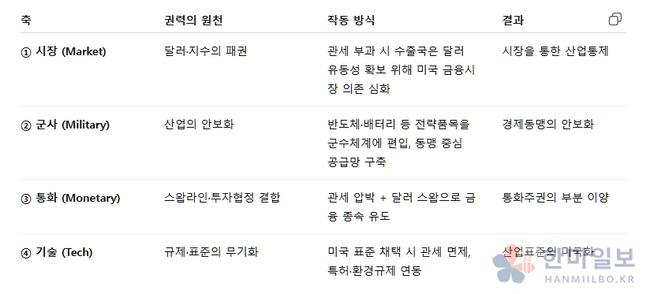
The source of power behind Trump's tariff policy leading to national repositioning was his design of tariffs not as a single policy but as a multifaceted governance tool.
He bound the four pillars of markets, military, currency, and technology into a single structure. In markets, he governed through dollars and stock indices; in the military, he incorporated industries into the security system. In currency, he controlled financial order by combining swap lines and investment agreements; and in technology, he weaponized standards and regulations. These four pillars interlocked to complete Trump's 'Constitution of Industrial Sovereignty.'
However, this tariff policy was both foreign policy and an internal war. The targets Trump confronted were not only China but also Wall Street financial power and the American deep state. While he advocated for "America First," he actually implemented "Global Finance Last."
It was a battle to limit capital freedom through tariffs, induce the return of manufacturing, and shift the nation's design authority from finance back to industry. His goal was to bring the financial network, which had led globalization, under political control.
The essence of that struggle was financial control through tax rates. Wall Street spoke of free markets, but that freedom was another name for unchecked power. Trump rejected that language and presented tariffs as a grammar of new discipline. It was a plan to rebuild the nation centered on production, not markets.
However, internal American financial elites and bureaucratic networks branded him as an 'anti-marketist,' and international media labeled his tariffs as 'retaliation.' In reality, those tariffs were in the process of redesigning the world.
Dollars become law, supply chains become military alliances, swaps become control mechanisms, and technology becomes norms. Trump's tariff policy was not about tax rates but an infrastructure of power. He did not close borders by raising taxes, but reopened the world's structure through tax rates.
Tariffs were not economic policy but a tool for power design, and through that tool, the US completed the map of industrial redistribution.
If South Korea still understands tariffs only as 'tax rates,' we will inevitably remain within translated sentences. Trump's tariffs were not numbers but design, and nations that fail to decipher the language of that design will ultimately live within structures written by others.
To read tariffs is not simply to count numbers, but to interpret the order those numbers speak. Trump's tariffs were the language of politics, not economics, and he ruled the world with tax rates and reshaped industries with language. "Up front," the question thrown by that single word is simple: "Where will you stand?"
#TrumpTariffNegotiations #UpFrontControversy #TariffForLeverage #USKoreaTrade #IndustrialSovereignty #DesignSovereignty #DeepState #WallStreetFinancialPower #EconomicGovernance #HankyorehPlanningSpecial

 Iranian Foreign Ministry: "Continuing Message Exchanges with the U.S. and Activities of Mediating Countries"
Esmaeil Baghaei, Spokesperson for the Iranian Ministry of Foreign Affairs [Xinhua, Yonhap News file photo]Esmaeil Baghaei, spokesperson for the Iranian Ministry of Foreign Affairs, stated on the 26th
Iranian Foreign Ministry: "Continuing Message Exchanges with the U.S. and Activities of Mediating Countries"
Esmaeil Baghaei, Spokesperson for the Iranian Ministry of Foreign Affairs [Xinhua, Yonhap News file photo]Esmaeil Baghaei, spokesperson for the Iranian Ministry of Foreign Affairs, stated on the 26th
 President Yoon: "Do You Think You Are Safe from the Special Counsel?"... Final Statement Video Released
President Yoon Suk Yeol rebuking the special prosecutor on the 24th. [Court video / @birds_justice X account subtitle GIF] A video of President Yoon Suk Yeol's closing statement at his trial rega
President Yoon: "Do You Think You Are Safe from the Special Counsel?"... Final Statement Video Released
President Yoon Suk Yeol rebuking the special prosecutor on the 24th. [Court video / @birds_justice X account subtitle GIF] A video of President Yoon Suk Yeol's closing statement at his trial rega
 President Yoon, regarding the first-instance ruling on the Public Official Election Act: “An excessive political verdict that distorts the facts… We will appeal immediately.”
The first-instance sentencing hearing for President Yoon Suk Yeol regarding violations of the Public Official Election Act is being broadcast live at Seoul Station on the 27th. [Photo=Yonhap News]Pres
President Yoon, regarding the first-instance ruling on the Public Official Election Act: “An excessive political verdict that distorts the facts… We will appeal immediately.”
The first-instance sentencing hearing for President Yoon Suk Yeol regarding violations of the Public Official Election Act is being broadcast live at Seoul Station on the 27th. [Photo=Yonhap News]Pres
 WSJ: "SK Hynix ADR Premium Is a Sign of AI Trading Overheat"
Advertisement for SK Hynix ADR listing in New York's Times Square [Reuters=Yonhap News file photo]The Wall Street Journal (WSJ) has pointed out that the price of SK Hynix’s American Depositary Recei
WSJ: "SK Hynix ADR Premium Is a Sign of AI Trading Overheat"
Advertisement for SK Hynix ADR listing in New York's Times Square [Reuters=Yonhap News file photo]The Wall Street Journal (WSJ) has pointed out that the price of SK Hynix’s American Depositary Recei
 'Godfather of Japanese Mystery Novels' Keigo Higashino Passes Away After Battle with Cancer at 68
Famous Japanese mystery novelist Keigo Higashino [AFP=Yonhap News]It has been belatedly reported that Keigo Higashino, the "godfather of Japanese mystery novels" and author of bestsellers such as "The
'Godfather of Japanese Mystery Novels' Keigo Higashino Passes Away After Battle with Cancer at 68
Famous Japanese mystery novelist Keigo Higashino [AFP=Yonhap News]It has been belatedly reported that Keigo Higashino, the "godfather of Japanese mystery novels" and author of bestsellers such as "The
 [Park Pil-kyu Security Column] To the Ignorant Trying to Clothe a Beast in Sheep's Clothing
Rep. Kim Byung-joo of the Democratic Party of Korea [Photo=Yonhap News]“The Air Force Academy doesn't teach you how to fly a plane!” “The Army, Navy, and Air Force academies are exactly the
[Park Pil-kyu Security Column] To the Ignorant Trying to Clothe a Beast in Sheep's Clothing
Rep. Kim Byung-joo of the Democratic Party of Korea [Photo=Yonhap News]“The Air Force Academy doesn't teach you how to fly a plane!” “The Army, Navy, and Air Force academies are exactly the
 [Issue Diagnosis] Two Effects of the Election Petition Review
 [Photo] Evidence of Election Fraud Flooding U.S. Media… Trump Had 2.7 Million Votes Stolen
 [Video] U.S. Semiquincentennial Air Show... 'Art in the Sky' streaks across New York
 [Editorial Cartoon] A Draconian Law That Undermines Freedom of Expression

 List
List