이 기사에서는 기자가 스카이데일리 시절 2년간 추적했던 ‘5·18 北 개입설’ 시리즈 일부를 발췌합니다. 올봄 윤석열 대통령 탄핵 이후 국내 언론사상 우파에서 좌파로 최단기간에 논조를 바꾼 스카이데일리는 기자가 작성했던 5·18 시리즈 40편을 올여름 온라인에서 전부 삭제했습니다. 스데 사장 민경두와 새로 부임한 좌파 편집진은 취재 당사자인 기자와 단 한 번도 상의하지 않고 5·18 사과문을 일방적으로 게재했고, 관련 기사도 모두 내렸습니다. “강하게 책임을 물어야 한다”는 비판이 나온 배경입니다. 문재인 정권에서 태동한 5·18조사위의 불공정한 조사 행태와 비합리적인 결론을 국민 일반에 알리고 공감대를 형성하는 일이 시급한데도 그 시리즈를 취재 당사자에게 묻지 않고 통 삭제했기 때문입니다. 해당 기사의 사진과 본문·PDF는 기자가 ‘아카이브’로 고스란히 보관하고 있습니다. 애초 <한미일보>는 스데의 삭제 행위는 저작권을 스스로 포기한 조처로 보고, 저작권 소송을 제기하려 검토했으나 지난 9월 민씨가 ‘스데를 청산한다’고 밝힌 뒤 jtbc·MBC 등이 대서특필한 관계로, ‘저작권 쟁송보다 스데가 문 닫기를 기다리는 게 빠르겠다’는 판단에 따라 저작권 소송을 유보한 바 있습니다. 급속도로 좌파 논조로 갈아탄 스데의 운명에 일고의 관심도 없지만, 향후 5·18 시리즈 아카이브의 <한미일보> 재게재와 후속 보도 판단을 위해 스데의 청산 추이를 지켜볼 예정입니다. <편집자 주>
[Notice] On November 6th, around 5 PM, five photos were added. These photos could not be included at the time of writing due to article content size limitations or unknown errors. From top to bottom: the photo caption describing the situation that suggests the "infiltration" by the North, a scene of DJ's inflammatory speech in Jeongeup, Jeonbuk, a monument for President Chun Doo-hwan being trampled by passersby, Jeungsimsa Temple on Mudeungsan Mountain in Gwangju, a declassified document from the US Under Secretary of State pointing out various rumors and North Korean propaganda attacks, and finally, the photos themselves. The content of the main article has not been modified.
 According to the declassified US State Department cable (80SEOUL 006865), in 1980, then-US Ambassador to Korea William Gleysteen reported to Washington that "impure elements' and communist instigators lay behind the whole affair" (including the capture of spy Lee Chang-ryong). The US diplomatic cable also explicitly states multiple perpetrators: "infiltrators (operatives sent from the North)" and "communist instigators (resident spies or revolutionary forces)."
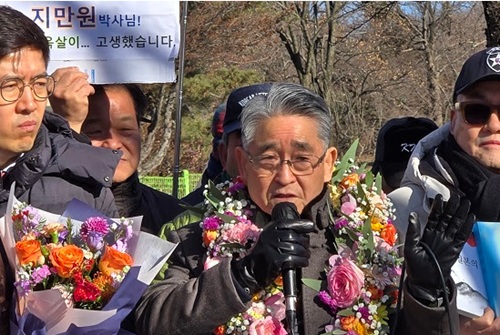 Dr. Ji Man-won, a pioneer of "May 18 Enlightenment," speaks about his feelings after being released from prison after a two-year sentence at a welcoming ceremony and press conference held in front of the main gate of Seoul Detention Center in Uiwang, Gyeonggi Province, on January 15th of this year. / Reporter Heo Gyeom
Dr. Ji Man-won (83), recognized as a leading scholar in the study of North Korea's alleged involvement in the May 18 Gwangju Uprising, has reportedly achieved a "partial success" despite facing considerable persecution for his research into North Korea's suspected intervention during the 1980 May 18th incident.
Although Dr. Ji has outwardly lost the civil lawsuit, he is receiving positive evaluations for bringing public opinion closer to the truth by including statements in the verdict that suggest the possibility of North Korean agents or spies operating during the May 18th incident.
An analysis of the court's ruling, obtained by The US-Korea Daily on the 4th, revealed that the Civil Division 1 of the Gwangju High Court (Judges Lee Eui-young, Cho Su-min, and Jung Jae-woo), which concluded the oral arguments on September 4th, included the phrase in its appellate ruling on October 30th: "It is possible to consider that small-scale North Korean operatives or resident spies may have been active during the May 18th Democratic Uprising."
In a phone conversation with this reporter, Goo Joo-wa, Dr. Ji's lawyer, stated, "This is a highly significant ruling that marks a shift in the court's stance, which has consistently ruled in one direction for decades, towards respecting diverse perspectives on the May 18th incident."
Attorney Goo added, "We hope that freedom of expression and academic freedom regarding the May 18th incident will be broadly recognized in the future. We also propose that all individuals investigated or tried under the Special Act on the May 18th Incident for similar content should receive dismissal of charges or not guilty verdicts."
North's Involvement Mentioned in Verdict... First Case Since the Supreme Court's Final Ruling in 1981
This marks the first time since the Supreme Court's initial final ruling in 1981 that the judiciary has included the possibility of North Korean involvement in the May 18th incident in its ruling.
The Supreme Court had previously finalized its ruling that the May 18th incident was an act of rebellion orchestrated by Kim Dae-jung (DJ).
In its appellate ruling delivered in 1981, the year following the May 18th incident, the Supreme Court characterized the uprising as an attempt by DJ to incite rebellion against the state.
One of the grounds cited was the subversive nature of the "National Congress for the Restoration of Korean Democracy and Unification (Hanmintong)" based in Japan, which was linked to Kim Dae-jung, stating, "Hanmintong, based in Japan, is an anti-state organization constituted and funded by directives from North Korea and Chongryon to achieve its objectives."
Furthermore, it was unequivocally stated that "the declaration of martial law, an act of high political and military significance, is not null and void," and "the judiciary does not have the authority to judge the rightness or wrongness of the declaration of martial law."
A comprehensive review of the rulings from the 1980 and 1981 first, second, and third trials indicates that the judiciary concluded, "The crime of conspiracy to commit rebellion involves two or more individuals agreeing on the content of rebellion before its execution, and a detailed plan is not necessary (ruling of April 8, 1975, 74do3323). The constituent elements, in accordance with Article 90 of the Criminal Act, suffice with the act of conspiring with the intent to commit rebellion." This solidified the charges of conspiracy to commit rebellion against DJ.
The Supreme Court's final ruling holds the effect of "res judicata," meaning that once confirmed by the Supreme Court, the same case cannot be re-examined or overturned by the judiciary, possessing a permanent legal effect.
The South Korean government was not the only entity to reach such a conclusion.
According to multiple US State Department and CIA documents, the United States had early on identified the May 18th incident as an "insurrection" or "rebellion" orchestrated by a combination of "North Korean Agents," "Kim Dae-jung followers (Associates)," "communist instigators," and "impure elements," classifying it as a "southward operation" planned and led in advance.
General John Adams Wickham, Commander of the US Forces Korea during the May 18th incident in 1980, reportedly stated that civilians taking arms from soldiers and police in Gwangju and confronting the military should be considered "Another Enemy" and immediately suppressed by regular forces, adding, "There should be no group stronger than the regular army in the country." This testimony comes from former Vice Minister of Defense Lee Jeong-rin.
The theory of North Korean involvement, depending on its verification, fundamentally alters the nature of the May 18th incident.
If it is revealed that North Korean armed infiltrators and resident spies, disguised in South Korean military uniforms and posing as martial law troops, shot innocent Gwangju citizens and then falsely attributed the actions to the martial law forces, the uprising would likely lose its legitimacy as a pure movement of resistance against government violence.
In such a scenario, a significant overhaul of individuals recognized as May 18th contributors would be inevitable, according to general consensus.
Treason by the Civilian Government's Supreme Court... DJ's Anti-State Armed Rebellion Transformed into a Democratic Movement
However, in 1997, the Supreme Court overturned its previous ruling, breaking the constitutional principle of double jeopardy (ne bis in idem) by re-examining the same case and changing its classification to a democratic movement.
Consequently, the 1981 ruling, which had established DJ's actions as an anti-state armed rebellion, was overturned after 16 years. DJ, having been absolved, went on to achieve great success, eventually becoming president.
The Supreme Court's decision to violate the principle of double jeopardy continues to be a subject of posthumous discussion to this day.
Simultaneously, proposals have emerged suggesting that the May 18th incident could potentially be re-evaluated as a riot.
The argument is that if a riot, characterized by the storming of prisons and the firing of weapons against the government, could be reinterpreted as a democratic movement due to differing legal interpretations for political reasons, despite no fundamental changes in the facts, then new interpretations could be made at any time in the future.
The turning point in the re-evaluation of the May 18th incident is widely attributed to the exposure of Roh Tae-woo's slush fund from the Sixth Republic.
A significant portion of the vast sum of money generated from the sale of the Democratic Justice Party's (DJP) training center in Garak-dong, Songpa-gu, Seoul, amounting to tens of billions of won, was embezzled by Roh Tae-woo, his wife Kim Ok-suk, and his aide Park Chul-un.
When Kim Yoon-hwan, the Secretary-General of the Democratic Liberal Party (DLP), learned of this, Kim Young-sam soon followed. To silence Kim Young-sam, Roh Tae-woo provided him with 300 billion won in political funds and passed on the presidential baton.
Dr. Michael Lee (92), who investigated Korea's turbulent modern history as a US intelligence agent for 40 years (Professor of Political Science at George Washington University), stated in an interview with this reporter during the series on the May 18th incident that the reason for the May 18th incident's political transformation into a democratic movement amidst a power struggle was "the attack by Kim Dae-jung's Jeolla faction on Kim Young-sam."
Dr. Lee, an intelligence officer who was the first to report to Washington information about North Korea's plan for a popular uprising in South Korea a year before the May 18th incident, testified, "After Kim Young-sam came to power in 1993, to cover up the scandal of the political funds received from Roh Tae-woo and to appease the outcry from the Honam region, Kim Young-sam enacted the 'Special Act on the May 18th Democratic Uprising' on December 21, 1995, to transform the May 18th armed riot for overthrowing the state in Gwangju into a democratic popular uprising."
The "Special Act on the May 18th Democratic Uprising" was also legally insufficient. For the Constitutional Court to declare it unconstitutional, a two-thirds majority of the nine justices, or at least six, had to agree. However, the Constitutional Court was one vote short, with five justices voting for unconstitutionality and four for constitutionality, preventing it from being declared unconstitutional.
Subsequently, the statute of limitations for the retrial of the May 18th Special Act expired on January 23, 1996. Ultimately, the Supreme Court, in April 1997, overturned its previous ruling, reclassifying the May 18th armed riot in Gwangju as a democratic movement.
"Left-Leaning Investigation Committee Claimed 'Gwangju Fired on Gwangju'"... Conclusion of Internal Strife
The Supreme Court's ruling at the time has been heavily criticized by legal and academic circles for its numerous errors, a criticism that continues to this day.
The core of the criticism is that there is not a single definitive piece of evidence proving the historical reality of "Chun Doo-hwan's order to fire."
The May 18th Democratic Uprising Investigation Committee (Chairman Song Seon-tae), which has continuously been criticized for its left-leaning investigative methods, officially concluded its activities on December 26, 2023. On December 27th, Yonhap News reported that the committee failed to investigate five tasks, including the firing order by then-Security Commander Chun Doo-hwan (promoted to head of the Joint Investigation Headquarters during the May 18th period) and secret burials.
As a result, these cases, which the investigation committee had designated as key official investigation matters, were concluded as one-sided claims that historically do not exist.
Consequently, sharp criticism has been raised that the government investigation committee, which failed to investigate key tasks despite spending a large amount of taxpayer money over four years, has degenerated into a means of "money-making" for its employees. This was pointed out as a moral hazard comparable to inflating the number of May 18th contributors, a controversy that has been ongoing.
The order to fire and secret burials have been the most heated issues of the May 18th Uprising for 44 years since May 1980.
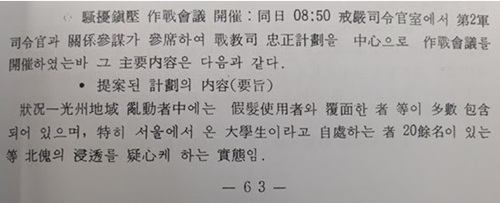 The Commander of the 2nd Corps also received reports on the infiltration of spies. Contrary to the perception that our military did not recognize North Korean infiltration during the May 18th incident, records show that military authorities actually suspected it in various instances. Page 63 of the Army Headquarters' Lessons Learned compilation, published on May 22, 1981, and obtained by the civilian May 18th Truth Investigation Committee (Chairman Jung Sung-hong), states that on May 23, 1980, the Commander of the 2nd Corps reported in a staff operations meeting that "among the rioters in the Gwangju region, there are many who used wigs and wore masks, and particularly about 20 individuals claiming to be university students from Seoul, indicating a situation that suggests infiltration by the North."
The core of this issue was that Commander Chun Doo-hwan allegedly ordered the martial law forces to shoot and kill Gwangju and Honam citizens according to the Shin-gunbu's plan for taking power. However, this has been consistently refuted as an illogical, one-sided claim that ignores the characteristics of military organization.
The reserve military and security organizations have pointed out that the "exercise of self-defense" as a legitimate response to the preemptive attack by armed rioters should not be considered an order to fire, and that Chun Doo-hwan, as the head of the Joint Investigation Headquarters (a three-star general), was not in a position to replace Lee Hee-sung, the martial law commander (a four-star general) who had the authority to issue firing orders.
In a 2016 interview with The Chosun Ilbo, General Lee Hee-sung, the martial law commander during the May 18th incident, stated, "You clearly don't understand the military operational chain of command," regarding Chun Doo-hwan's order to fire, adding, "Security Commander Chun Doo-hwan had nothing to do with the May 18th incident."
The National Movement for the Restoration of the Honor of the ROK Armed Forces (Myongbon) strongly protested, pointing out that the May 18th Investigation Committee, established under the Moon Jae-in administration and consuming over 50 billion won in government budget over four years, ultimately failed to investigate the order to fire theory. They declared, "It has been confirmed that there was no mass firing by martial law troops," and demanded, "The government should move to restore the honor of the martial law troops."
At the time, Myongbon stated in a declaration, "It has been factually proven that the 'Chun Doo-hwan order to fire' never existed historically. The ploy to protect the sanctity of the May 18th incident by fabricating President Chun Doo-hwan as the one who ordered the firing, thereby concealing Kim Dae-jung's conspiracy to commit rebellion and North Korea's involvement, has been thwarted by numerous testimonies of truth."
Specifically, Myongbon stated in its declaration, "Despite interrogating 20,317 martial law troops deployed to the May 18th incident, including 73 leaders and 318 troops, through statement records, recordings, and interviews with 1,193 individuals, it was revealed that no one testified to mass firing or mass massacre."
It continued, "Despite the fact that the order to fire (shooting) by Commander Chun Doo-hwan at that time was clearly proven to be non-existent, the investigation committee concluded it as an inability to ascertain the truth and, without explanation, mentioned a massacre by martial law troops in its report, thereby solidifying the martial law troops as perpetrators of massacre and insulting the military, the last bastion of the nation, as a wicked group."
Consequently, there have been widespread demands for accountability from the May 18th Democratic Uprising side for perpetuating the false narrative that martial law troops first shot and killed innocent Gwangju citizens for over 40 years.
In particular, the argument was made that the May 18th Investigation Committee, which deliberately ignored the possibility of external intervention, should be punished according to the Special Act on the May 18th Incident for concluding that Gwangju citizens shot and killed fellow Gwangju citizens, a tragic conclusion. The argument was that severe accountability should be sought for concluding that innocent Gwangju citizens were perpetrators of fratricide, by ignoring various government documents and testimonies that suggested North Korea's possible involvement in the May 18th incident.
The concern of "fratricide" had been consistently raised by May 18th researchers, many of whom are from Gwangju and the Jeolla region, raising awareness. However, the May 18th Investigation Committee did not reflect this, and voices questioning its reliability even from within arose due to its unfair conclusions.
Internal Opposition within the May 18th Investigation Committee Established by Moon Jae-in: "Such a Conclusion is Unacceptable"
Lee Jong-hyeop, standing committee member recommended by the Future United Party (predecessor of the People Power Party), and non-standing committee members Lee Dong-wook and Cha Ki-hwan, who worked for the May 18th Investigation Committee, submitted dissenting opinions in the report, citing the inaccuracy and deficiency of the investigation and stating, "The truth should not be considered determined."
When the investigation committee, having completed its activities, held a press conference to boast about its achievements under Song Seon-tae's leadership, these three committee members distributed a statement to reporters saying, "We cannot agree with the conclusion."
Accordingly, it was pointed out that the public needs to reconsider the societal implications of whether the May 18th incident was a riot or a democratic movement.
The need to evaluate the investigation results fairly from both left and right perspectives was emphasized. Investigation committees related to the May 18th incident, formed under successive administrations, have never been free from criticism of being overwhelmingly left-leaning.
Sharp criticism has been persistently raised that the proportion of right-wing figures is almost non-existent. For example, it is a well-known fact that Dr. Ji Man-won's attempt to join the May 18th Investigation Committee was thwarted by the fierce opposition of May 18th related organizations. It was also suggested that this was not unrelated to the organizational atmosphere, where many of the key figures holding the reins of the investigation direction were alumni of Chonnam National University's student activism.
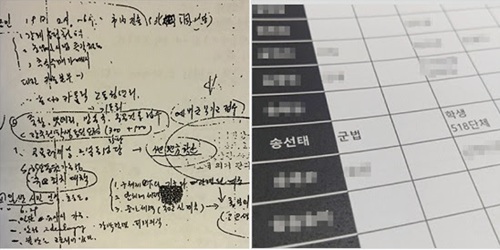 The "Freedom Notebook" detailing the plan for the Gwangju armed riot. There is testimony that Song Seon-tae recorded it (left). Records concerning Song Seon-tae within the list of May 18th contributors.The involvement of May 18th contributors in the investigation committee's activities was also pointed out as a problem. Their participation in the drafting of the investigation report is legally prohibited as an act of disqualification that would undermine fairness. "Disqualification" is a legal principle that fundamentally excludes individuals due to the risk of compromising the fairness of the investigation, similar to how a judge cannot preside over their own son's case.
The exclusion of May 18th contributors from the investigation committee is necessary because it is impossible to rule out the possibility that they would intentionally downplay or conceal evidence or matters that could lead to the loss of their "contributor" status during the investigation. However, the Moon Jae-in administration not only violated the principle of excluding contributors from participating in the investigation committee but also appointed Song Seon-tae, a contributor himself, as the chairman of the investigation committee at the ministerial level, thus sparking controversy over fairness from the outset.
It has also been pointed out as contradictory that successive administrations have formed May 18th investigation committees, consuming budgets, with the aim of investigating Chun Doo-hwan's order to fire, while simultaneously pursuing efforts to include the May 18th incident in the preamble of the Constitution.
In response, a May 18th researcher commented critically, "If there is still something to investigate, there is no need to even approach the preamble of the Constitution, which requires the inclusion of completed historical facts. If you are going to investigate, you shouldn't talk about the preamble of the Constitution until you are done. If you are going to put it in the preamble, you shouldn't investigate further. This is a contradictory situation."
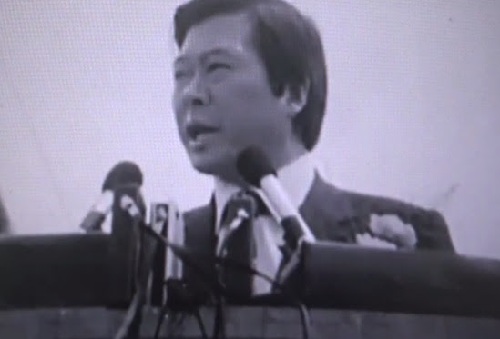 Kim Dae-jung (DJ) incited the public a week before the May 18th incident on May 11, 1980, saying, "Do urban guerrilla warfare like in Vietnam," and Song Seon-tae, a Chonnam National University student, personally wrote the "Freedom Notebook," a plan for an armed riot to seize the Jeonnam Provincial Office using dynamite on the same day. Their plan became a reality exactly one week later during the May 18th Uprising. Forty-four years later, Kim Dae-jung is established as a "hero of democratization," and Song Seon-tae is the ministerial-level chairman of the May 18th Truth Investigation Committee established by the Moon Jae-in administration, a twist of historical irony. / Captured from a video of DJ's speech obtained by the reporter.
Song Seon-tae, Author of the Armed Riot Plan "Freedom Notebook," Served as May 18th Investigation Committee Chairman
The controversy surrounding the fairness of the May 18th Investigation Committee was partly due to the debate over the chairman's qualifications. It was during the reporter's investigation that Song Seon-tae's status as a May 18th contributor was first confirmed. Following the report, criticism flooded in, likening the situation to "giving a cat the job of guarding the fish."
It was revealed that Song Seon-tae, a student at Chonnam National University, personally authored the "Freedom Notebook," a plan for an armed riot to seize the Jeonnam Provincial Office using dynamite, on the same day that DJ was inciting guerrilla warfare in Jeongeup, Jeonbuk.
The "Freedom Notebook" is considered by some to be crucial evidence proving that the May 18th incident did not originate as a "non-violent democratic movement." This is due to its horrific content detailing the seizure of broadcasting stations, armories, and public institutions using bamboo spears and the occupation of the provincial office with seized weapons. It is essentially viewed as a plan for an armed uprising and a direct object of focus for uncovering the truth of the May 18th incident.
According to the minutes of the 15th meeting of the Special Committee for Investigation into the Truth of the May 18th Gwangju Democratic Uprising in December 1988, witness Han Sang-seok testified that when questioned by hearing committee member Kwon Hae-ok, a member of the Democratic Justice Party, about the author of the "Freedom Notebook," he replied, "Song Seon-tae and I wrote it together."
According to Han Sang-seok's testimony, the "Freedom Notebook" was confiscated by the Joint Investigation Headquarters on October 25, 1980, and was accepted as evidence by the court when prosecutors presented it during the second trial of Han and others. The process by which the "Freedom Notebook" was made public was testified to by Yoon Han-bong, who was known as the chief organizer of the student movement in Jeonnam.
Yoon Han-bong, who was the director of the Jeonnam branch of the Jeonnam Democratic Youth League (Mincheonghyop) and the National Alliance in 1980, stated, "A student council executive hid that notebook and then surrendered it. Fortunately, the notebook emerged after the investigation was concluded, so it couldn't be disregarded." According to Yoon, the government formed the Joint Investigation Headquarters immediately after the May 18th incident, and by October of that year, when the "Freedom Notebook" was discovered, the investigation was essentially in its final stages, leading to it being brushed aside.
Yoon Sang-won, a lecturer at "Deulbul Night School" and spokesperson for the civilian army, made similar remarks to Yoon Han-bong at a meeting of youth activists on May 9th of that year, stating, "To prepare for the deployment of troops and armed suppression, we must prepare iron pipes, wooden clubs, and Molotov cocktails, raid the reserve armories to secure firearms, and produce TNT (dynamite) for self-armament." Yoon's testimony is recorded in Volume 12 of the Gwangju Metropolitan City May 18th Historical Compilation Committee's compilation, page 168.
Yoon Han-bong also testified, "Song Seon-tae claimed that he authored it and wrote it with imagination, but then denied it and got away with it during the police investigation."
However, the "Freedom Notebook" is considered to be more serious because it was actually realized.
According to the "Freedom Notebook" document obtained by the reporter at the time, the individuals planning the armed riot precisely marked the time and location: "May 19th, 2-6 AM, advance into the city from the northeast cathedral." It also presented links between the Catholic Farmers' Association (Kanong), the Catholic Youth Association, and prayer groups, and indicated "seizure of bamboo spears, batteries, broadcasting stations, and public buildings," followed by "seizure of reserve armories," with a circle and star. This was interpreted as an intention to emphasize the necessity of acquiring weapons.
According to "A Study of Personal Histories for Organizing the History of the May 18th Uprising," Yoon Han-bong stated in a direct oral interview with the author in 2006, "My theory is that we must seize the provincial office and continue the uprising until the end. To arm ourselves, we must identify the locations of reserve armories and where dynamite is." In fact, during the May 18th incident, 44 reserve armories were seized, and a large quantity of explosives, including dynamite, was installed in the basement of the Jeonnam Provincial Office.
Given that an individual involved in a specific plan for armed riot established shortly before the May 18th incident is serving as the ministerial-level chairman of the government's investigation committee, tasked with determining the truth at a significant cost of government funds, doubts have intensified regarding the reliability of the final investigation results from the Truth Investigation Committee.
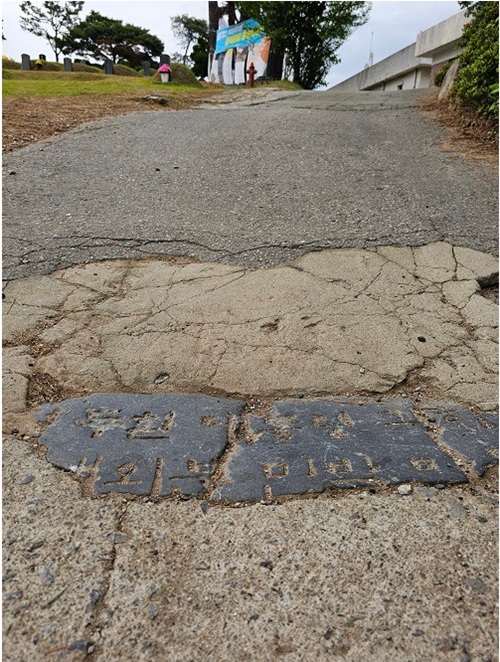 The monument to former President Chun Doo-hwan, placed on the floor of the old May 18th cemetery (Manggwol-dong National Cemetery for Democratic and Revolutionary Martyrs) in May of this year, being trampled by passersby. This monument was erected at the entrance of a village in Damyang County, Jeollanam-do, in 1982 to commemorate his stay. After the end of the Chun Doo-hwan regime, a citizen knocked down and broke the monument, which was then moved to the floor of the Manggwol-dong cemetery for passersby to step on. Dr. Michael Lee, former chief East Asia researcher at the US CIA and the person who investigated all the behind-the-scenes details of North Korea's involvement in the May 18th incident in 1980, emphasized in an interview with Sky Daily on the 9th, "When South Korea's national security was extremely precarious after President Park Chung-hee's assassination, North Korea saw that as a great opportunity and targeted it. However, it was well managed by Security Commander Chun Doo-hwan, which is why they target him and hate him. The fact that Chun Doo-hwan, who had no connection to it, is being blamed entirely for Gwangju suggests that North Korea is capable of shooting at Gwangju citizens and blaming the martial law troops." He urged the public to know the truth. / Although the company credit was indicated during Sky Daily's reporting, the photo was taken by reporter Heo Gyeom.
"Collective Firing" Without Evidence Promoted and Incited for Over 40 Years... Was the Armed Attack by Civilian Forces on the Government Justified?
The premise for the armed civilian forces, sometimes referred to as "rioters," to gain nationwide legitimacy for their attack on the government is largely based on two points:
First, the government forces (martial law troops) first fired collectively on citizens under the order of their superior. Second, the government had made a decisive mistake that made its overthrow justifiable, and it bore responsibility for that mistake.
However, the evidence for the martial law troops' order to fire remains controversial due to insufficient evidence to this day. This was certainly the case 45 years ago when DJ was inciting the crowds. Even the May 18th Investigation Committee established by Moon Jae-in has reported its failure to investigate Chun Doo-hwan's order to fire due to "insufficient evidence," as reported by Gwangju media.
Consequently, there is a considerable public opinion that "when in doubt, favor the defendant," a principle enshrined in the Constitution and criminal procedure law that dictates acquittal when there is no certainty of guilt or innocence. Such a common-sense principle has not been applied to President Chun Doo-hwan for a staggering 45 years.
Although Security Commander Chun Doo-hwan (later head of the Joint Investigation Headquarters) is legally innocent, the atmosphere still prevailing is one where he is considered guilty in the public's sentiment. The narrative is simply "Chun Doo-hwan = devil." His remains have yet to find a resting place due to ongoing opposition.
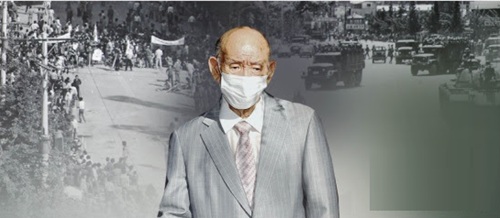 President Chun Doo-hwan. / Yonhap News Graphic.
Some also attribute President Chun Doo-hwan's mistakes to the December 12th incident, and the interpretation of the December 12th incident as a military coup is also subject to ongoing debate.
According to the prosecution's investigation records at the time, on October 26, 1979, the day President Park Chung-hee was assassinated, Jeong Seung-hwa appeared in the same car as Kim Jae-gyu, who was wearing blood-stained clothes. Despite witnessing Kim Jae-gyu change into new clothes and shoes, Jeong Seung-hwa did not report it to his direct superior, Minister of National Defense Roh Jae-hyun. For a full four hours until 11:40 PM, when Chief Secretary Kim Gye-won informed Jeong Seung-hwa and Roh Jae-hyun, who were in the same room, of Kim Jae-gyu being the perpetrator, Jeong Seung-hwa remained silent. This is an action pattern that no one would consider normal.
He also ordered the suspension of the deployment of security personnel to the assassination site, an order that could only be given by Chief of Security Cha Ji-chul. This action was logically possible only if he was aware of Cha's death. If the President and Cha Ji-chul were dead and Kim Jae-gyu was covered in blood, it was the basic duty of a soldier to inform his superiors and cabinet members of the circumstances. Therefore, Chun Doo-hwan, then Security Commander and head of the investigation, had an obligation to investigate Jeong Seung-hwa, his superior and Army Chief of Staff.
In contrast, DJ's actions during the same period were different. It is recorded in the Supreme Court's ruling in 1981 that he formed an interim cabinet on May 1, 1980, amidst the chaos following President Park Chung-hee's assassination on October 26, 1979.
According to the Kim Dae-jung rebellion conspiracy rulings of the first, second, and third trials, the court concluded that "On this day, at his residence, Kim Dae-jung incited the students to expand campus protests into outdoor protests and encouraged citizens to join, leading to the nationwide spread of violent protests, which would cause the government to collapse. Therefore, he instructed youth organizers with influence in academia to focus more on inciting students and set the execution date for mid-May."
Prior to this, the Supreme Court at the time also determined that there was a plan for an interim cabinet. The Supreme Court justices stated in the factual findings of the ruling, "In early April, they agreed to instigate nationwide anti-government violent protests simultaneously through personal organizations, religious groups, and youth and students."
The list of the interim cabinet members unexpectedly came to light. According to reports in magazines such as Shindonga in July 1999, Madam Lee Hee-ho was apprehended with the interim cabinet list on May 17, 1980, when DJ was arrested. Madam Lee attempted to take the papers she took out of a drawer and put them in her handbag and leave, but was caught by NIS investigators. The investigators demanded that she submit them, and ultimately, a two-page document was confiscated. One page was the interim cabinet list. Newspapers at the time reported this fact.
US State Department Documents Declassified: "DJ Paid Students to Incite Rebellion"
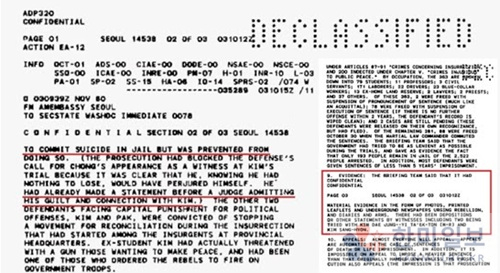 Legal testimony of Jeong Dong-nyeon (deceased 2022), former chairman of the May 18th Memorial Foundation / US State Department.Declassified US State Department documents from the time of the May 18th incident also suggest new circumstances surrounding DJ's conspiracy to commit rebellion.
A newly declassified top-secret document from the May 18th incident (80SEOUL 014538), released by the US State Department on October 4th (local time) of the previous year, confirms that the US Embassy in Korea reported to Washington that South Korean authorities had secured "material evidence" of DJ paying students to incite rebellion.
In other words, in addition to verbal statements that could be tainted by torture or forced confessions, the Supreme Court could have considered material evidence when confirming DJ's death sentence. To date, the significance of this case has been diminished to the "Kim Dae-jung Rebellion Conspiracy Case" as involved parties claimed to have made false confessions under severe torture, which later served as a catalyst for the May 18th incident, where people fired weapons at the government, to be reclassified as a democratic movement.
Furthermore, a diplomatic cable reported by the US Embassy to Washington describes, as one piece of evidence supporting DJ's charges of conspiracy to commit rebellion, a statement made by Jeong Dong-nyeon (deceased 2022), former chairman of the May 18th Memorial Foundation, before he stood trial, in which he confessed his connection with DJ and his guilt.
Specifically, the US Embassy reported that the government claimed, "Mr. Jeong was the ringleader of the uprising and worked closely with Kim Dae-jung, attempting 'to overthrow the government by violence'."
The US Embassy further reported that Mr. Jeong, known to be deeply infatuated with Kim Dae-jung, allegedly gave money to students for insurrection, claiming it came from Kim Dae-jung's own pocket.
The report also includes a briefing from military prosecutors that Mr. Jeong might have hoped to receive "a National Assembly seat" as compensation if Kim Dae-jung came to power.
Additionally, in the declassified diplomatic cable, it is specifically recorded, "Later he received 5 million won from Kim through Kim Sang-hyun."
The military prosecutors, who indicted Kim Dae-jung and others on charges of rebellion, reported to the US Embassy that they had secured "material evidence in the form of photos, printed leaflets and underground newspapers urging rebellion, and diaries and arms" as evidence for the trial.
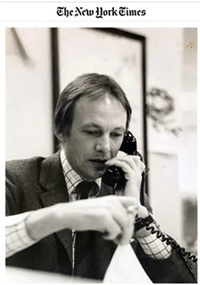 Henry Scott-Stokes, former New York Times bureau chief.Henry Scott-Stokes, former New York Times bureau chief, sharply criticized Kim Dae-jung in his book "The Illusion of Allied Victory Historiography as Seen by a British Journalist," in the chapter "Asian Leaders I Met," stating, "Kim Dae-jung is a swindler and a liar," and "the Gwangju incident is the event that clearly revealed Kim Dae-jung's deception of democracy." His remarks are noteworthy in redefining the nature of the May 18th incident.
He harshly criticized, "Kim Dae-jung's objective was power, and amidst the unfolding Gwangju incident, Kim Dae-jung was most concerned with seizing power." He further stated, "The 1980 Gwangju incident was an event where Kim Dae-jung himself incited the riot to become president under the guise of being a champion of democratization." He added, "Those who instigated the Gwangju incident, and those around Kim Dae-jung, all knew well how much Kim Dae-jung valued worldly status and money and how he was fixated on accumulating wealth for his family. We foreign journalists have concealed this fact." He also expressed shame for his own foolishness as a journalist and stated, "Far more serious than accumulating wealth was the act of treason that sold out the country. Needless to say, this was related to North Korea."
In a handwritten letter submitted to then-President Chun Doo-hwan in 1982, DJ confessed to his wrongdoings that harmed national security and pleaded for leniency, promising not to engage in political activities in the future. President Chun Doo-hwan then released DJ and other related individuals on a large scale and stated his intention to bury "Gwangju's pain," refraining from further investigation into the instigators of the riot. However, DJ's armed rebellion in Gwangju gradually transformed into a democratic movement amidst the political collusion narrative that formed with the exposure of Roh Tae-woo's slush fund from the Sixth Republic.
Hwasun Police Station Lock-up Attacked by 800 People... Attempted Weapons Seizure by Firing Guns, Demanding "Release the Detainees"
Even within the May 18th Investigation Committee, which was continuously criticized for being left-leaning and faced numerous controversies throughout its operation, there were instances of dissent against biased conclusions.
Consequently, this dealt a serious blow to the preliminary conclusions of the May 18th Investigation Committee, which seemed to have already predetermined the outcome as a "democratic movement."
Conservative party-nominated investigation committee members newly discovered and revealed government records indicating that around 800 "rioters" had attacked a police lock-up on May 21st, prior to the "collective firing," firing guns to extract detainees.
While the fact that protestors attacked armories to seize weapons has been widely known, this marks the first time a government document has officially confirmed an incident where shots were fired and police were threatened to release detainees.
The four government records, newly discovered and publicly released, including the "Hwasun Police Station Comprehensive Situation Room Duty Log," are the first to include the term "approximately 800 rioters." This is the largest scale of rioters or protestors who have attacked armories in the Jeonnam region to date.
Therefore, it was necessary to thoroughly investigate why individuals claiming to be part of a pure democratic movement attacked a police lock-up. However, the investigation committee led by May 18th contributor Song Seon-tae attempted to downplay the significance of this event, leading to conflict with three committee members.
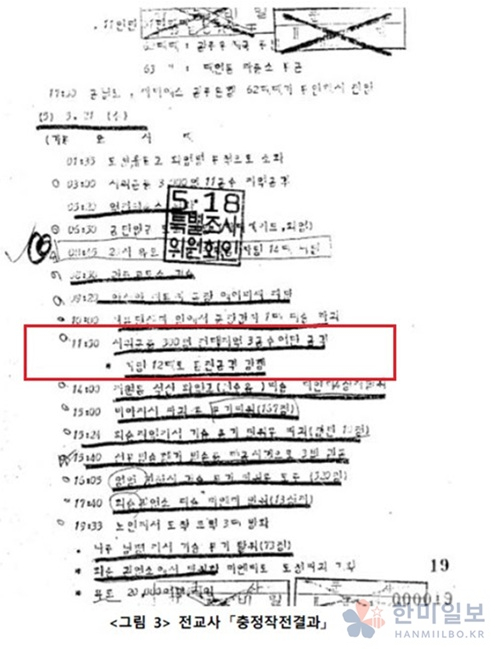 The "Chungjeong Operation Results" report from the Combat Officer Training and Education Command states that at 11:30 AM on May 21st, "330 rioters attacked the 3rd Airborne Brigade in the Jeonnam region" and "launched a charge with 12 vehicles." Source: Training and Education Command data.The reason for the 180-degree shift in conclusion from "truth ascertainable" to "impossible to ascertain" was that the May 18th government investigation committee members newly interpreted the incident of the "Hwasun Police Station attack and attempt to free detainees by firing shots" as evidence of the protestors' preemptive armament.
Globally, attempts to escape from state correctional facilities such as prisons, detention centers, and lock-ups, whether by convicted individuals or those awaiting trial or suspects, are invariably considered to be accompanied by anti-social behavior.
In any country, direct attacks on penal facilities are met with strong responses. Armed attacks with firearms are met with even stronger legal sanctions. The Supreme Court in 1997, which overturned the May 18th incident from a riot to a democratic movement, was reportedly unaware of this historical fact. According to the conservative party-nominated committee members, this fact was only recently discovered.
This has led to speculation that the possibility of a retrial has been opened.
While the timing of the protestors' attack on armories has been a persistent "hot potato" since the 2000s, the newly discovered government documents at the time expanded the scope for further investigations, particularly from a right-wing perspective. This can be seen as highlighting the limitations of the Moon Jae-in investigation committee and concluding with a new implication that the formation of a right-wing-focused investigation committee is urgently needed.
Despite these circumstances, there are reports that the "Special Act on the May 18th Incident" is being used to suppress freedom of expression and silence researchers, scholars, or journalists who question the one-sided designation of the incident as a "democratic movement" and present rational counterarguments.
Criticism continues to be raised about the physical possibility of legally enforcing a single interpretation of historical facts.
"The spirit of May 18th is a spirit of service."
When asked by a reporter from this publication about the meaning of the "spirit of May 18th" that they intended to include in the preamble of the Constitution, a high-ranking official from the May 18th Memorial Foundation, which has been frequently filing lawsuits and complaints using the Special Act on the May 18th Incident, responded with this statement.
Immediately, a sarcastic remark followed: "Are you going to go to such lengths just to put the spirit of service into the preamble of the Constitution because you have nothing better to do?" The wry laughter was unavoidable. They themselves caused it.
"Cheongcheon River" Appears in Police Wiretap Records... "5,000 Communications Between Gwangju and North Korea During May 18th Period"
While some legislatively mandate the classification of the May 18th incident as a democratic movement regardless of the reasons, there are also many researchers who seek to properly investigate the nature of the May 18th incident from a balanced perspective, studying both left and right viewpoints.
According to the 20th Division's 60th and 61st Regiment suppression situation logs, obtained by the reporter from an anonymous researcher, police intercepted unusual communications from the Bulgap-san relay station in Yeonggwang, Jeonnam, on May 29th.
The call sign "Cheongcheon River" was detected by the police at 2:43 PM that day.
Cheongcheon River is a river that forms the border between North Pyongan Province and South Pyongan Province in North Korea. The Taedong River flows through Pyongyang to the south, and the Yalu River is to the north.
According to the radio log, the unidentified caller using "Cheongcheon River" asked, "Where exactly is number 61 located?" The use of "eodi" (where) is a North Korean dialect. It is unclear whether the radio listener intentionally recorded this dialect, judging it to be communication between spies.
Furthermore, in a radio interception at 4:01 PM, the caller said, "The signal is bad. Send my regards to Jaesik in Seoul." Thirteen minutes later, at 4:14 PM, the communication was heard as, "Bring the letter. You'll understand if you do it right away." And again, the reply was, "Send regards from three people," according to the radio log.
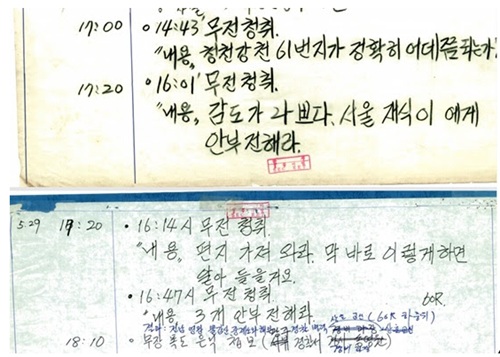 The call sign "Cheongcheon River" appearing in the police wiretap log. / Capture from the 20th Division suppression situation log.The log was recorded by Lieutenant Ha of the 60th Regiment, who obtained inter-radio communications between the Bulgap-san relay station in Yeonggwang, Jeonnam, and coastal police. The military had de-assigned 39 police officers at 9:30 AM that day. Some police units, which had been under military command during the martial law period, were finally beginning to operate autonomously. Accordingly, it appears that the Seobu Police Station in Gwangju initiated communication interception.
The time of the last communication log recorded by Lieutenant Ha of the 60th Regiment is 5:20 PM. This is 33 minutes after the last radio interception.
Fifty minutes after the log recording time, at 6:10 PM, the head of the Seobu Police Station received intelligence about armed rioters hiding. The content indicated that 15 rioters armed with guns and grenades were hiding near the Geum-dong Namdo Theater. One platoon consisting of 17 police officers, 2 officers, and 30 enlisted men was dispatched, and during the search of the area at 7:40 PM, 6 suspects were apprehended and handed over to the police. Government documents regarding their potential anti-communist involvement or further information have not been released.
Fifty minutes before this, at 6:50 PM, the 2nd Battalion of the 61st Regiment seized four carbines, 81 rounds of ammunition, one police belt, six magazines, and two police batons behind the Jeon-il Building, as recorded in the log. Around the same time, at 7:10 PM, Sergeant Shim of the Security Command notified the 20th Division Regiments, the police, and the Combat Officer Training and Education Command (CAC) of intelligence related to the "Chungjeong Operation." The main contents included: △ rioters hiding in the Daechon-dong red-light district with firearms; △ Prince Hotel and Daeheung Inn in Gwangju were used as riot hideouts until May 27th.
The May 18th Investigation Committee, led by Song Seon-tae, did not even mention these details in its final report. While these are official government records that could reasonably suggest external intervention, Song Seon-tae omitted them from the report.
There were also multiple testimonies claiming that over 5,000 communications from Gwangju to North Korea occurred during the May 18th period.
The extensive communications intercepted by the police, presumed to be using North Korean call signs, are considered by May 18th researchers to be strong evidence of the activities of resident or infiltrated spies.
The Civilian May 18th Truth Investigation Committee (Minjinsa, Chairman Jung Sung-hong), formed by journalists to counter the left-leaning government investigation committee, stated, "We heard from a high-ranking retired corps commander-level intelligence official who was knowledgeable about the situation at the time that 'over 5,000 communications from Gwangju to the North were intercepted by the Odaesan monitoring base throughout the entire May 18th period.'" A high-ranking official from the Joint Investigation Headquarters at the time also provided the same testimony to this reporter.
Communication interception during the May 18th period is today referred to as SIGINT (Signals Intelligence). This is information obtained through the interception and monitoring of communications, calls, etc., using various advanced equipment. In 2021, CNN reported on the possibility of Kim Jong-un's death, but the South Korean and US intelligence agencies were relaxed due to SIGINT. They judged that there were no anomalies in North Korea's communications that would indicate any issue with Kim Jong-un's health, as communication volume would spike in an urgent situation.
There is also strong testimony that the military identified spy activities through radio intercepts. Chun Doo-hwan's memoirs state, "According to radio intercept results, there were numerous spies on the scene. However, we were not in a position to deploy the military to identify them. If we deployed, it would become a civil war, and if it became a civil war, the North would invade."
This is interpreted as Chun Doo-hwan, then head of the Joint Investigation Headquarters, fearing the escalation of the situation if the military attempted to apprehend spies, which would be akin to "burning down the house to catch the rats."
May 18th D-4: 100 Suspicious Outsiders Spotted by 70 of Our Officers at a Mountain Temple
While the recent court ruling for Dr. Ji Man-won's inclusion of the possibility of small-scale North Korean operatives and resident spies in the verdict is sensational, domestic and international official documents and testimonies have long hinted at the presence of subversive forces.
One specific testimony involves the sighting of over 100 unfamiliar young men at a temple on Mudeungsan Mountain just before the May 18th incident, who were spotted by South Korean military officers.
As per the reporter's comprehensive investigation at the time, around 100 unfamiliar young men were spotted by South Korean military officers at Jeungsimsa Temple, located on the slopes of Mudeungsan Mountain in Unrim-dong, Dong-gu, Gwangju, shortly before the May 18th incident. This was the first time these sightings were made public.
On May 14, 1980, approximately 70 soldiers and civilian employees from the Logistics Support Group of the Combat Officer Training and Education Command (Chonkyo-sa) in Gwangju climbed Mudeungsan Mountain after lunch. Only two were enlisted personnel: a medic and a photographer. With the exception of a few civilian employees, all were officers.
This date was four days before the May 18th incident. The witnesses testified that it was a Wednesday. The Republic of Korea Army designates Wednesdays as "Combat Sports Day" for physical training activities such as running and hiking. May 18th of that year was a Sunday, and May 14th was a Wednesday.
The testimony is very detailed. The bus traveled on a mountain road from Jisan-dong towards Nam-myeon, Damyang-gun, crossing Mudeungsan. This road is now called the "Old Mudeungsan Road." The soldiers then disembarked from the bus upon arriving at Chungjangsa Shrine (Kim Deok-ryeong's tomb).
The soldiers recall taking a group photo at Chungjangsa Shrine and then embarking on a mountain hike.
After reaching the summit of Jungmeori-jae around 3 PM, passing through Chungjangsa (Kim Deok-ryeong's tomb), Baramjae, and Tokkibong, they took a group photo with the army missile base on Mudeungsan summit in the background.
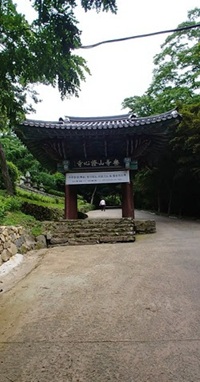 The entrance to Jeungsimsa Temple on Mudeungsan Mountain.As they descended along a narrow path in the valley of Jeungsimsa Temple, over 100 suspicious men came into the officers' view. Witnesses testified that they had long hair and fierce eyes. The soldiers later testified, "They had unusual eyes that showed extreme vigilance, and they appeared tense."
As they descended, approximately 50 suspicious individuals were positioned on either side of the narrow path in the valley, and some soldiers exchanged conversation with them. One witness, mistaking the suspicious individuals for students, asked, "Why are you here instead of studying?" After a long pause, one of them replied, "We're just here to play."
At that time, there was no exchange of fire or violent clashes between the military and the civilian forces. The patriotic citizens of Gwangju had not anticipated such a tragic event in modern history as the May 18th incident unfolding in their own city. This was well before the period when citizen forces drove trucks and buses into the martial law troops, provoking gunfire and return fire, leading to a fierce battle between both sides.
Consequently, questions have resurfaced about whether these individuals were involved in organized armed rebellion, including the seizure of armories and the attack on the prison, and their identities.
This temple served in part as a base for anti-state forces at the time, including Son Seong-mo, a long-term prisoner who refused to convert, who concealed his identity as a monk and acted as a spy. Son Seong-mo, in his first trial in April 1988, denied all charges of violating the National Security Act, stating, "I am not a spy," but then directly revealed his infiltration route, saying, "I came forward to realize Chairman Kim Il-sung's reunification line."
Numerous testimonies in records such as the "Democratization White Paper" and May 18th testimony collections reveal that the civilian forces attempted to "defend" this temple. Specific testimony was secured that approximately 100 suspicious individuals were spotted by our military at such a location four days before the first clash of the May 18th incident, the bloody incident in front of Chonnam National University.
If there was a hidden force that gaslit the vast majority of pure and naive Gwangju citizens for over 40 years, then uncovering its identity and the full extent of its involvement is a task that can no longer be postponed.
Was the Kim Dae-jung Rebellion Conspiracy Case Merely a Conspiracy Theory?
There are numerous examples where the final report of the May 18th Investigation Committee, established by the Moon Jae-in administration, cannot be trusted at face value.
It has recently been revealed through declassified US government documents that Lee Taek-don (deceased 2012), a former Member of Parliament from the New Democratic Party and a former judge, who was on trial for rebellion during the May 18th incident in 1980, was surprised by the evidence presented by the prosecution regarding Kim Dae-jung's (DJ) communist connections and stated in court, "The New Democratic Party, which nominated DJ as its presidential candidate, should apologize to the public."
It has been confirmed that the trial records for the "Kim Dae-jung Rebellion Conspiracy Case" have not been fully disclosed to this day.
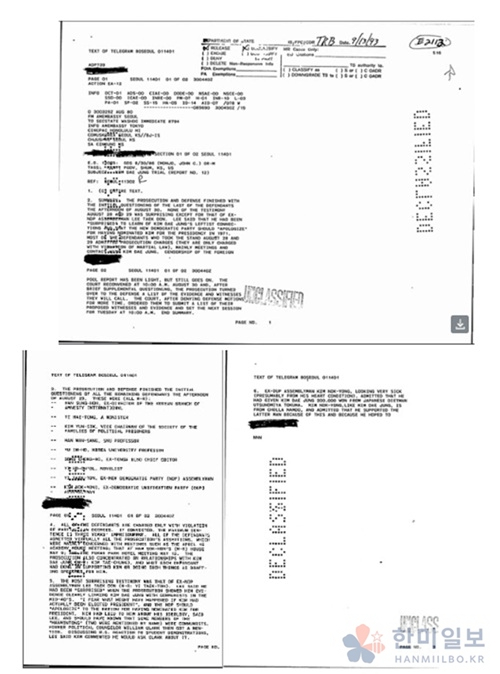 According to diplomatic cable (80SEOUL 011401) from the May 18th incident, additionally declassified by the US State Department on November 20 (local time), Lee Taek-don stated during the 2nd trial on August 28-29, 1980, "I was surprised to learn Kim Dae-jung is a communist," the US Embassy in Korea reported to Washington. Capture of US State Department declassified document.According to diplomatic cable (80SEOUL 011401) from the May 18th incident, additionally declassified by the US State Department on November 20 (local time), a US Embassy official who observed the 2nd trial on August 28-29, 1980, reported to Washington that "Lee Taek-don revealed that Kim Dae-jung had lied to him about his ideology."
The US Embassy reported to Washington that Lee stated with regret, referring directly to the "National Association for the Promotion of Korean Reunification and Restoration of Democracy (Hanmintong)" based in Japan, that "And should have known that some members of the ‘HANMINTONG’ (two were mentioned by name) were communists," and he disclosed the real names of two communists in court.
It was also revealed that DJ incited the public on May 11, 1980, by saying, "Do urban guerrilla warfare like in Vietnam."
According to an analysis of video material exclusively obtained by the reporter at the time, Kim Dae-jung, co-chairman of the National Alliance, delivered an impassioned speech a week before the May 18th incident, on May 11, 1980, in Jeongeup, Jeollabuk-do, with the inflammatory message, "In the style of Vietnam, infiltrate the populace and engage in urban and rural guerrilla warfare."
This became a reality exactly one week later during the May 18th Uprising, and 44 years later, Kim Dae-jung is established as a "hero of democratization," a historical irony.
Furthermore, the May 18th government investigation committee ultimately failed to investigate the "helicopter machine-gun fire" in front of the Jeonnam Provincial Office. This starkly revealed the propaganda and incitement that martial law troops fired from helicopters at citizens. At this point, it could be argued that the political interpretation, rather than the actual truth, was designated as a democratic movement.
Although the investigation committee made a forced conclusion that the truth was ascertained based on flimsy evidence and speculation, it faced internal opposition from committee members who stated, "It is difficult to conclude in this manner," ultimately failing to prove the facts.
As a result, the controversy over "machine-gun fire," first triggered by Father Cho Bi-oh (real name Cho Cheol-hyun, deceased 2016) in his testimony at the National Assembly hearing in 1989, has been concluded after 35 years as a one-sided claim whose factual verification is impossible.
For a long time, bullet marks on the ceiling (bullet holes) of the top floor (former Jeon-il Broadcasting) of the Jeon-il Building and the central pillar were claimed to be caused by "machine-gun fire" from martial law helicopters. This continuously highlighted the ruthless brutality of the martial law troops, leading to accusations of misleading the public and damaging the morale and honor of the military.
The May 18th Investigation Committee also attempted to handle the alleged sexual assault (rape) by martial law troops as "truth ascertainment" without proper evidence investigation, but was rejected. Among the victim testimonies, there was a claim of rape on a bus by martial law troops during riot suppression on Geumnam-ro. However, seven out of the nine committee members did not accept it as evidence, stating, "The credibility is low."
Accusations followed that they were trying to force the equation of "martial law troops = devils" after the established equation of "Chun Doo-hwan = devil."
The May 18th Investigation Committee, led by Song Seon-tae, at times altered the perpetrator's unit in the report after realizing that the victim's testimony did not align with the martial law troops' operational location and situation. Despite having sufficient authority granted to the investigation committee by law to identify the perpetrator, it concluded that the truth was ascertained simply because "the victim's testimony is credible," without further investigation.
Furthermore, instances were pointed out where past compensation review materials from the 1st to 7th period, which had existed without verification, were readily updated under the assumption that they were established facts, indicating irresponsible management that rendered taxpayer money meaningless. Sharp criticism was raised as to why the investigation committee was formed if it was simply going to repeat past data without conducting its own investigation.
Given these circumstances, a humorous remark even emerged suggesting the need to examine the brain structure of those who unconditionally concluded it as a "democratic movement."
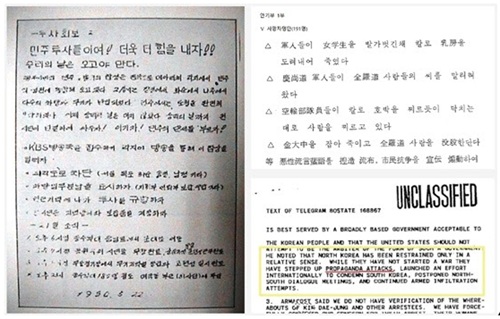 Various rumors disseminated in the Gwangju region around the May 18th incident in 1980 were judged by US intelligence authorities to have misled public opinion and increased animosity towards the martial law troops. Leaflets (left) inciting people with false news such as "participating from all over the country," types of rumors (top right) portraying the martial law troops as perpetrators of sexual violence, and a declassified document from the US Under Secretary of State pointing to strengthened North Korean propaganda attacks.
Sky Daily's May 18th Series Deleted... The Key to Investigating the Reality of "May 18th North Korean Involvement" Lies with Gwangju
The examples cited in this report are only a small excerpt from the May 18th series by Sky Daily (CEO Min Kyung-doo), which was unilaterally deleted by the newspaper this summer. The two years of investigative records, calculated at an average of 10,000 words per article, would amount to approximately 400,000 words based on 40 articles.
This is why criticism continues that Sky Daily has abandoned its journalistic duty to inform the public of the truth and foster sound public opinion.
Consequently, the reasons for re-examining the May 18th incident from a right-wing perspective are abundant. There is a growing sentiment in some conservative circles that this is an urgent national task that cannot be obstructed by a mere "Special Act on the May 18th Incident."
Furthermore, a cautious opinion has been presented that the key to investigating the reality of North Korea's involvement in the May 18th incident lies with Gwangju itself, by voluntarily disclosing the list of May 18th contributors, which has been the subject of continuous controversy regarding its accuracy.
May 18th researchers unanimously agree on the need to form an investigation committee free from partisan bias that will investigate the reality of North Korea's involvement in the Gwangju incident, rather than a supplementary investigation for the Gwangju Democratic Uprising.
A May 18th researcher stated to this newspaper, "It is not for the purpose of discriminating against the Jeolla region or denigrating the democratic movement, but to investigate the causes of the 'North-South conflict (clashes between South Korean civilian forces and martial law troops)' that began due to North Korea's deceptive propaganda and false incitement, which falsely portrayed the military as having fired first. We need to hold North Korea accountable, as in the Aung San bombing in Myanmar and the Korean Air (KAL) downing incident, and inform the public about the harm communism has inflicted on our society as it truly is."
Dr. Michael Lee, a former CIA operative, asserted, "The May 18th Gwangju incident must be restored to its original designation as an armed riot to overthrow the state, and history must be rewritten."
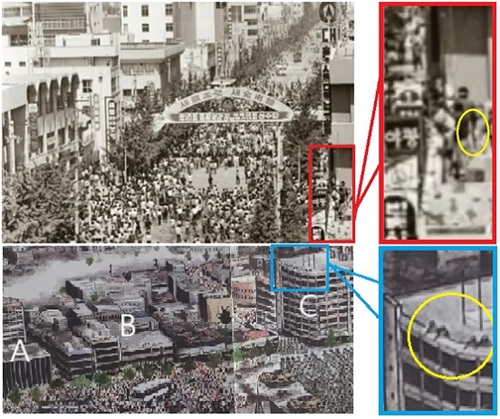 In a photo captured by this newspaper, taken on or around May 21, 1980, a civilian wearing a headband is seen holding what appears to be a long gun on the rooftop of a building near Geumnam-ro, where citizens are gathered. The civilian forces stated on the 21st that they had seized or acquired firearms after the "collective firing (accurate term is collective shooting, not volley fire)," so the photo could not have been taken prior to the 21st. There would be no reason for such a demonstration on Geumnam-ro after the seizure of the Jeonnam Provincial Office on the 21st. The red-squared building in the upper left photo is the Dong-gu Office, located between the Catholic Center and the Jeon-il Building at the time. In the enlarged right photo of the rooftop of this building, the person in the yellow circle, holding what appears to be a firearm, is wearing a headband. This person appears to be a civilian. The person next to them is wearing white pants. It is impossible for civilian forces and armed martial law troops to stand together. The person closer to the camera also appears to be holding a firearm in their left hand. At the time, autopsy results of the civilian victims found numerous bullet marks that appeared to have been fired downwards from the top of the buildings. This has led to strong suspicions of a "deception operation" where someone intentionally shot civilians from the rooftops of buildings around Geumnam-ro to incite hostility against the martial law troops and frame them. In response, individuals like Kim Yong-jang, who claimed to have worked as a temporary US military interpreter, gave false testimony at a press conference in 2019, claiming the Shin-gunbu orchestrated it, and the May 18th Investigation Committee announced it had found martial law troops firing downwards from the building rooftops. Many artworks also definitively portray the martial law troops as the main culprits who triggered the incident. Ha Seong-heup's work "May 21, 1980, Firing (2017)" depicts individuals aiming guns downwards from the rooftop of the Jeon-il Building, resembling martial law troops (yellow circle in the blue photo below). However, the Dong-gu Office (building B) in the large photo on the lower left is located directly below the Jeon-il Building (building C) with no obstructions. If martial law troops were on the rooftop of the Jeon-il Building, civilians on the rooftop of the Dong-gu Office (building B) would be within their line of fire. As seen in the photo above, if the object held in the right hand of the civilian wearing a headband on the rooftop of building B is indeed a firearm, it is reasonable to assume that martial law troops were not on the rooftop of the Jeon-il Building at the same time. Freelance journalist Koichi Kajima, who covered Gwangju, also testified that "there was a notice that if photos were taken from buildings, they would be set on fire," implying that individuals other than martial law troops could not enter buildings they had already occupied, and indeed, photographers from domestic newspapers were turned away. Despite these circumstances, Kim Yong-jang, a temporary US military interpreter, gave false testimony at a press conference, claiming, "Security Commander Chun Doo-hwan gave the order to shoot," and this was widely reported by newspapers and broadcasters nationwide. It is reported that Kim Yong-jang, as a temporary employee, does not receive a pension from the US government and is currently residing in Fiji in the South Pacific.
Reporter Heo Gyeom

 Iranian Foreign Ministry: "Continuing Message Exchanges with the U.S. and Activities of Mediating Countries"
Esmaeil Baghaei, Spokesperson for the Iranian Ministry of Foreign Affairs [Xinhua, Yonhap News file photo]Esmaeil Baghaei, spokesperson for the Iranian Ministry of Foreign Affairs, stated on the 26th
Iranian Foreign Ministry: "Continuing Message Exchanges with the U.S. and Activities of Mediating Countries"
Esmaeil Baghaei, Spokesperson for the Iranian Ministry of Foreign Affairs [Xinhua, Yonhap News file photo]Esmaeil Baghaei, spokesperson for the Iranian Ministry of Foreign Affairs, stated on the 26th
 President Yoon: "Do You Think You Are Safe from the Special Counsel?"... Final Statement Video Released
President Yoon Suk Yeol rebuking the special prosecutor on the 24th. [Court video / @birds_justice X account subtitle GIF] A video of President Yoon Suk Yeol's closing statement at his trial rega
President Yoon: "Do You Think You Are Safe from the Special Counsel?"... Final Statement Video Released
President Yoon Suk Yeol rebuking the special prosecutor on the 24th. [Court video / @birds_justice X account subtitle GIF] A video of President Yoon Suk Yeol's closing statement at his trial rega
 President Yoon, regarding the first-instance ruling on the Public Official Election Act: “An excessive political verdict that distorts the facts… We will appeal immediately.”
The first-instance sentencing hearing for President Yoon Suk Yeol regarding violations of the Public Official Election Act is being broadcast live at Seoul Station on the 27th. [Photo=Yonhap News]Pres
President Yoon, regarding the first-instance ruling on the Public Official Election Act: “An excessive political verdict that distorts the facts… We will appeal immediately.”
The first-instance sentencing hearing for President Yoon Suk Yeol regarding violations of the Public Official Election Act is being broadcast live at Seoul Station on the 27th. [Photo=Yonhap News]Pres
 WSJ: "SK Hynix ADR Premium Is a Sign of AI Trading Overheat"
Advertisement for SK Hynix ADR listing in New York's Times Square [Reuters=Yonhap News file photo]The Wall Street Journal (WSJ) has pointed out that the price of SK Hynix’s American Depositary Recei
WSJ: "SK Hynix ADR Premium Is a Sign of AI Trading Overheat"
Advertisement for SK Hynix ADR listing in New York's Times Square [Reuters=Yonhap News file photo]The Wall Street Journal (WSJ) has pointed out that the price of SK Hynix’s American Depositary Recei
 'Godfather of Japanese Mystery Novels' Keigo Higashino Passes Away After Battle with Cancer at 68
Famous Japanese mystery novelist Keigo Higashino [AFP=Yonhap News]It has been belatedly reported that Keigo Higashino, the "godfather of Japanese mystery novels" and author of bestsellers such as "The
'Godfather of Japanese Mystery Novels' Keigo Higashino Passes Away After Battle with Cancer at 68
Famous Japanese mystery novelist Keigo Higashino [AFP=Yonhap News]It has been belatedly reported that Keigo Higashino, the "godfather of Japanese mystery novels" and author of bestsellers such as "The
 [Park Pil-kyu Security Column] To the Ignorant Trying to Clothe a Beast in Sheep's Clothing
Rep. Kim Byung-joo of the Democratic Party of Korea [Photo=Yonhap News]“The Air Force Academy doesn't teach you how to fly a plane!” “The Army, Navy, and Air Force academies are exactly the
[Park Pil-kyu Security Column] To the Ignorant Trying to Clothe a Beast in Sheep's Clothing
Rep. Kim Byung-joo of the Democratic Party of Korea [Photo=Yonhap News]“The Air Force Academy doesn't teach you how to fly a plane!” “The Army, Navy, and Air Force academies are exactly the
 [Issue Diagnosis] Two Effects of the Election Petition Review
 [Photo] Evidence of Election Fraud Flooding U.S. Media… Trump Had 2.7 Million Votes Stolen
 [Video] U.S. Semiquincentennial Air Show... 'Art in the Sky' streaks across New York
 [Editorial Cartoon] A Draconian Law That Undermines Freedom of Expression

 List
List










