- The collapse of governance, which began with a judicial warning
- Supreme Court ruling, Kwak Jong-geun's perjury, NIS report: cascading cracks
- Institutionalization of Confirmation Bias Revealed in the Mayor's Address
최근 보름 사이 정권의 세 축인 사법·정보·정치가 동시에 흔들렸다. 대법원의 공소기각 판결로 시작된 법의 경고는 곽종근 증언의 붕괴, 국정원의 외교 정보 혼선으로 이어졌고, 결국 대통령의 시정연설이 그 모든 위기의 본질을 드러냈다. 이재명 정권의 위기는 사건이 아니라 인식의 구조적 결함에서 비롯되고 있다. <편집자 주>
 When three traffic lights blink simultaneously, state affairs lose direction. A warning from the law, the collapse of truth, the silence of information, and the President's confirmation bias. Hanmi Ilbo Graphics
The crisis of the Lee Jae-myung administration is not stemming from external attacks but from internal collapse. The Supreme Court's ruling sounded the alarm, a witness in a rebellion case faltered, and the National Intelligence Service leaked uncertain information aligned with the political schedule. And the President's policy speech unified all these signs. The administration is no longer the subject managing events but has degenerated into a passive entity unable to interpret them.
The Supreme Court's dismissal of the indictment was the starting point of all crises. The Supreme Court ruled that indictments for cases where prosecutors initiated direct investigations beyond the scope stipulated by law are invalid. This was a clear brake on politically motivated investigations that abused prosecutorial power and a declaration by the judiciary to restore constitutional balance. As the legitimacy of the administration's investigations hit the wall of law, the foundation of governance began to shake. The moment the language of law triumphed over the language of politics, the administration lost its institutional control.
The crisis became further visible with the subsequent testimony of former Commander Gwak Jong-geun in the rebellion trial. He testified in court that "former President Yoon Suk-yeol directly ordered to 'drag him out'," but it was revealed that the timeline did not match when the call records submitted by the prosecution were disclosed.
As the credibility of the key testimony crumbled, the legitimacy of the rebellion frame also faltered. The moment the administration believed it could control the truth, truth revived in the realm of law, beyond the administration's narrative. With the warning from the judiciary followed by cracks in truth, power lost the illusion of 'legitimacy built on narrative'.
The third sign appeared in the National Intelligence Service's report. In its report to the National Assembly's Intelligence Committee, the NIS stated, "There is a high possibility of a North Korea-US summit being realized immediately after the ROK-US joint military exercises next March." However, this was already at the level of public mention by the US government. Particularly, as the timing of the report coincided with the political schedule, criticism arose that it was "information to support the administration." The moment intelligence agencies act with the administration's security in mind, the nation loses its ability to produce objective information.
As not only judicial independence but also information neutrality began to waver, the administration began to operate solely through 'the language of political interpretation,' not reality. And the event that brought all these signs into concrete form was the policy speech on November 4th.
President Lee Jae-myung said he had "put his soul into it." However, that soul was a product of confirmation bias, not dedication. He presented "concluding the ROK-US customs agreement," "progress in nuclear submarine consultations," and "full restoration of ROK-China relations" as achievements, but none of them were proven true.
The United States stated that negotiations were ongoing, nuclear submarine fuel consultations were in the discussion initiation stage, and ROK-China relations were still mired in distrust. Nevertheless, the President defined these as 'completed achievements.' This was not rhetorical exaggeration but a dangerous distortion that transformed reality into conviction. The moment a political leader declares what they believe as fact, state affairs transform from governance into a system of self-suggestion.
The policy speech was a decisive event demonstrating the institutionalization of that confirmation bias. The staff chose compliance over criticism, the ruling party chose agreement over checks and balances, and the media chose silence over questions. As a result, the President's words became the nation's facts, and beliefs were translated into policy. The crisis of the Lee Jae-myung administration stems not from foreign policy or the economy, but from a loss of the sense to perceive truth.
Hanmi Ilbo views this trend as a 'collapse of governance starting with a judicial warning and culminating in confirmation bias.' The Supreme Court's ruling was a warning from the law, Gwak Jong-geun's perjury was a crack in truth, the NIS report was a distortion of information, and the policy speech was the systematization of confirmation bias. The crisis of this administration is not a policy failure but a defect in the ability to accept truth. When law, information, and language all operate within the framework of belief, politics can no longer govern reality.
#LeeJaeMyungAdministration #PolicySpeech #ConfirmationBias #SupremeCourtDismissal #GwakJongGeunPerjury #NISReport #JudicialWarning #GovernanceCrisis #PoliticalDistrust #HanmiIlboAnalysis
- 관련기사
-
What do you think of this article?

 Trump pressures for rate cut again ahead of FOMC... "Should be the lowest in the world"
U.S. President Donald Trump. [Photo = The White House] U.S. President Donald Trump once again pressured the Federal Reserve, the U.S. central bank, to lower interest rates on the 27th (local time
Trump pressures for rate cut again ahead of FOMC... "Should be the lowest in the world"
U.S. President Donald Trump. [Photo = The White House] U.S. President Donald Trump once again pressured the Federal Reserve, the U.S. central bank, to lower interest rates on the 27th (local time
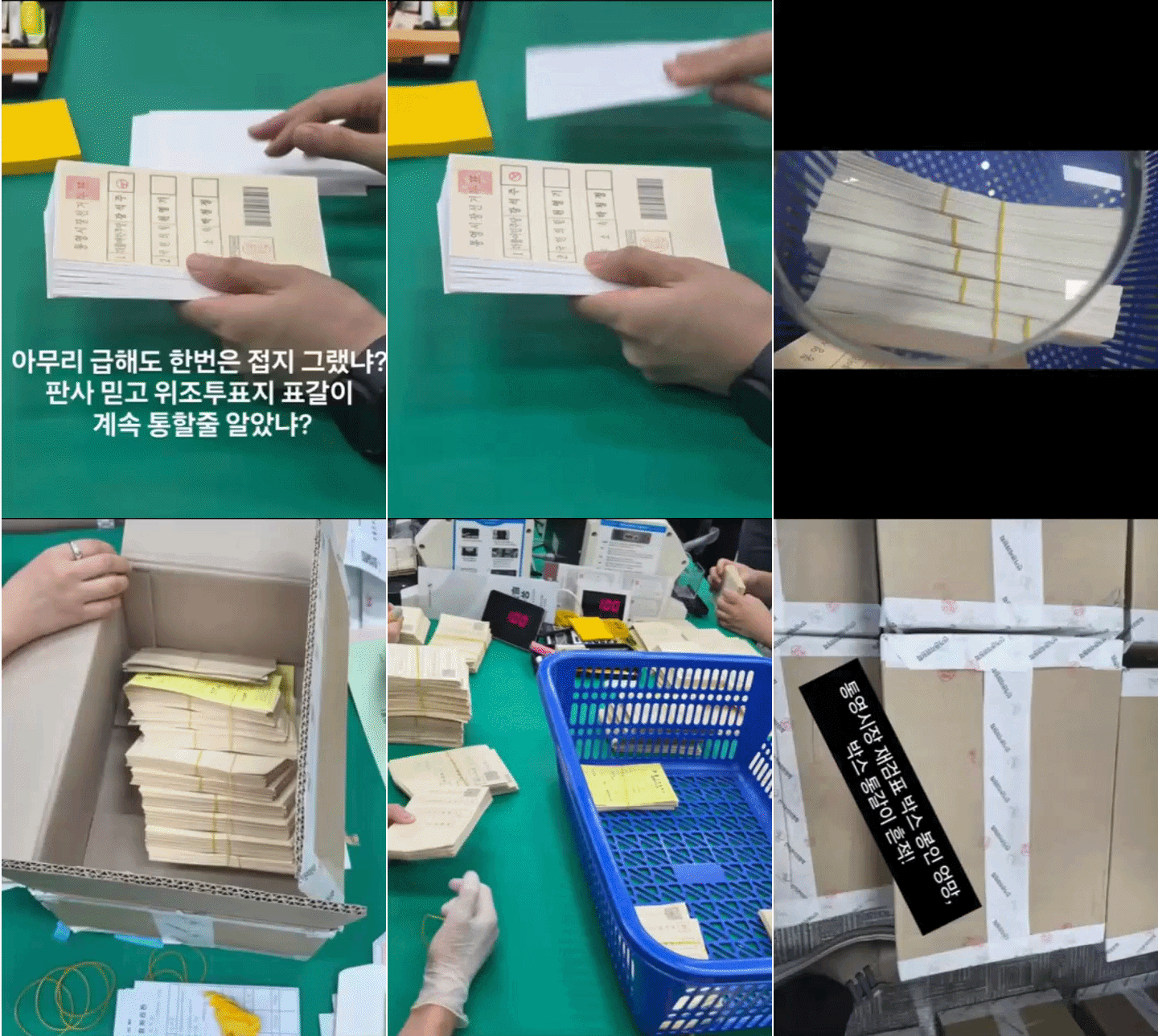 “Ignoring crisp ballots and damaged seals”… Tongyeong mayoral recount concludes with ‘no change in outcome,’ leaving suspicions and public outrage behind
Suspected counterfeit ballots discovered in Tongyeong [GIF from social media of Representative Hwang Kyo-ahn / Attorney Park Joo-hyun]During a recount of the Tongyeong mayoral election in South Gyeong
“Ignoring crisp ballots and damaged seals”… Tongyeong mayoral recount concludes with ‘no change in outcome,’ leaving suspicions and public outrage behind
Suspected counterfeit ballots discovered in Tongyeong [GIF from social media of Representative Hwang Kyo-ahn / Attorney Park Joo-hyun]During a recount of the Tongyeong mayoral election in South Gyeong
 President Yoon, regarding the first-instance ruling on the Public Official Election Act: “An excessive political verdict that distorts the facts… We will appeal immediately.”
The first-instance sentencing hearing for President Yoon Suk Yeol regarding violations of the Public Official Election Act is being broadcast live at Seoul Station on the 27th. [Photo=Yonhap News]Pres
President Yoon, regarding the first-instance ruling on the Public Official Election Act: “An excessive political verdict that distorts the facts… We will appeal immediately.”
The first-instance sentencing hearing for President Yoon Suk Yeol regarding violations of the Public Official Election Act is being broadcast live at Seoul Station on the 27th. [Photo=Yonhap News]Pres
 WSJ: "SK Hynix ADR Premium Is a Sign of AI Trading Overheat"
Advertisement for SK Hynix ADR listing in New York's Times Square [Reuters=Yonhap News file photo]The Wall Street Journal (WSJ) has pointed out that the price of SK Hynix’s American Depositary Recei
WSJ: "SK Hynix ADR Premium Is a Sign of AI Trading Overheat"
Advertisement for SK Hynix ADR listing in New York's Times Square [Reuters=Yonhap News file photo]The Wall Street Journal (WSJ) has pointed out that the price of SK Hynix’s American Depositary Recei
 'Godfather of Japanese Mystery Novels' Keigo Higashino Passes Away After Battle with Cancer at 68
Famous Japanese mystery novelist Keigo Higashino [AFP=Yonhap News]It has been belatedly reported that Keigo Higashino, the "godfather of Japanese mystery novels" and author of bestsellers such as "The
'Godfather of Japanese Mystery Novels' Keigo Higashino Passes Away After Battle with Cancer at 68
Famous Japanese mystery novelist Keigo Higashino [AFP=Yonhap News]It has been belatedly reported that Keigo Higashino, the "godfather of Japanese mystery novels" and author of bestsellers such as "The
 [Park Pil-kyu Security Column] To the Ignorant Trying to Clothe a Beast in Sheep's Clothing
Rep. Kim Byung-joo of the Democratic Party of Korea [Photo=Yonhap News]“The Air Force Academy doesn't teach you how to fly a plane!” “The Army, Navy, and Air Force academies are exactly the
[Park Pil-kyu Security Column] To the Ignorant Trying to Clothe a Beast in Sheep's Clothing
Rep. Kim Byung-joo of the Democratic Party of Korea [Photo=Yonhap News]“The Air Force Academy doesn't teach you how to fly a plane!” “The Army, Navy, and Air Force academies are exactly the
 [Issue Diagnosis] Two Effects of the Election Petition Review
 [Photo] Evidence of Election Fraud Flooding U.S. Media… Trump Had 2.7 Million Votes Stolen
 [Video] U.S. Semiquincentennial Air Show... 'Art in the Sky' streaks across New York
 [Editorial Cartoon] A Draconian Law That Undermines Freedom of Expression

 List
List