 New York Stock Exchange. Yonhap News Agency file photo.
Concerns about an AI bubble are spreading across global stock markets, with growing warnings that AI-related stocks are overvalued.
The three major stock indexes on the New York Stock Exchange all fell on the 4th (local time). The tech-heavy Nasdaq Composite Index saw the largest decline, dropping 2.04%.
In Asia, stock markets in South Korea and Japan experienced sharp declines on the 5th, indicating the spread of concerns about an AI bubble.
Notably, Palantir, one of the leading stocks driving the US stock market's AI boom this year, saw its share price plummet by nearly 8% despite reporting strong third-quarter earnings.
Palantir's stock closed at $190.70 on the Nasdaq market on the 4th, down 7.95%.
Reuters pointed out that although Palantir announced robust third-quarter results on the 3rd, its stock failed to continue its rally, which had been setting new record highs day after day.
Previously, Palantir had announced its third-quarter results, reporting a record-high revenue of $1.18 billion (approximately 1.7 trillion won) and earnings per share of 21 cents, both exceeding market expectations.
Palantir, an AI software company, has significantly boosted its corporate value by leveraging its close relationship with the U.S. federal government, including the Department of Defense, with the advent of the AI era. Recently, it has strengthened its position by securing several contracts utilizing data and AI technologies in the defense sector.
However, even the stronger-than-expected third-quarter earnings failed to meet the heightened expectations of investors, leading to downward pressure on the stock price.
The fact that Michael Burry, a short-seller who gained fame for predicting the collapse of the U.S. housing market in 2008, made a bearish bet on the stocks of Palantir and AI chip maker Nvidia also fueled the sharp decline in stock prices.
Burry, the real-life inspiration for the movie 'The Big Short,' also warned on social media platform X late last month, for the first time in two years, that stocks of AI and tech companies were in a bubble.
 Palantir. EPA Yonhap News.
Palantir's stock has experienced a steep rally this year, soaring by more than 170%, making it a favorite among retail investors not only in the U.S. but also in South Korea. Its stock price has surged by an astonishing 1,000% over the past two years.
Reuters reported that the average daily trading volume by individual investors alone reached $320 million (approximately 463 billion won).
However, the forward price-to-earnings (P/E) ratio, based on estimated earnings for the next 12 months, stands at an exorbitant approximately 250 times, constantly raising concerns about a bubble. This level significantly exceeds Nvidia's 33 times and Microsoft's 29.9 times.
Dan Coatsworth, Market Analyst at investment platform AJ Bell, commented, "Time will tell if Burry has timed his bets correctly," suggesting that Palantir's stock decline might be a temporary breather before resuming its rally.
Bloomberg News reported that the 'Retail Favorites Index,' composed of stocks favored by retail investors, also experienced a significant drop on the same day, making it the worst day for the market since April, when it plunged due to the announcement of U.S. retaliatory tariffs.
This index includes stocks like Palantir, Tesla, Reddit, and Robinhood. It fell by 3.6% on the day, with its decline being nearly three times that of the S&P 500 index.
CEOs of major U.S. investment banks, including Goldman Sachs and Morgan Stanley, also joined the stock market bubble debate on the same day.
David Solomon, CEO of Goldman Sachs, stated on the same day, "There is a possibility of a 10-20% decline in the stock market over the next 12 to 24 months," adding, "After a market rally, there will be a period of correction, and investors will re-evaluate."
 Reuters Yonhap News.
Amid the rally that saw the three major U.S. stock indexes reach all-time highs late last month, voices of concern about an AI bubble have not subsided.
In September, after OpenAI, the creator of the leading AI chatbot ChatGPT, announced a strategic partnership involving an investment of up to $100 billion from Nvidia to purchase millions of Nvidia chips, skepticism about 'circular transactions' grew.
OpenAI is valued at $500 billion, but it remains in deficit and lacks a clear revenue model.
This partnership structure, where OpenAI, with investment from Nvidia, buys Nvidia's products, has ignited skepticism about whether it is merely a form of 'round-tripping' and thus part of a bubble.
Research firm Seventh Report pointed out last month that OpenAI's valuation of $500 billion is 25 times its projected revenue for 2025, stating, "Management will need to soon demonstrate its ability to convert growth into profits to justify such a high valuation."
Melissa Amore, CEO of stock education platform Stock Swish, said on the 5th that she is preparing for further stock price declines and advised investors to prepare a list of stocks to buy if they can withstand the pain.
She added, however, "(This is) only if you can bear the pain," and stated, "Otherwise, I would advise selling."
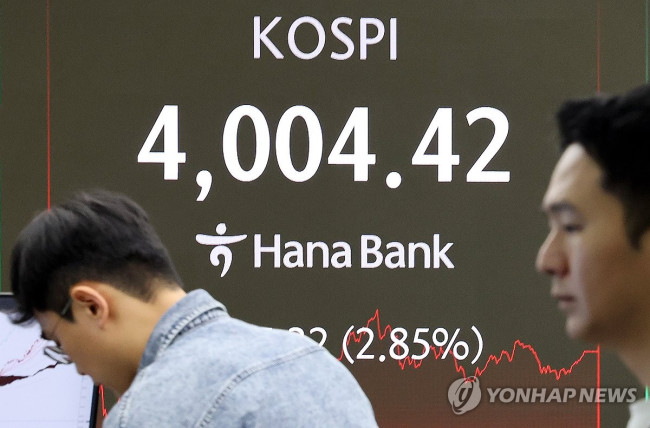 Dealers work at the dealing room of Hana Bank's headquarters in Jung-gu, Seoul, on the 5th, the day the KOSPI sharply declined. On this day, the KOSPI index closed at 4,004.42, down 117.32 points (2.85%) from the previous trading day, and the KOSDAQ index closed at 901.89, down 24.68 points (2.66%). Yonhap News.
Concerns about an AI bubble also spread to Asian stock markets on the 5th. Samsung Electronics and SK Hynix, which had been leading the rise of the KOSPI, experienced sharp declines of 6-7% at one point in the morning, causing the KOSPI index to briefly fall below the 3,900 level.
However, the KOSPI managed to rebound later in the day, recovering the 4,000 mark and closing at 4,004.42, down 2.85% from the previous trading day.
Foreign investors' net selling of over 2.5 trillion won led the decline, and the KOSDAQ index also fell by 2.66%.
Japan's representative stock index, the Nikkei 225 Average Stock Price (hereinafter referred to as the Nikkei Index), also briefly broke the 50,000 mark due to concerns about an AI bubble in the morning, but recovered in the afternoon to close at 50,212, down 2.5%.
Taiwan's Weighted Stock Index, home to TSMC, the world's largest foundry (contract semiconductor manufacturing) company, also started with a sharp decline at the opening, dropping to the 27,400s, but later reduced its losses to close at 27,717.06, down 1.42%.
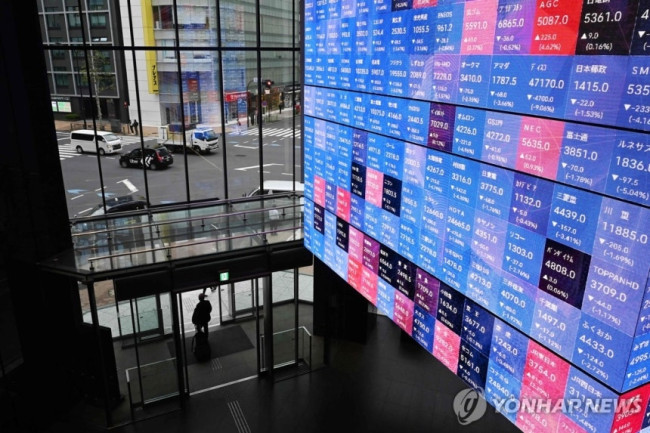 On the 5th, the Nikkei Index ticker in Tokyo, Japan, is colored blue, indicating a decline.
Yonhap News

 Iranian Foreign Ministry: "Continuing Message Exchanges with the U.S. and Activities of Mediating Countries"
Esmaeil Baghaei, Spokesperson for the Iranian Ministry of Foreign Affairs [Xinhua, Yonhap News file photo]Esmaeil Baghaei, spokesperson for the Iranian Ministry of Foreign Affairs, stated on the 26th
Iranian Foreign Ministry: "Continuing Message Exchanges with the U.S. and Activities of Mediating Countries"
Esmaeil Baghaei, Spokesperson for the Iranian Ministry of Foreign Affairs [Xinhua, Yonhap News file photo]Esmaeil Baghaei, spokesperson for the Iranian Ministry of Foreign Affairs, stated on the 26th
 President Yoon: "Do You Think You Are Safe from the Special Counsel?"... Final Statement Video Released
President Yoon Suk Yeol rebuking the special prosecutor on the 24th. [Court video / @birds_justice X account subtitle GIF] A video of President Yoon Suk Yeol's closing statement at his trial rega
President Yoon: "Do You Think You Are Safe from the Special Counsel?"... Final Statement Video Released
President Yoon Suk Yeol rebuking the special prosecutor on the 24th. [Court video / @birds_justice X account subtitle GIF] A video of President Yoon Suk Yeol's closing statement at his trial rega
 President Yoon, regarding the first-instance ruling on the Public Official Election Act: “An excessive political verdict that distorts the facts… We will appeal immediately.”
The first-instance sentencing hearing for President Yoon Suk Yeol regarding violations of the Public Official Election Act is being broadcast live at Seoul Station on the 27th. [Photo=Yonhap News]Pres
President Yoon, regarding the first-instance ruling on the Public Official Election Act: “An excessive political verdict that distorts the facts… We will appeal immediately.”
The first-instance sentencing hearing for President Yoon Suk Yeol regarding violations of the Public Official Election Act is being broadcast live at Seoul Station on the 27th. [Photo=Yonhap News]Pres
 WSJ: "SK Hynix ADR Premium Is a Sign of AI Trading Overheat"
Advertisement for SK Hynix ADR listing in New York's Times Square [Reuters=Yonhap News file photo]The Wall Street Journal (WSJ) has pointed out that the price of SK Hynix’s American Depositary Recei
WSJ: "SK Hynix ADR Premium Is a Sign of AI Trading Overheat"
Advertisement for SK Hynix ADR listing in New York's Times Square [Reuters=Yonhap News file photo]The Wall Street Journal (WSJ) has pointed out that the price of SK Hynix’s American Depositary Recei
 'Godfather of Japanese Mystery Novels' Keigo Higashino Passes Away After Battle with Cancer at 68
Famous Japanese mystery novelist Keigo Higashino [AFP=Yonhap News]It has been belatedly reported that Keigo Higashino, the "godfather of Japanese mystery novels" and author of bestsellers such as "The
'Godfather of Japanese Mystery Novels' Keigo Higashino Passes Away After Battle with Cancer at 68
Famous Japanese mystery novelist Keigo Higashino [AFP=Yonhap News]It has been belatedly reported that Keigo Higashino, the "godfather of Japanese mystery novels" and author of bestsellers such as "The
 [Park Pil-kyu Security Column] To the Ignorant Trying to Clothe a Beast in Sheep's Clothing
Rep. Kim Byung-joo of the Democratic Party of Korea [Photo=Yonhap News]“The Air Force Academy doesn't teach you how to fly a plane!” “The Army, Navy, and Air Force academies are exactly the
[Park Pil-kyu Security Column] To the Ignorant Trying to Clothe a Beast in Sheep's Clothing
Rep. Kim Byung-joo of the Democratic Party of Korea [Photo=Yonhap News]“The Air Force Academy doesn't teach you how to fly a plane!” “The Army, Navy, and Air Force academies are exactly the
 [Issue Diagnosis] Two Effects of the Election Petition Review
 [Photo] Evidence of Election Fraud Flooding U.S. Media… Trump Had 2.7 Million Votes Stolen
 [Video] U.S. Semiquincentennial Air Show... 'Art in the Sky' streaks across New York
 [Editorial Cartoon] A Draconian Law That Undermines Freedom of Expression

 List
List









