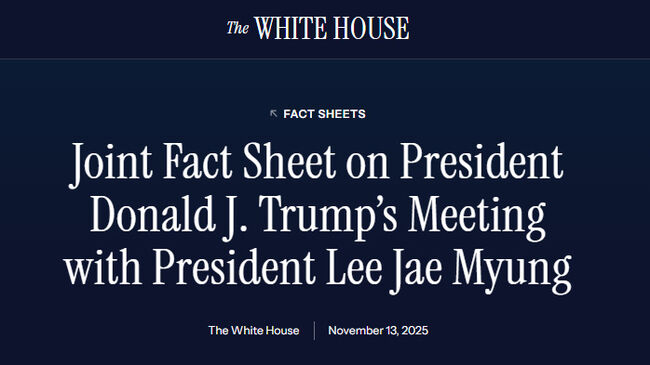
The details of the trade negotiations between the United States and South Korea, which had been the subject of much discussion but lacked concrete substance, have finally been officially announced in a document by both governments.
This publication aims to break down the implications of these negotiation details in an easily understandable manner for readers, based on materials released by the White House.
Before delving into the detailed explanation, the title of this fact sheet itself is noteworthy. While national names are used for negotiations with other countries, employing terms like 'Deal' or 'Agreement', the document pertaining to the negotiations with South Korea features the names of the representatives in the title, and words signifying negotiation or agreement are absent.
‘Joint Fact Sheet on President Donald J. Trump’s Meeting with President Lee Jae Myung’
This should be viewed not as a fact sheet reporting on the results of negotiations concluded between the US and South Korea, but rather as a report format detailing discussions held. The reason for this interpretation is evident in the very first paragraph of this announcement.
Unlike other fact sheets that directly address the negotiation details, the fact sheet concerning South Korea begins with an unnecessary travelogue about the state visit to Gyeongju being the first of its kind, and further elaborates on the democratic nature of President Trump's re-election and President Lee Jae Myung's presidential victory.
This section gives the impression that the negotiations themselves, rather than their specific outcomes, served as an acknowledgment of the Lee Jae Myung administration by the United States. The unprecedented and 'unnecessary' nature of these sentences in the fact sheet's preamble raises suspicions about its underlying motives.
To put it bluntly, this fact sheet only serves to document an ongoing agreement and holds no binding conclusions whatsoever.
Let's now move on to the content. For ease of explanation, the commentary sections are marked in a different color.
※ A problem has been identified where the font color is not reflected in the mobile viewing version. In the text below, the bolded text represents the commentary section.
◇Reconstruction and Expansion of Key Industries: Presidents Trump and Lee reaffirmed the strategic trade and investment agreement announced by South Korea in July.
This clarifies that there has been no change from when President Trump first announced the conclusion of a trade agreement with South Korea.
- Welcomes South Korean investments in various sectors that promote economic and national security interests, including but not limited to shipbuilding, energy, semiconductors, pharmaceuticals, critical minerals, and artificial intelligence/quantum computing.
- This deal includes a South Korean investment of $150 billion in a US-approved shipbuilding sector, referred to as ‘the Approved Investments’.
The use of "Approved Investments" in capital letters further emphasizes that the United States holds the leading role.
- The deal also includes an additional South Korean investment of $200 billion committed under a Memorandum of Understanding (MOU) on strategic investments, which is expected to be signed by representatives of the United States and South Korea.
The MOU has not yet been signed. The text of the MOU itself is not yet finalized. However, it has become clear that South Korea will invest $200 billion in the United States.
- The United States will apply the higher of the KORUS FTA or U.S. Most Favored Nation (MFN) tariff rates, or a 15% tariff rate on goods originating from the Republic of Korea, as applicable under reciprocal tariffs provided for under Executive Order 14257, as amended on April 2, 2025.
By clearly stating that the "higher tariff rate" will be applied, it is evident that the FTA has been rendered ineffective.
- The United States will reduce the Section 232 tariff rate on South Korean automobiles, auto parts, lumber, and timber and wood derivatives to 15%. For South Korean products where the KORUS FTA or MFN tariff rate is 15% or higher, no additional Section 232 tariff will apply. For South Korean products where the KORUS FTA or MFN tariff rate is less than 15%, the sum of the KORUS FTA or MFN tariff rate and the Section 232 tariff rate will be 15%.
This clearly establishes a minimum tariff rate of 15% for Korean automobiles, parts, lumber, and derivatives.
Japan and the European Union (EU) are subject to an exception and quota system only for steel and aluminum, securing a status close to exemption from the Section 232 tariff system.
- For Section 232 tariffs imposed on pharmaceuticals, the United States intends to apply a Section 232 tariff rate not exceeding 15% on goods imported from the Republic of Korea.
The decision to set a 15% cap on pharmaceuticals is understood as a measure to stabilize drug prices within the United States.
- Regarding tariffs on semiconductors (including manufacturing equipment), the Section 232 tariff conditions for South Korea will apply, and these will be no less favorable than conditions that may be presented to countries exporting semiconductors of equivalent or greater scale to South Korea in future semiconductor trade agreements, as determined by the United States.
- The United States will eliminate additional tariffs imposed under Executive Order 14257, as amended on April 2, 2025. This applies to specific products included in the list of tariff adjustments for allied nations, such as generic drugs, raw materials for generic drugs, chemical precursors for generic drugs, and certain natural resources unavailable in the United States. The United States will also eliminate tariffs imposed on aircraft and parts from the Republic of Korea under Executive Order 14257, as amended, Proclamation 9704, as amended, Proclamation 9705, as amended, and Proclamation 10962, as amended.
Generic drugs refer to medications replicated from expired patented drugs.
The elimination of tariffs on aircraft and parts is a measure to protect American industry and is clearly executed through presidential decree, reiterating that the United States holds the initiative.
◇Foreign Exchange Market Stabilization: The United States and South Korea have thoroughly discussed the potential impact of the commitments in the MOU on South Korea's foreign exchange market stability. Both countries agreed that the commitments in the MOU should not cause market instability. As trusted partners, both countries agree that South Korea is not obligated to procure U.S. dollar funds exceeding a total of $20 billion in any calendar year. South Korea will endeavor to procure U.S. dollar funds through means other than market purchases to minimize any potential impact on the market. If the implementation of the MOU commitments is determined to cause market instability, such as irregular fluctuations in the Won, South Korea may request adjustments in the amount and timing of fund procurement, and the United States will consider such requests in good faith.
Again, the MOU has not yet been signed. The phrasing "agree that there is no obligation" is also noteworthy.
◇Strengthening Commercial Ties: The two leaders welcomed a series of commercial commitments in strategic sectors, reflecting the confidence of private companies in a strong bilateral economic partnership.
- The two leaders welcomed the announcement by South Korean companies in August of $150 billion in foreign direct investment (FDI) to the United States during President Trump's term. Both countries will strive to facilitate these investments.
FDI refers to investments made directly into the United States by individuals or companies from South Korea. This appears to be separate from the $200 billion investment by the South Korean government and the $150 billion investment in the shipbuilding sector. Based on this alone, South Korea would be investing a total of $500 billion: $200 billion in cash investment to the US, $150 billion in shipbuilding, and $150 billion in FDI.
President Trump's term extends until January 20, 2029.
- The two leaders welcomed Korean Air's (KAL) announcement in August to purchase 103 Boeing aircraft equipped with GE Aerospace engines. The value of this contract for Boeing is $36 billion and includes the Boeing 737 MAX jetliner, the 787 Dreamliner, and the 777X passenger and freighter aircraft. This is expected to bring Korean Air's total purchase of Boeing aircraft to over 150 by 2025.
- The United States and the Republic of Korea welcome the ‘Buy America in Seoul’ initiative. Accordingly, South Korea will cooperate with provincial governments to host annual exhibitions introducing American companies, including small and medium-sized enterprises, to promote U.S. exports to South Korea.
This section signifies the successful push for a comprehensive opening of the South Korean market to American goods. It appears that all 50 U.S. state governments will engage in export efforts to South Korea, with South Korea pledging full cooperation.
◇Promoting Mutual Trade: The two leaders recognized that the recently announced agreement reflects the shared goal of promoting mutually beneficial trade and investment. In the spirit of this agreement, both the U.S. and South Korea will establish commitments and action plans to eliminate non-tariff barriers and promote mutual trade, which will be adopted by the KORUS Joint Committee by the end of the year. This includes the following:
Recently, the White House announced agreements with El Salvador, Ecuador, Guatemala, Argentina, Switzerland, and Liechtenstein to eliminate 'non-tariff barriers'.
The removal of non-tariff barriers is understood as a two-stage strategy for President Trump's tariff policy, essentially aiming to bind economic agreements into a mutual alliance system. This is because it is interpreted as an effort to remove elements that hinder becoming allies with the U.S., such as drugs, pro-China political leanings, and issues of electoral fraud.
Interestingly, the removal of 'non-tariff barriers' is not unilateral. It is clear that in the case of South Korea, the negotiations have proceeded in a direction where South Korea concedes more to the United States compared to other countries. Primarily, the automobile market and the food and agricultural product markets are essentially promised complete openness.
- South Korea will eliminate the 50,000-unit limit on U.S. vehicles compliant with U.S. Federal Motor Vehicle Safety Standards (FMVSS) that can be imported into South Korea without further modification. South Korea will also reduce regulatory burdens on U.S. automotive exports by not requiring additional documents beyond those submitted to U.S. certifying bodies in the emission certification process.
- The Republic of Korea will take the following steps in cooperation with the United States to eliminate non-tariff barriers affecting trade in food and agricultural products: implement existing commitments specified in bilateral agreements and protocols, streamline regulatory approval processes for agricultural biotechnology products, resolve outstanding U.S. applications (clear the backlog), establish a dedicated desk for U.S. horticultural product-related requests, and maintain market access for U.S. meat and cheese using specific terminology.
The phrase 'outstanding U.S. applications' includes the opening of the rice market and the lifting of the age limit for beef. It appears to be an attempt to avoid controversy by embedding sensitive issues for the South Korean public within a single sentence.
- The United States and the Republic of Korea commit to ensuring that U.S. companies are not discriminated against and do not face unnecessary barriers in digital services laws and policies, including network usage fees and online platform regulations, and will facilitate cross-border data flows, including location information, reinsurance data, and personal data. Furthermore, the United States and the Republic of Korea will support the permanent moratorium on duties on electronic transmissions at the World Trade Organization (WTO).
It is currently uncertain whether guaranteeing that U.S. platforms like X, Facebook, and YouTube will not be discriminated against by the South Korean government means prohibiting censorship, but this section raises many questions.
Additionally, the United States clarifies that data collected by U.S. companies operating in South Korea can be brought back to the United States.
- The Republic of Korea commits to providing additional procedural fairness provisions, including the recognition of lawyer-client privilege in competition proceedings.
- The United States and the Republic of Korea will cooperate to protect intellectual property rights. The Republic of Korea will continue to take necessary steps for accession to the Patent Cooperation Treaty (PCT).
- The United States and the Republic of Korea pledge to cooperate to ensure strong protections for internationally recognized labor rights. Both countries will cooperate to eradicate all forms of forced labor globally, including eradicating the import of products produced by forced labor.
Products produced by forced labor include those from China's Xinjiang Uyghur Autonomous Region, meaning South Korea will enter into a trade alliance to prohibit the import of all products that the United States prohibits on the grounds of human rights.
- The United States and South Korea reaffirm the importance of ensuring that differences in environmental protection levels do not distort trade and investment. To this end, South Korea will effectively enforce environmental regulations to promote mutual trade, including the full implementation of the WTO Agreement on Fisheries Subsidies.
The Fisheries Subsidies Agreement was adopted by the WTO in June 2022 with the goal of addressing one of the main causes of overfishing by reducing harmful subsidies that countries provide to maintain the profitability of commercial fishing operators. This agreement prohibits subsidies that facilitate (1) illegal, unreported, and unregulated (IUU) fishing, (2) fishing of overfished stocks, and (3) fishing of unmanaged stocks on the high seas.
◇Protecting Economic Prosperity: The leaders of both countries acknowledged the need to strengthen cooperation in economic and national security fields to maintain competitiveness and secure safe supply chains. This includes cooperation to prevent tariff evasion, mutually complementary measures to counter unfair and non-market policies and practices, and enhanced regulation of foreign investment and outbound domestic investment. Both countries will ensure that benefits are provided to countries that have fulfilled equivalent commitments for international procurement obligations.
◇Modernizing the ROK-U.S. Alliance: The United States reaffirmed its steadfast commitment to the defense of the Republic of Korea through the continued presence of the United States Forces Korea (USFK).
- The United States reaffirmed its commitment to provide extended deterrence, utilizing its full range of capabilities, including nuclear. The two leaders pledged to strengthen cooperation through consultation mechanisms, including the Nuclear Consultative Group.
- President Lee announced plans to increase defense spending to 3.5% of GDP as soon as possible, in accordance with domestic legal requirements, which President Trump welcomed.
As of 2025, South Korea's defense spending ratio is approximately 2.4% of GDP. Over the next decade, defense spending could increase by an average of over 7% annually, reaching about 3.5% of GDP by 2035. The Lee Jae Myung administration previously stated its intention to increase defense spending by 8.2% in 2026, raising the defense budget as a percentage of GDP to 2.42%.
According to this plan, the defense budget for 2026 is set at 66.2947 trillion Korean Won.
- The Republic of Korea also committed to spending $25 billion on the procurement of U.S. military equipment by 2030 and shared plans to provide comprehensive support to USFK totaling $33 billion, in accordance with South Korean legal requirements.
The cost-sharing for USFK in 2026 has been set at 1.5192 trillion Korean Won. President Trump previously demanded $10 billion (approximately 14 trillion Korean Won), which caused controversy. $33 billion is over 46 trillion Korean Won. This amount is unachievable even by providing 10 trillion Korean Won annually from 2027 to 2030, raising questions about the plan being presented.
- The leaders of both countries pledged to continue alliance cooperation for the transfer of wartime operational control. With U.S. support, South Korea committed to accelerating efforts to strengthen the military capabilities necessary to lead the combined defense against the Democratic People's Republic of Korea (North Korea). This includes the introduction of advanced U.S. weapon systems and the expansion of bilateral defense industry cooperation, including in the area of advanced weapon systems.
- The United States and the Republic of Korea will enhance the U.S. conventional deterrence posture against all regional threats to the alliance, including North Korea. Both sides reaffirm relevant agreements since 2006. Both sides will continue close consultations and report on implementation progress to their respective leaders.
The 2006 ROK-U.S. Security Consultations included strengthening the U.S. conventional deterrence posture against 'regional threats,' considering not only North Korea but also China. It also indicates a move towards South Korea bearing more responsibility and costs in the U.S. Indo-Pacific strategy through the modernization of the ROK-U.S. alliance.
- The United States and South Korea pledged to expand cooperation in cyberspace and outer space. The leaders of both countries also reaffirmed their commitment to continue cooperation on artificial intelligence (AI) in the military domain.
The enhanced cooperation in cyberspace and outer space also signifies South Korea's participation in the U.S. efforts to contain China. This paints a picture of South Korea and the United States collaborating on online hacking attacks originating from North Korea and China, which may also include efforts to eradicate attempts at election fraud.
◇Cooperation on Korean Peninsula and Regional Issues: The leaders of both countries pledged to work for peace, security, and prosperity on both the Korean Peninsula and in the Indo-Pacific region.
- The leaders reaffirmed their commitment to the complete denuclearization of North Korea and peace and stability on the Korean Peninsula, and pledged to cooperate to implement the joint statement from the 2018 U.S.-North Korea Singapore Summit.
- The leaders agreed to closely cooperate on North Korea policy and urged North Korea to abide by its international obligations, including abandoning its weapons of mass destruction (WMD) and ballistic missile programs, and to return to meaningful dialogue.
- The leaders pledged to strengthen the trilateral cooperative relationship with Japan.
- The leaders reaffirmed their efforts to maintain freedom of navigation and overflight and other lawful uses of the sea. This reiterates that all countries' maritime claims must be consistent with international maritime law.
- The ROK and the U.S. emphasized the importance of maintaining peace and stability across the Taiwan Strait. Both sides urged the peaceful resolution of cross-strait issues and made it clear that they oppose any unilateral change to the status quo.
This effectively clarifies that South Korea opposes China's aggression towards Taiwan.
◇Enhancing Maritime and Nuclear Cooperation: The United States welcomed South Korea's commitment to contribute to the modernization and capacity expansion of the U.S. shipbuilding industry, including investments in U.S. shipyards and U.S. labor. South Korea expressed its welcome for U.S. support for South Korea's civilian and military nuclear power programs.
- Through a shipbuilding working group, both countries will pursue further cooperation in areas such as maintenance, repair, and overhaul (MRO), workforce development, shipyard modernization, and supply chain resilience.
There are only mentions of pursuing these initiatives, with no substantial details.
- These plans will increase the number of U.S. merchant vessels and combat-ready warships as soon as possible, including the possibility of constructing U.S. naval vessels within South Korea.
The construction of U.S. naval vessels in South Korea is only mentioned as a possibility.
- Consistent with the bilateral Article 123 agreement and within the scope of U.S. legal requirements, the United States supports the process leading to South Korea's enrichment and reprocessing of spent nuclear fuel for peaceful use.
By limiting reprocessing of nuclear fuel to peaceful use, it prevents it from leading to nuclear-powered submarines or aircraft carriers.
- The United States has approved South Korea's construction of nuclear-powered attack submarines. The United States will cooperate closely with South Korea to advance the requirements for this construction project, including fuel procurement pathways.
While the U.S. President can make export decisions regarding highly sensitive technologies like nuclear-powered submarines, implementation requires Congressional approval or adjustments to specific laws such as arms control treaties. The President's approval does not guarantee that South Korea will be able to acquire nuclear submarines.
Furthermore, under the Arms Export Control Act (AECA), defense industry exports are strictly regulated. Congress also has the authority to prohibit exports if necessary.
As is known, the Philadelphia site designated by President Trump for submarine construction currently lacks any infrastructure capable of building nuclear-powered submarines. This will require considerable time and funding, the cost of which will likely be borne by the customer, South Korea.
Political and diplomatic columnist Jean Cummings, in a post on Facebook on the 14th titled 'South Korea's Sovereignty Officially Incorporated into the U.S. Control System,' evaluated the release of this fact sheet as "a declaration that South Korea's strategic autonomy has been officially incorporated into the U.S. control system."
Indeed, although this fact sheet does not yet guarantee legal binding force, it demonstrates the complete opening of the South Korean market to the United States, the investment of funds and human resources in the U.S. under U.S. control to drive U.S. industrial development, and the further strengthening of the relationship between South Korea and the U.S. as economic and security partners.
It remains to be seen when and with what content the MOUs mentioned in this fact sheet will be finalized and signed by both parties.
U.S. NNP = Chief Reporter Sung Ku Hong / Special Contribution by This Publication NNP info@newsandpost.com

 Iranian Foreign Ministry: "Continuing Message Exchanges with the U.S. and Activities of Mediating Countries"
Esmaeil Baghaei, Spokesperson for the Iranian Ministry of Foreign Affairs [Xinhua, Yonhap News file photo]Esmaeil Baghaei, spokesperson for the Iranian Ministry of Foreign Affairs, stated on the 26th
Iranian Foreign Ministry: "Continuing Message Exchanges with the U.S. and Activities of Mediating Countries"
Esmaeil Baghaei, Spokesperson for the Iranian Ministry of Foreign Affairs [Xinhua, Yonhap News file photo]Esmaeil Baghaei, spokesperson for the Iranian Ministry of Foreign Affairs, stated on the 26th
 President Yoon: "Do You Think You Are Safe from the Special Counsel?"... Final Statement Video Released
President Yoon Suk Yeol rebuking the special prosecutor on the 24th. [Court video / @birds_justice X account subtitle GIF] A video of President Yoon Suk Yeol's closing statement at his trial rega
President Yoon: "Do You Think You Are Safe from the Special Counsel?"... Final Statement Video Released
President Yoon Suk Yeol rebuking the special prosecutor on the 24th. [Court video / @birds_justice X account subtitle GIF] A video of President Yoon Suk Yeol's closing statement at his trial rega
 President Yoon, regarding the first-instance ruling on the Public Official Election Act: “An excessive political verdict that distorts the facts… We will appeal immediately.”
The first-instance sentencing hearing for President Yoon Suk Yeol regarding violations of the Public Official Election Act is being broadcast live at Seoul Station on the 27th. [Photo=Yonhap News]Pres
President Yoon, regarding the first-instance ruling on the Public Official Election Act: “An excessive political verdict that distorts the facts… We will appeal immediately.”
The first-instance sentencing hearing for President Yoon Suk Yeol regarding violations of the Public Official Election Act is being broadcast live at Seoul Station on the 27th. [Photo=Yonhap News]Pres
 WSJ: "SK Hynix ADR Premium Is a Sign of AI Trading Overheat"
Advertisement for SK Hynix ADR listing in New York's Times Square [Reuters=Yonhap News file photo]The Wall Street Journal (WSJ) has pointed out that the price of SK Hynix’s American Depositary Recei
WSJ: "SK Hynix ADR Premium Is a Sign of AI Trading Overheat"
Advertisement for SK Hynix ADR listing in New York's Times Square [Reuters=Yonhap News file photo]The Wall Street Journal (WSJ) has pointed out that the price of SK Hynix’s American Depositary Recei
 'Godfather of Japanese Mystery Novels' Keigo Higashino Passes Away After Battle with Cancer at 68
Famous Japanese mystery novelist Keigo Higashino [AFP=Yonhap News]It has been belatedly reported that Keigo Higashino, the "godfather of Japanese mystery novels" and author of bestsellers such as "The
'Godfather of Japanese Mystery Novels' Keigo Higashino Passes Away After Battle with Cancer at 68
Famous Japanese mystery novelist Keigo Higashino [AFP=Yonhap News]It has been belatedly reported that Keigo Higashino, the "godfather of Japanese mystery novels" and author of bestsellers such as "The
 [Park Pil-kyu Security Column] To the Ignorant Trying to Clothe a Beast in Sheep's Clothing
Rep. Kim Byung-joo of the Democratic Party of Korea [Photo=Yonhap News]“The Air Force Academy doesn't teach you how to fly a plane!” “The Army, Navy, and Air Force academies are exactly the
[Park Pil-kyu Security Column] To the Ignorant Trying to Clothe a Beast in Sheep's Clothing
Rep. Kim Byung-joo of the Democratic Party of Korea [Photo=Yonhap News]“The Air Force Academy doesn't teach you how to fly a plane!” “The Army, Navy, and Air Force academies are exactly the
 [Issue Diagnosis] Two Effects of the Election Petition Review
 [Photo] Evidence of Election Fraud Flooding U.S. Media… Trump Had 2.7 Million Votes Stolen
 [Video] U.S. Semiquincentennial Air Show... 'Art in the Sky' streaks across New York
 [Editorial Cartoon] A Draconian Law That Undermines Freedom of Expression

 List
List









