12‧3 비상계엄 논란의 확산 중심에는 ‘체포조 명단’이 있었다. 정치권은 이 조직들을 뒤섞어 ‘내란 프레임’을 구축했고, 곽종근 전 특전사령관의 뒤바뀐 발언이 뒤늦게 이 서사와 결합하며 파장이 확대됐다. ③편에서는 체포조 명단의 실체, 군 기능의 혼동, 그리고 진술 변화의 맥락과 시점을 토대로 무엇이 사실이고 무엇이 프레임인지 검증한다.<편집자 주>
 Martial law troops approaching the main building of the National Assembly on the day of martial law. They were walking towards the main gate of the National Assembly without any shots fired or bayonets fixed. This is in stark contrast to the state of emergency martial law on December 12th. This footage was broadcast live at the time. [Captured from National Assembly Broadcasting]
[Table of Contents]
① Hong Jang-won… The truth the ‘earthworm’ couldn’t tell
② Gwak Jong-geun… The military's judgment and the actual situation at the National Assembly on the day of martial law
③ Arrest Team List… What changed before and after its disclosure
④ The legal structure of sedition… Why it doesn't apply
⑤ Conclusion… What is the truth of that day?
The arrest team list existed as an image rather than a document from the beginning. While the phrase "arrest team organization" was not found anywhere in the military, political circles and some media outlets quickly constructed a narrative that the President attempted to seize control of the National Assembly with this single phrase.
However, as the organizational structure is broken down piece by piece, that narrative loses its realistic basis. There were no elements within the military's actual authority or operational system that would have enabled an "arrest team," and no such action was ever carried out.
Ultimately, the question shifts from whether an arrest team existed to why something that did not exist was constructed as if it did.
The term "arrest team" was never used within the military. No testimony was produced from any command line of the Special Warfare Command, Counter-Intelligence Corps, or Defense Security Command hearing this term; instead, commanders uniformly stated, "There were no such orders," and "There was no intention of entering the National Assembly."
The Counter-Intelligence Corps structurally lacks the authority to conduct arrests or use physical force, the Defense Security Command is an overseas and North Korea-focused intelligence agency and thus unrelated to domestic politics, and the Special Warfare Command is not an organization that carries out arrest operations against civilians. Despite this, the defense team for former President Yoon Suk-yeol explained that someone mixed the functions of these three organizations to create the political image of an "arrest team."
In reality, the Counter-Intelligence Corps is an organization responsible for monitoring trends, analyzing risk factors, and identifying the location of specific individuals, but it cannot track locations or make arrests without a warrant. The lack of detention facilities is precisely because their mission does not involve arrests or detentions.
The Defense Security Command is even more so an overseas and North Korea-focused intelligence agency unrelated to domestic politics, and stories like Representative Park Sun-won of the Democratic Party's "missing Defense Security Command agent theory" do not align with the military's structure. The Special Warfare Command is also unrelated to the arrest of National Assembly members, and commanders' testimonies generally agree that the mission assigned was at the level of facility protection.
Considering that a joint investigation headquarters was not formed at the time, meaning the legal procedures for investigation, arrest, and detention were not initiated, the military's actual capabilities were extremely limited. Location tracking without a warrant was impossible, and arrest was even more so. No documents supporting plans for the use of force were left in any command or reporting chain. In other words, it is natural to assume that an operation with no possibility of execution could not have occurred.
The "arrest team" frame gained significant traction due to the decisive role played by political rhetoric and the subsequent piecing together of fragmented information. Representative Kim Byung-joo's "interview with Gwak Jong-geun, Commander of the Special Warfare Command," and former Secretary Park Sun-won's "assassination plot theory and arrest team operation theory" formed the framework of the narrative, and when Hong Jang-won's so-called "earthworm memo" was added on top of this frame, the story grew even larger.
Gwak's change in stance, in particular, altered the nature of the controversy. His initial statements were vague, such as "that was not the intention" and "it was a matter of pressure," but over time, his statements escalated to include direct claims like "the President ordered them to be brought out."
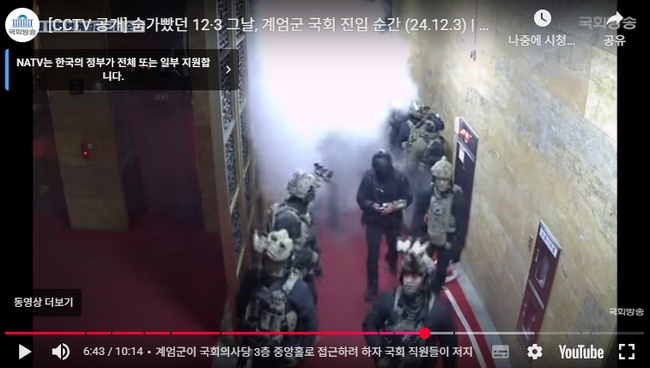 Martial law troops (estimated to be about 10 people) who entered the National Assembly building are seen waiting, avoiding the spray from a fire extinguisher activated by National Assembly officials. Many soldiers were injured that day, but there were no civilian casualties. [Captured from National Assembly Broadcasting]
However, not a single piece of military internal record has been found to support these statements. There is no evidence of such an order existing in any record along the martial law command line, including operation orders, situation reports, command and communication logs, or meeting minutes. Only a solitary claim, unconnected to the testimony of any commander or officer, remains.
Yet, it has become a central issue in the current trial. The reason for the debate over whether the President gave a direct order is analyzed as "not because the order actually existed, but because there is absolutely no physical evidence to prove it."
The explanation is that as there are no records, only claims remain, and as claims are strengthened, the political narrative grows. In the absence of physical evidence, Gwak's testimony was amplified and, when combined with the narratives of Democratic Party lawmakers Kim Byung-joo and Park Sun-won, the "arrest team" controversy appears to have gained more power from its frame than from the facts.
The basis for this judgment is threefold.
First, if an arrest team existed, there should be at least minimal operational documents or command records to support it. However, what remains are only contradictory materials and circumstances.
Second, it is confirmed through court testimony that no organization, whether the Counter-Intelligence Corps, Defense Security Command, or Special Warfare Command, had the authority to arrest or use force, legal procedures were not initiated due to the absence of a joint investigation headquarters, and commanders' on-site understanding was focused on facility protection. Consequently, the conditions for an arrest team to be formed realistically did not exist with this combination.
Therefore, the final remaining question leads to: "Did the President, as the Commander-in-Chief, and the Minister of National Defense truly not know these facts?"
The deployed troops around the National Assembly were a small, virtually unarmed unit of fewer than 300 personnel. If it were believed that this force could prevent the lifting of martial law or forcibly detain National Assembly members, that judgment itself would be deemed impossible by anyone with military experience. There is no basis to support this in any aspect of the military, legal, or command structure, and no records exist either.
Ultimately, what existed was not "a military operation," but a "political narrative" that made people believe such an operation had occurred.
The next question now is "how did the arrest team narrative, created by politicians, acquire the name 'sedition' in court?"
Part ④ will examine the extent to which this controversy is plausible within the actual legal system, highlighting the gap between the political frame and legal reality through the elements of sedition and case law standards.
※ This article informs that it is the conclusion of this newspaper, analyzed by synthesizing testimonies revealed in the sedition trial and expert advice.
#December3 #ArrestTeamControversy #CounterIntelligenceCorps #DefenseSecurityCommand #SpecialWarfareCommand #GwakJonggeunTestimony #HongJangwonMemo #SeditionFrame #MilitaryFactVerification #HaniDaily

 Iranian Foreign Ministry: "Continuing Message Exchanges with the U.S. and Activities of Mediating Countries"
Esmaeil Baghaei, Spokesperson for the Iranian Ministry of Foreign Affairs [Xinhua, Yonhap News file photo]Esmaeil Baghaei, spokesperson for the Iranian Ministry of Foreign Affairs, stated on the 26th
Iranian Foreign Ministry: "Continuing Message Exchanges with the U.S. and Activities of Mediating Countries"
Esmaeil Baghaei, Spokesperson for the Iranian Ministry of Foreign Affairs [Xinhua, Yonhap News file photo]Esmaeil Baghaei, spokesperson for the Iranian Ministry of Foreign Affairs, stated on the 26th
 President Yoon: "Do You Think You Are Safe from the Special Counsel?"... Final Statement Video Released
President Yoon Suk Yeol rebuking the special prosecutor on the 24th. [Court video / @birds_justice X account subtitle GIF] A video of President Yoon Suk Yeol's closing statement at his trial rega
President Yoon: "Do You Think You Are Safe from the Special Counsel?"... Final Statement Video Released
President Yoon Suk Yeol rebuking the special prosecutor on the 24th. [Court video / @birds_justice X account subtitle GIF] A video of President Yoon Suk Yeol's closing statement at his trial rega
 President Yoon, regarding the first-instance ruling on the Public Official Election Act: “An excessive political verdict that distorts the facts… We will appeal immediately.”
The first-instance sentencing hearing for President Yoon Suk Yeol regarding violations of the Public Official Election Act is being broadcast live at Seoul Station on the 27th. [Photo=Yonhap News]Pres
President Yoon, regarding the first-instance ruling on the Public Official Election Act: “An excessive political verdict that distorts the facts… We will appeal immediately.”
The first-instance sentencing hearing for President Yoon Suk Yeol regarding violations of the Public Official Election Act is being broadcast live at Seoul Station on the 27th. [Photo=Yonhap News]Pres
 WSJ: "SK Hynix ADR Premium Is a Sign of AI Trading Overheat"
Advertisement for SK Hynix ADR listing in New York's Times Square [Reuters=Yonhap News file photo]The Wall Street Journal (WSJ) has pointed out that the price of SK Hynix’s American Depositary Recei
WSJ: "SK Hynix ADR Premium Is a Sign of AI Trading Overheat"
Advertisement for SK Hynix ADR listing in New York's Times Square [Reuters=Yonhap News file photo]The Wall Street Journal (WSJ) has pointed out that the price of SK Hynix’s American Depositary Recei
 'Godfather of Japanese Mystery Novels' Keigo Higashino Passes Away After Battle with Cancer at 68
Famous Japanese mystery novelist Keigo Higashino [AFP=Yonhap News]It has been belatedly reported that Keigo Higashino, the "godfather of Japanese mystery novels" and author of bestsellers such as "The
'Godfather of Japanese Mystery Novels' Keigo Higashino Passes Away After Battle with Cancer at 68
Famous Japanese mystery novelist Keigo Higashino [AFP=Yonhap News]It has been belatedly reported that Keigo Higashino, the "godfather of Japanese mystery novels" and author of bestsellers such as "The
 [Park Pil-kyu Security Column] To the Ignorant Trying to Clothe a Beast in Sheep's Clothing
Rep. Kim Byung-joo of the Democratic Party of Korea [Photo=Yonhap News]“The Air Force Academy doesn't teach you how to fly a plane!” “The Army, Navy, and Air Force academies are exactly the
[Park Pil-kyu Security Column] To the Ignorant Trying to Clothe a Beast in Sheep's Clothing
Rep. Kim Byung-joo of the Democratic Party of Korea [Photo=Yonhap News]“The Air Force Academy doesn't teach you how to fly a plane!” “The Army, Navy, and Air Force academies are exactly the
 [Issue Diagnosis] Two Effects of the Election Petition Review
 [Photo] Evidence of Election Fraud Flooding U.S. Media… Trump Had 2.7 Million Votes Stolen
 [Video] U.S. Semiquincentennial Air Show... 'Art in the Sky' streaks across New York
 [Editorial Cartoon] A Draconian Law That Undermines Freedom of Expression

 List
List









