 Interior of a Hanok house converted into a guesthouse. Yonhap News
"I thought small changes were necessary for the rural village not to disappear. With the mindset of throwing a small stone to create ripples, I renovated an empty house and then personally introduced it to outsiders who showed interest."
Empty Hanok houses, which were once a nuisance in Yeondang Village, Yeongyang-gun, Gyeongsangbuk-do, where the Dongnae Jeong clan resides, are gradually being transformed into cafes and guesthouses.
The small changes in the village began with the concern of a resident who wished for his hometown to remain for a long time, and have now borne fruit with "27,000 annual visitors."
On the first of the month, in Yeondang Village, Ibam-myeon, Yeongyang-gun, Gyeongsangbuk-do.
This is a village where the Dongnae Jeong clan resides, and it is home to Seoseokji, a garden facility built in the 5th year of King Gwanghae's reign (1613) and a national heritage site.
The village is situated on a desirable location, known as "Baesan-imsu" (backed by mountains and fronted by a river), with mountains behind it and a stream flowing in front.
As I entered the village, a ginkgo tree, said to be over 400 years old, stood tall, and a silence composed solely of natural sounds lingered in my ears.
Jeong Jun-yeong (44), the former village head of Yeondang Village, who I met here, smiled brightly and said, "Our village has changed a lot."
Jeong offered to show me the newly established guesthouses and cafes in the village and led the way.
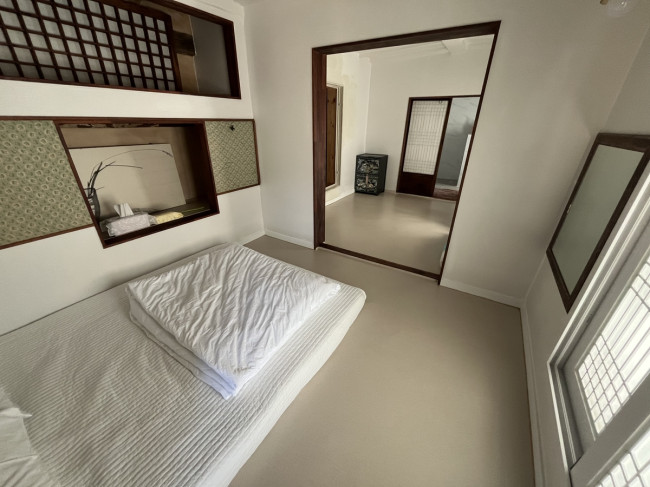 Interior of a guesthouse
Walking along the tiled wall beside a winding path, I came across a guesthouse located in the heart of the village.
This is a Hanok house, over 150 years old according to its building register, which has been transformed into a guesthouse after interior renovations.
Upon passing through the gate of the Hanok house, now a guesthouse, a wide-open wooden porch and a small, 'ㅁ'-shaped courtyard in front came into view.
Sitting down on the porch, Jeong remarked, "The advantage of Hanok houses is that the surrounding buildings block the cold wind, allowing you to feel the sunshine directly outdoors."
The interior rooms have retained much of the Hanok house's original appearance, with only modern upgrades to the flooring and sink.
In addition, a cafe named 'Yeondanglim,' which has been in operation for four years after renovating a house, and various pensions have become part of the village.
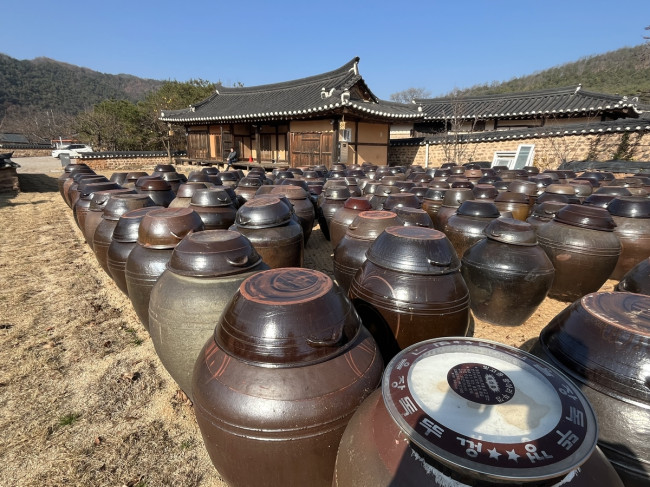 Hanok house converted into a pension with traditional Korean earthenware jars in the courtyard.
Yeondang Village was originally inhabited by only about 30 residents, with no outsiders or even returning natives. As the influx of people ceased, empty houses began to increase one by one.
Then, a small change occurred after Jeong took office as village head in 2019.
He turned his attention to the approximately 20 empty Hanok houses.
"At the time, there were many complaints among the village elders about the neglected houses," Jeong said. "The people who left didn't maintain them, so the remaining residents were suffering from these eyesores."
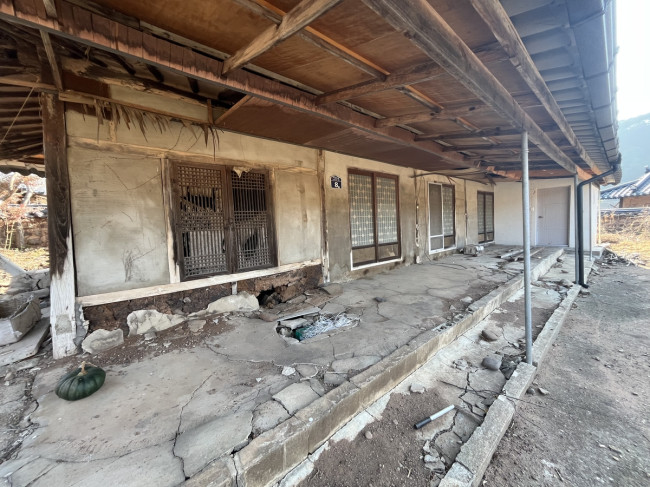 Empty house in Yeondang Village
Jeong first secured funding for the vulnerable area support project and then renovated the empty houses, including demolishing old slate roofs.
Later, upon hearing rumors that outsiders were looking for suitable buildings to open cafes or guesthouses, he directly obtained their contact information and introduced them to the village's empty houses.
In the process of filling the empty houses one by one, he initially faced opposition from some village elders who were fearful of change. Currently, out of approximately 20 empty houses, 9 are being used as cafes, and 4 are scheduled to be converted into restaurants or pensions.
"Now, cafes and guesthouses have become an everyday part of life for the village elders," Jeong said. "Based on the counts of cafes and cultural interpreter houses, 27,000 people visited the village last year alone."
He added, "There are still a few empty houses, and I am coordinating with outsiders and village residents who wish to open restaurants or pensions here. Ultimately, I want to make Yeondang Village into a 'village hotel' that is loved by tourists."
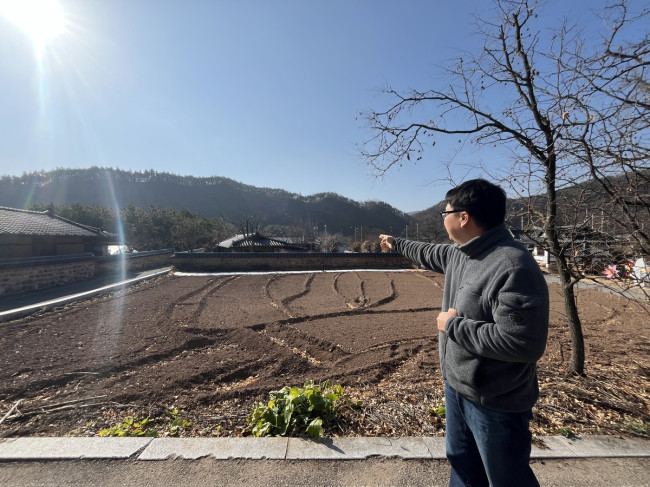 Jeong Jun-yeong pointing to an empty house

 Iranian Foreign Ministry: "Continuing Message Exchanges with the U.S. and Activities of Mediating Countries"
Esmaeil Baghaei, Spokesperson for the Iranian Ministry of Foreign Affairs [Xinhua, Yonhap News file photo]Esmaeil Baghaei, spokesperson for the Iranian Ministry of Foreign Affairs, stated on the 26th
Iranian Foreign Ministry: "Continuing Message Exchanges with the U.S. and Activities of Mediating Countries"
Esmaeil Baghaei, Spokesperson for the Iranian Ministry of Foreign Affairs [Xinhua, Yonhap News file photo]Esmaeil Baghaei, spokesperson for the Iranian Ministry of Foreign Affairs, stated on the 26th
 President Yoon: "Do You Think You Are Safe from the Special Counsel?"... Final Statement Video Released
President Yoon Suk Yeol rebuking the special prosecutor on the 24th. [Court video / @birds_justice X account subtitle GIF] A video of President Yoon Suk Yeol's closing statement at his trial rega
President Yoon: "Do You Think You Are Safe from the Special Counsel?"... Final Statement Video Released
President Yoon Suk Yeol rebuking the special prosecutor on the 24th. [Court video / @birds_justice X account subtitle GIF] A video of President Yoon Suk Yeol's closing statement at his trial rega
 President Yoon, regarding the first-instance ruling on the Public Official Election Act: “An excessive political verdict that distorts the facts… We will appeal immediately.”
The first-instance sentencing hearing for President Yoon Suk Yeol regarding violations of the Public Official Election Act is being broadcast live at Seoul Station on the 27th. [Photo=Yonhap News]Pres
President Yoon, regarding the first-instance ruling on the Public Official Election Act: “An excessive political verdict that distorts the facts… We will appeal immediately.”
The first-instance sentencing hearing for President Yoon Suk Yeol regarding violations of the Public Official Election Act is being broadcast live at Seoul Station on the 27th. [Photo=Yonhap News]Pres
 WSJ: "SK Hynix ADR Premium Is a Sign of AI Trading Overheat"
Advertisement for SK Hynix ADR listing in New York's Times Square [Reuters=Yonhap News file photo]The Wall Street Journal (WSJ) has pointed out that the price of SK Hynix’s American Depositary Recei
WSJ: "SK Hynix ADR Premium Is a Sign of AI Trading Overheat"
Advertisement for SK Hynix ADR listing in New York's Times Square [Reuters=Yonhap News file photo]The Wall Street Journal (WSJ) has pointed out that the price of SK Hynix’s American Depositary Recei
 'Godfather of Japanese Mystery Novels' Keigo Higashino Passes Away After Battle with Cancer at 68
Famous Japanese mystery novelist Keigo Higashino [AFP=Yonhap News]It has been belatedly reported that Keigo Higashino, the "godfather of Japanese mystery novels" and author of bestsellers such as "The
'Godfather of Japanese Mystery Novels' Keigo Higashino Passes Away After Battle with Cancer at 68
Famous Japanese mystery novelist Keigo Higashino [AFP=Yonhap News]It has been belatedly reported that Keigo Higashino, the "godfather of Japanese mystery novels" and author of bestsellers such as "The
 [Park Pil-kyu Security Column] To the Ignorant Trying to Clothe a Beast in Sheep's Clothing
Rep. Kim Byung-joo of the Democratic Party of Korea [Photo=Yonhap News]“The Air Force Academy doesn't teach you how to fly a plane!” “The Army, Navy, and Air Force academies are exactly the
[Park Pil-kyu Security Column] To the Ignorant Trying to Clothe a Beast in Sheep's Clothing
Rep. Kim Byung-joo of the Democratic Party of Korea [Photo=Yonhap News]“The Air Force Academy doesn't teach you how to fly a plane!” “The Army, Navy, and Air Force academies are exactly the
 [Issue Diagnosis] Two Effects of the Election Petition Review
 [Photo] Evidence of Election Fraud Flooding U.S. Media… Trump Had 2.7 Million Votes Stolen
 [Video] U.S. Semiquincentennial Air Show... 'Art in the Sky' streaks across New York
 [Editorial Cartoon] A Draconian Law That Undermines Freedom of Expression

 List
List









