 Veteran actress Kim Ji-mee. Yonhap News
Veteran film actress Kim Ji-mee (real name Kim Myeong-ja) has passed away. She was 85 years old.
The Federation of Korean Film Actors announced on the 10th that "Actress Kim Ji-mee passed away in the United States" and that "Director Lee Jang-ho informed us."
Born in Daedeok-gun, South Chungcheong Province in 1940, the deceased was a representative star actress in the Korean film industry, debuting with Director Kim Ki-young's 'Twilight Train' (1957) and continuing to make films until the 1990s.
She worked with master directors through films such as 'The Land' (1974, Kim Soo-yong) and 'Gilsotteum' (1985, Im Kwon-taek), winning awards including the Best Actress award at the Panama International Film Festival and the Grand Bell Awards for Best Actress. The number of films she appeared in reaches approximately 700.
The title "Brilliant Actress," given to her when she was inducted into the "Hall of Fame for Film People" in 2010, succinctly describes her.
While attending Deokseong Girls' High School, she planned to study abroad in the United States. By chance, she was "street-cast" by Director Kim Ki-young and embarked on her acting career at the age of 17. The stage name 'Kim Ji-mee' she adopted during her debut became her professional name.
Receiving attention for her successful debut, she became an instant star the following year with the melodrama 'Starlight, Where Are You?' (1958, Hong Seong-gi). She went on to appear in films such as '3 PM on a Rainy Day' (1959, Park Jong-ho) and 'Jang Hee-bin' (1961, Jeong Chang-hwa), gracing the "Renaissance" period of Korean cinema that extended through the 1960s.
Her sophisticated and urban image was a captivating point for audiences at the time. 'Firefly' (1965, Jo Hae-won), in which she played a mysterious woman at the center of murder cases, is considered a representative work showcasing her "femme fatale" charm.
Her marriages and divorces with director Hong Seong-gi, with whom she created successful melodramas, and popular actor Choi Moo-ryong and singer Na Hoon-a, show a facet of her glamorous life as a star. She was even compared to Hollywood star Elizabeth Taylor.
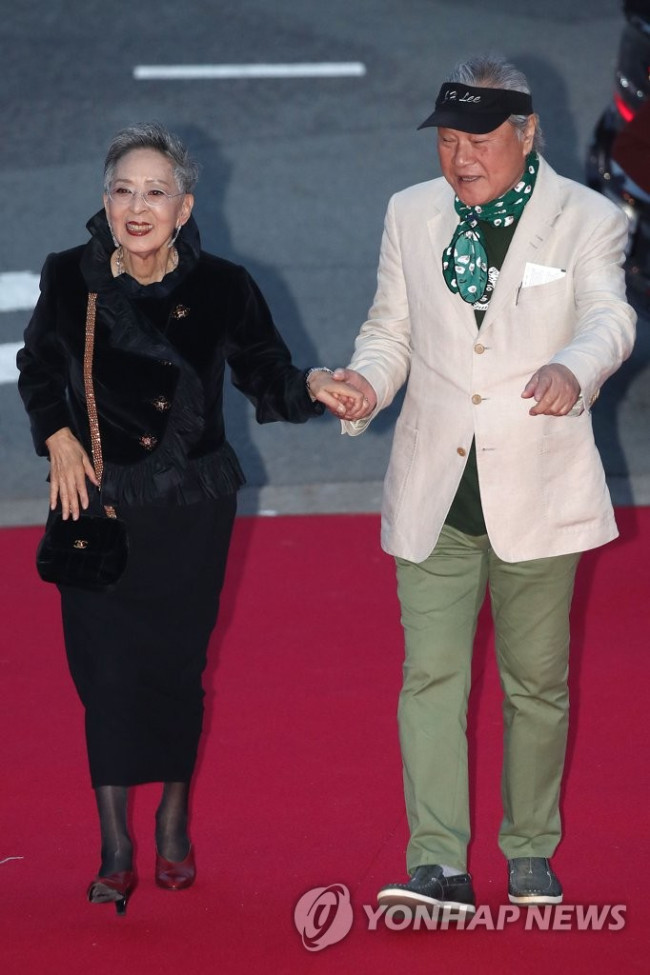 Director Lee Jang-ho and actress Kim Ji-mee walking hand-in-hand on the red carpet. Yonhap News
She also demonstrated a broad scope as an actress. Her collaborations with masters like Kim Soo-yong, Im Kwon-taek, and Kim Ki-young were opportunities to test the limits of her acting.
She received the Best Actress award at the Panama International Film Festival and the Grand Bell Awards for her role as the matriarch leading a wealthy landlord family in 'The Land' (1974, Kim Soo-yong), and the Grand Bell Awards for Best Actress for her role as a prisoner in love in 'The Promise of the Flesh' (1975, Kim Ki-young), a remake of 'Late Autumn,' thus proving her acting prowess.
'Gilsotteum' (1985, Im Kwon-taek), in which she played a middle-aged woman searching for her separated family, is considered the pinnacle of her acting. She received the Grand Bell Award for Best Actress for this film, showcasing her mature performance with her own voice rather than post-dubbing.
She was also actively involved as a producer.
After establishing her production company 'Jimi Film' in 1985, she produced seven films, including 'Ticket' (1986, Im Kwon-taek).
The number of films she appeared in is known to be around 700, including 'Myung Ja Akiko Sonya' (1992, Lee Jang-ho).
She also demonstrated her capabilities as a film administrator.
She continued her active engagement by serving as the Chairman of the Korean Film Actors Association in 1995, co-chairman of the Emergency Committee for the Defense of Screen Quotas in 1998, and a committee member of the Korean Film Council in 1999.
Considered a "powerhouse of Korean cinema," she protected the Korean film industry with her unique charisma and strong presence.
At an open talk at the Busan International Film Festival in 2019, Kim Ji-mee said, "The time is approaching my final destination as an actress and as a person. I would be grateful if you would keep me forever in your hearts, you who have given me love."
The Federation of Korean Film Actors is preparing a funeral for the film industry, organized by the association.

 Iranian Foreign Ministry: "Continuing Message Exchanges with the U.S. and Activities of Mediating Countries"
Esmaeil Baghaei, Spokesperson for the Iranian Ministry of Foreign Affairs [Xinhua, Yonhap News file photo]Esmaeil Baghaei, spokesperson for the Iranian Ministry of Foreign Affairs, stated on the 26th
Iranian Foreign Ministry: "Continuing Message Exchanges with the U.S. and Activities of Mediating Countries"
Esmaeil Baghaei, Spokesperson for the Iranian Ministry of Foreign Affairs [Xinhua, Yonhap News file photo]Esmaeil Baghaei, spokesperson for the Iranian Ministry of Foreign Affairs, stated on the 26th
 President Yoon: "Do You Think You Are Safe from the Special Counsel?"... Final Statement Video Released
President Yoon Suk Yeol rebuking the special prosecutor on the 24th. [Court video / @birds_justice X account subtitle GIF] A video of President Yoon Suk Yeol's closing statement at his trial rega
President Yoon: "Do You Think You Are Safe from the Special Counsel?"... Final Statement Video Released
President Yoon Suk Yeol rebuking the special prosecutor on the 24th. [Court video / @birds_justice X account subtitle GIF] A video of President Yoon Suk Yeol's closing statement at his trial rega
 President Yoon, regarding the first-instance ruling on the Public Official Election Act: “An excessive political verdict that distorts the facts… We will appeal immediately.”
The first-instance sentencing hearing for President Yoon Suk Yeol regarding violations of the Public Official Election Act is being broadcast live at Seoul Station on the 27th. [Photo=Yonhap News]Pres
President Yoon, regarding the first-instance ruling on the Public Official Election Act: “An excessive political verdict that distorts the facts… We will appeal immediately.”
The first-instance sentencing hearing for President Yoon Suk Yeol regarding violations of the Public Official Election Act is being broadcast live at Seoul Station on the 27th. [Photo=Yonhap News]Pres
 WSJ: "SK Hynix ADR Premium Is a Sign of AI Trading Overheat"
Advertisement for SK Hynix ADR listing in New York's Times Square [Reuters=Yonhap News file photo]The Wall Street Journal (WSJ) has pointed out that the price of SK Hynix’s American Depositary Recei
WSJ: "SK Hynix ADR Premium Is a Sign of AI Trading Overheat"
Advertisement for SK Hynix ADR listing in New York's Times Square [Reuters=Yonhap News file photo]The Wall Street Journal (WSJ) has pointed out that the price of SK Hynix’s American Depositary Recei
 'Godfather of Japanese Mystery Novels' Keigo Higashino Passes Away After Battle with Cancer at 68
Famous Japanese mystery novelist Keigo Higashino [AFP=Yonhap News]It has been belatedly reported that Keigo Higashino, the "godfather of Japanese mystery novels" and author of bestsellers such as "The
'Godfather of Japanese Mystery Novels' Keigo Higashino Passes Away After Battle with Cancer at 68
Famous Japanese mystery novelist Keigo Higashino [AFP=Yonhap News]It has been belatedly reported that Keigo Higashino, the "godfather of Japanese mystery novels" and author of bestsellers such as "The
 [Park Pil-kyu Security Column] To the Ignorant Trying to Clothe a Beast in Sheep's Clothing
Rep. Kim Byung-joo of the Democratic Party of Korea [Photo=Yonhap News]“The Air Force Academy doesn't teach you how to fly a plane!” “The Army, Navy, and Air Force academies are exactly the
[Park Pil-kyu Security Column] To the Ignorant Trying to Clothe a Beast in Sheep's Clothing
Rep. Kim Byung-joo of the Democratic Party of Korea [Photo=Yonhap News]“The Air Force Academy doesn't teach you how to fly a plane!” “The Army, Navy, and Air Force academies are exactly the
 [Issue Diagnosis] Two Effects of the Election Petition Review
 [Photo] Evidence of Election Fraud Flooding U.S. Media… Trump Had 2.7 Million Votes Stolen
 [Video] U.S. Semiquincentennial Air Show... 'Art in the Sky' streaks across New York
 [Editorial Cartoon] A Draconian Law That Undermines Freedom of Expression

 List
List










