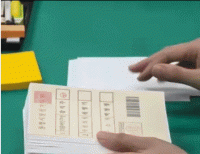
선거는 국민 주권이 가장 집약적으로 발현되는 순간입니다. 그러나 그 과정을 감시하고 확인할 수 없다면, 선거는 신뢰를 잃습니다. OBBBA는 미국 연방 차원에서 처음으로 ‘시민·정당·민간의 삼각 감시 체계’를 제도화했습니다. 이번 편에서는 ‘감시 없는 투표’가 가져올 제도 위기를 진단합니다.<편집자 주>
 Jang Dong-hyuk, a lawmaker from the People Power Party, answers questions from reporters after announcing his candidacy for party leader at the National Assembly Museum in Yeouido, Seoul on the 23rd. Yonhap News
Table of Contents
1. The Shadow of Elections Targeted by Trump's 'OBBBA Act'
2. Why Election Manipulation Was Not Punished
3. 'Unsupervised Technology' is the Enemy of Democracy
4. Whose Responsibility is Election Monitoring?
5. South Korea, Redesign Your Electoral System
The 2020 US presidential election went beyond mere controversy over the results to pose fundamental questions about the very authority for 'election monitoring'.
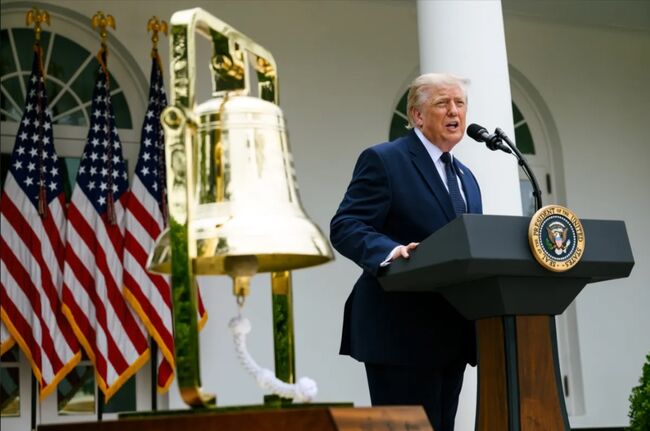
Who can monitor vote counting, and is that monitoring legally protected? Former President Trump, with this awareness, stipulated the 'institutionalization of private monitoring systems' through the OBBBA (One Big Beautiful Bill Act), signed in July 2025.
This was not only a technical reform (limiting electronic counting machines, principle of manual counting, etc.) but also a measure that acknowledged and institutionalized the fact that the final line of defense in elections is ultimately 'people'.
"Observation is not a right, but a duty"
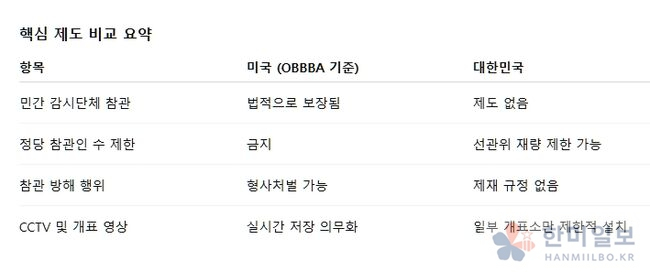
The OBBBA includes the following key provisions:
△ Prohibition of limiting the number of party observers within the counting stations
△ Guarantee of registration and observation for non-profit private monitoring organizations
△ Obligation to install CCTV within counting stations and to save video in real-time
△ Application of 'election obstruction crime' for interference with observation
This is the first legislation at the federal level in the United States to codify 'citizen monitoring' as a constitutional right and a practical obligation. The Trump camp emphasized the need for 'authorized observation,' stating, "Machines are not supervised. Only people can observe and verify."
Korea's Reality: 'Guilty Without Authority'
In contrast, Korea's observation system exists only in name, lacking substantive authority.
The following issues have been repeated during the general and presidential elections in 2022 and 2024:
△ Cases where party observers were investigated for 'damage' after attempting to check the status of ballot boxes or apply seals
△ The Election Commission arbitrarily restricted the position, number, and time of observers at counting stations
△ Private observation is disallowed due to a lack of legal basis... Access to counting stations is denied without the Election Commission's permission
Article 161 of the Public Official Election Act stipulates the authority of observers, but in practice, they are arbitrarily restricted under the guise of "the Election Commission's policy." There have been cases where observers attempting to observe were treated as obstructors, and those who recorded evidence were expelled.
The Difference Between 'Obstruction of Observation Crime' and 'Authority to Regulate Observation'
The OBBBA designates political parties, private entities, and citizens within counting stations as equal monitoring entities and establishes criminal penalties for interference with them.
However, in Korea, there are no separate legal sanctions even if observers are restricted or expelled. Instead, the system is institutionally tolerated where the Election Commission can expel observers under the pretext of 'maintaining order.' This is a dangerous distortion that transforms 'observers' into 'obstructors.'
Election Monitoring is an Exercise of Sovereignty
Article 1, Clause 2 of the Constitution declares, "The sovereignty of the Republic of Korea resides in the people, and all state authority emanates from the people." However, on election sites, the people remain mere spectators, not observers.
△ Inability to verify the movement of ballots
△ Restriction on photographing the sealed status of early voting ballot boxes
△ Fear of repercussions for raising objections on election day
The OBBBA elevated observation from a 'permitted right' to a 'citizen's duty.'
To the question of who are the monitors of the electoral system, Korea has yet to provide an answer.
Next Episode Preview
〈Part 5〉 South Korea, Redesign Your Electoral System... The Final Question Posed by OBBBA
What should we change? What are the minimum conditions for restoring institutional trust? We explore the redesign of South Korea's electoral system.
#OBBBA #ElectionMonitoring #ObserverSystem #ElectionReform #CitizenParticipation #PrivateMonitoring #TruthOfTheBallotBox #HanmiIlbo #TransparentElections #GuiltyWithoutAuthority

 Trump pressures for rate cut again ahead of FOMC... "Should be the lowest in the world"
U.S. President Donald Trump. [Photo = The White House] U.S. President Donald Trump once again pressured the Federal Reserve, the U.S. central bank, to lower interest rates on the 27th (local time
Trump pressures for rate cut again ahead of FOMC... "Should be the lowest in the world"
U.S. President Donald Trump. [Photo = The White House] U.S. President Donald Trump once again pressured the Federal Reserve, the U.S. central bank, to lower interest rates on the 27th (local time
 “Ignoring crisp ballots and damaged seals”… Tongyeong mayoral recount concludes with ‘no change in outcome,’ leaving suspicions and public outrage behind
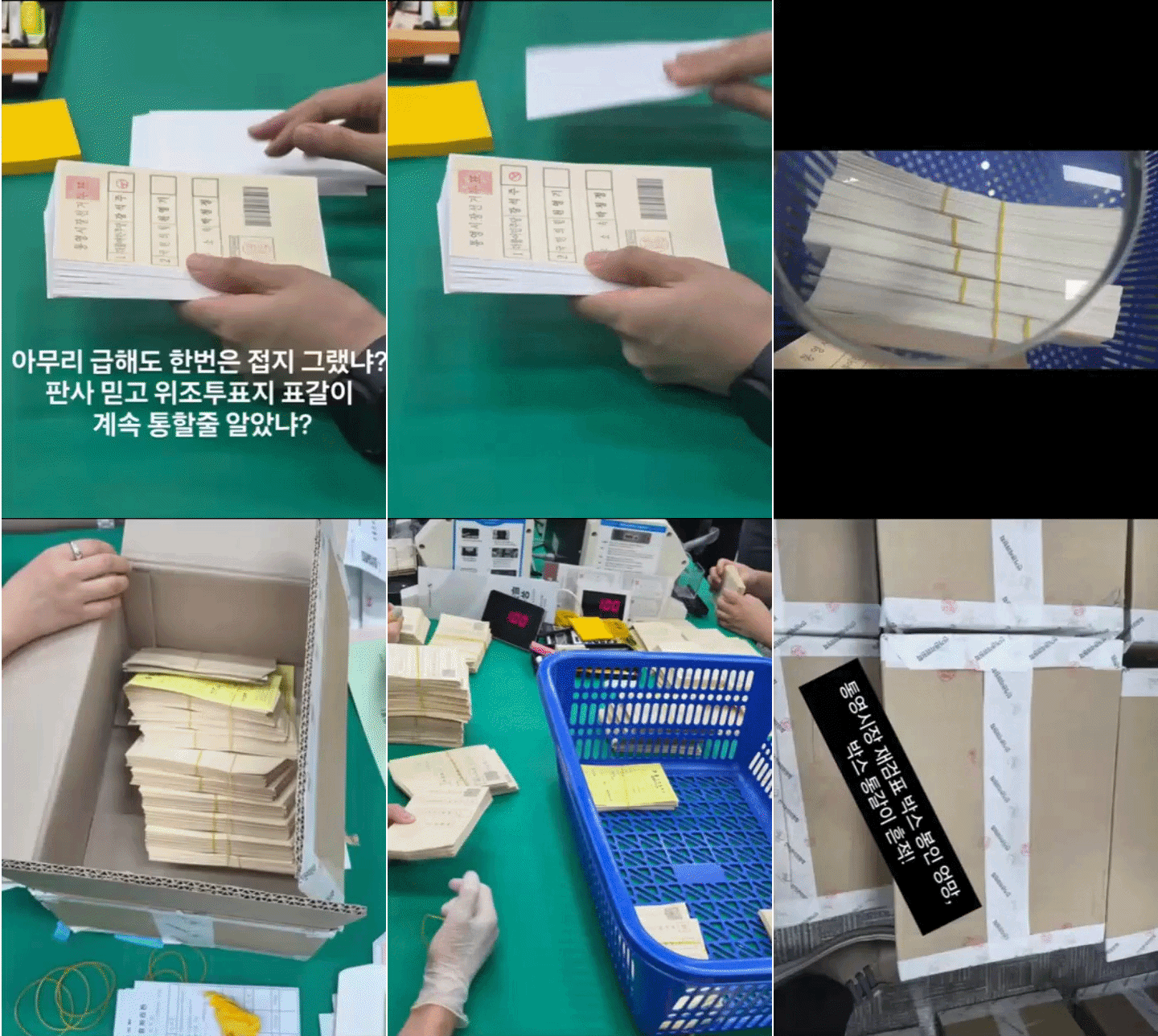
Suspected counterfeit ballots discovered in Tongyeong [GIF from social media of Representative Hwang Kyo-ahn / Attorney Park Joo-hyun]During a recount of the Tongyeong mayoral election in South Gyeong
“Ignoring crisp ballots and damaged seals”… Tongyeong mayoral recount concludes with ‘no change in outcome,’ leaving suspicions and public outrage behind
Suspected counterfeit ballots discovered in Tongyeong [GIF from social media of Representative Hwang Kyo-ahn / Attorney Park Joo-hyun]During a recount of the Tongyeong mayoral election in South Gyeong
 President Yoon, regarding the first-instance ruling on the Public Official Election Act: “An excessive political verdict that distorts the facts… We will appeal immediately.”
The first-instance sentencing hearing for President Yoon Suk Yeol regarding violations of the Public Official Election Act is being broadcast live at Seoul Station on the 27th. [Photo=Yonhap News]Pres
President Yoon, regarding the first-instance ruling on the Public Official Election Act: “An excessive political verdict that distorts the facts… We will appeal immediately.”
The first-instance sentencing hearing for President Yoon Suk Yeol regarding violations of the Public Official Election Act is being broadcast live at Seoul Station on the 27th. [Photo=Yonhap News]Pres
 WSJ: "SK Hynix ADR Premium Is a Sign of AI Trading Overheat"
Advertisement for SK Hynix ADR listing in New York's Times Square [Reuters=Yonhap News file photo]The Wall Street Journal (WSJ) has pointed out that the price of SK Hynix’s American Depositary Recei
WSJ: "SK Hynix ADR Premium Is a Sign of AI Trading Overheat"
Advertisement for SK Hynix ADR listing in New York's Times Square [Reuters=Yonhap News file photo]The Wall Street Journal (WSJ) has pointed out that the price of SK Hynix’s American Depositary Recei
 'Godfather of Japanese Mystery Novels' Keigo Higashino Passes Away After Battle with Cancer at 68
Famous Japanese mystery novelist Keigo Higashino [AFP=Yonhap News]It has been belatedly reported that Keigo Higashino, the "godfather of Japanese mystery novels" and author of bestsellers such as "The
'Godfather of Japanese Mystery Novels' Keigo Higashino Passes Away After Battle with Cancer at 68
Famous Japanese mystery novelist Keigo Higashino [AFP=Yonhap News]It has been belatedly reported that Keigo Higashino, the "godfather of Japanese mystery novels" and author of bestsellers such as "The
 [Park Pil-kyu Security Column] To the Ignorant Trying to Clothe a Beast in Sheep's Clothing
Rep. Kim Byung-joo of the Democratic Party of Korea [Photo=Yonhap News]“The Air Force Academy doesn't teach you how to fly a plane!” “The Army, Navy, and Air Force academies are exactly the
[Park Pil-kyu Security Column] To the Ignorant Trying to Clothe a Beast in Sheep's Clothing
Rep. Kim Byung-joo of the Democratic Party of Korea [Photo=Yonhap News]“The Air Force Academy doesn't teach you how to fly a plane!” “The Army, Navy, and Air Force academies are exactly the
 [Issue Diagnosis] Two Effects of the Election Petition Review
 [Photo] Evidence of Election Fraud Flooding U.S. Media… Trump Had 2.7 Million Votes Stolen
 [Video] U.S. Semiquincentennial Air Show... 'Art in the Sky' streaks across New York
 [Editorial Cartoon] A Draconian Law That Undermines Freedom of Expression

 List
List