 This photo of U.S. President Donald Trump speaking with Ryosei Akazawa, Japan’s Minister of Economic Revitalization and chief trade negotiator, in the Oval Office was posted to X by White House Deputy Chief of Staff Dan Scavino on the 22nd (local time), the day President Trump announced the trade agreement with Japan. Yonhap News
It has been revealed that U.S. President Donald Trump intervened personally in the final stages of U.S.-Japan trade negotiations to force Japan to significantly increase its proposed investments in the U.S. in exchange for tariff reductions.
A photo posted to X (formerly Twitter) by White House Deputy Chief of Staff Dan Scavino on the 22nd (local time) shows President Trump in the Oval Office speaking with Ryosei Akazawa, Japan’s Minister of Economic Revitalization and head of tariff negotiations.
On the desk in front of President Trump sits a document titled "Japan Invest America," in which the figure of $400 billion appears to have been crossed out and replaced with a handwritten "$500 billion."
It is presumed that while Japan initially proposed $400 billion in investments in the U.S., President Trump, upon being briefed, modified the figure to $500 billion on the spot.
In a post on social media the previous day announcing the trade deal with Japan, President Trump stated that Japan had agreed to invest $550 billion in the U.S. and that the U.S. would capture 90% of the profits from these investments.
The document in the photo shows a profit-sharing ratio of 50%, not 90%, suggesting that President Trump may have changed this figure as well.
The document also contains the line, "10% tariff, and 15% on automobiles, pharmaceuticals, and semiconductors," with what appears to be a handwritten "20%" noted above pharmaceuticals and semiconductors.
According to announcements from both countries so far, the U.S. has agreed to lower the reciprocal tariff on Japan from 25% to 15%, and to reduce the 25% tariff on automobiles—which includes the existing 2.5% tariff—to 15%.
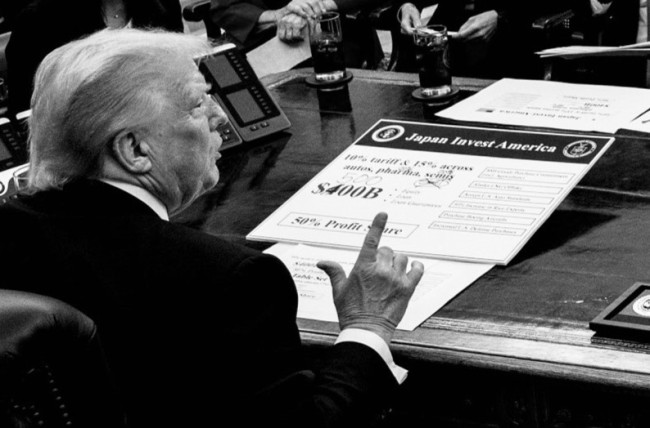 This photo of U.S. President Donald Trump speaking with Ryosei Akazawa, Japan’s Minister of Economic Revitalization and chief trade negotiator, in the Oval Office was posted to X by White House Deputy Chief of Staff Dan Scavino on the 22nd (local time), the day the trade agreement with Japan was announced. The document in the photo shows where $400 billion, the amount Japan proposed to invest in the U.S., was crossed out and replaced with a handwritten $500 billion. Yonhap News
Taken together, the official announcements and the document in the photo suggest that after being briefed on the agreements reached at the ministerial level, President Trump pressured Japan for greater concessions.
The Oval Office photo shows U.S. officials including Treasury Secretary Scott Bessent, Commerce Secretary Howard Lutnick, Secretary of State Marco Rubio, and White House Deputy Chief of Staff for Policy Stephen Miller in attendance, while Japanese Ambassador to the U.S. Shigeo Yamada is visible on the Japanese side.
President Trump had previously made an unscheduled call to meet with Minister Akazawa at the White House on April 16, when the latter visited the U.S. for trade talks.
In an interview with Bloomberg TV on the 23rd, Treasury Secretary Bessent stated, "President Trump brought the Japanese trade delegation into the Oval Office for an extensive negotiation. Japan was a tough negotiator, but President Trump was stronger."
Secretary Bessent noted, "It is very important to note that the 15% reciprocal tariff and 15% auto tariff for Japan are a different kind of deal. That is because Japan proposed a very innovative solution."
He explained, "Japan proposed an idea called the Japan-U.S. Partnership, where Japan provides capital, credit guarantees, and funding for major projects within the U.S. Japan was willing to provide this innovative financial mechanism, which is why they received the 15% rate."
Considering this explanation, Japan's commitment to invest a staggering $550 billion in the U.S. appears to have been the decisive factor in reaching the agreement. This $550 billion figure is nearly eight times Japan's $69 billion trade surplus with the U.S. last year.
Secretary Bessent stated that the $550 billion consists entirely of new investments rather than existing ones, and is planned to be directed toward strategic industries such as semiconductors and pharmaceuticals to strengthen U.S. supply chains.
When asked if the European Union (EU) or other countries could receive tariff rates lower than 15%, he replied, "The 15% is the result of a very innovative package proposed by Japan, and President Trump could have pressured Japan to do even more."
Asked if there were any innovative proposals from the EU, he said, "Not yet. But the conversations are going better than they were before."
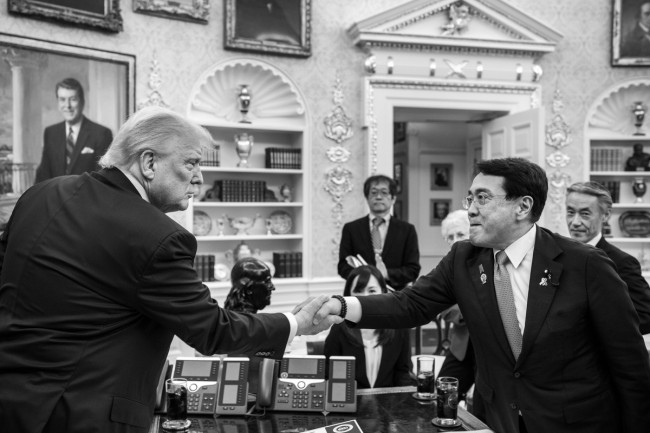 This photo of U.S. President Donald Trump shaking hands with Ryosei Akazawa, Japan’s Minister of Economic Revitalization and chief trade negotiator, in the Oval Office was posted to X by White House Deputy Chief of Staff Dan Scavino on the 22nd (local time), the day the trade agreement with Japan was announced.
Yonhap News

 Iranian Foreign Ministry: "Continuing Message Exchanges with the U.S. and Activities of Mediating Countries"
Esmaeil Baghaei, Spokesperson for the Iranian Ministry of Foreign Affairs [Xinhua, Yonhap News file photo]Esmaeil Baghaei, spokesperson for the Iranian Ministry of Foreign Affairs, stated on the 26th
Iranian Foreign Ministry: "Continuing Message Exchanges with the U.S. and Activities of Mediating Countries"
Esmaeil Baghaei, Spokesperson for the Iranian Ministry of Foreign Affairs [Xinhua, Yonhap News file photo]Esmaeil Baghaei, spokesperson for the Iranian Ministry of Foreign Affairs, stated on the 26th
 President Yoon: "Do You Think You Are Safe from the Special Counsel?"... Final Statement Video Released
President Yoon Suk Yeol rebuking the special prosecutor on the 24th. [Court video / @birds_justice X account subtitle GIF] A video of President Yoon Suk Yeol's closing statement at his trial rega
President Yoon: "Do You Think You Are Safe from the Special Counsel?"... Final Statement Video Released
President Yoon Suk Yeol rebuking the special prosecutor on the 24th. [Court video / @birds_justice X account subtitle GIF] A video of President Yoon Suk Yeol's closing statement at his trial rega
 President Yoon, regarding the first-instance ruling on the Public Official Election Act: “An excessive political verdict that distorts the facts… We will appeal immediately.”
The first-instance sentencing hearing for President Yoon Suk Yeol regarding violations of the Public Official Election Act is being broadcast live at Seoul Station on the 27th. [Photo=Yonhap News]Pres
President Yoon, regarding the first-instance ruling on the Public Official Election Act: “An excessive political verdict that distorts the facts… We will appeal immediately.”
The first-instance sentencing hearing for President Yoon Suk Yeol regarding violations of the Public Official Election Act is being broadcast live at Seoul Station on the 27th. [Photo=Yonhap News]Pres
 WSJ: "SK Hynix ADR Premium Is a Sign of AI Trading Overheat"
Advertisement for SK Hynix ADR listing in New York's Times Square [Reuters=Yonhap News file photo]The Wall Street Journal (WSJ) has pointed out that the price of SK Hynix’s American Depositary Recei
WSJ: "SK Hynix ADR Premium Is a Sign of AI Trading Overheat"
Advertisement for SK Hynix ADR listing in New York's Times Square [Reuters=Yonhap News file photo]The Wall Street Journal (WSJ) has pointed out that the price of SK Hynix’s American Depositary Recei
 'Godfather of Japanese Mystery Novels' Keigo Higashino Passes Away After Battle with Cancer at 68
Famous Japanese mystery novelist Keigo Higashino [AFP=Yonhap News]It has been belatedly reported that Keigo Higashino, the "godfather of Japanese mystery novels" and author of bestsellers such as "The
'Godfather of Japanese Mystery Novels' Keigo Higashino Passes Away After Battle with Cancer at 68
Famous Japanese mystery novelist Keigo Higashino [AFP=Yonhap News]It has been belatedly reported that Keigo Higashino, the "godfather of Japanese mystery novels" and author of bestsellers such as "The
 [Park Pil-kyu Security Column] To the Ignorant Trying to Clothe a Beast in Sheep's Clothing
Rep. Kim Byung-joo of the Democratic Party of Korea [Photo=Yonhap News]“The Air Force Academy doesn't teach you how to fly a plane!” “The Army, Navy, and Air Force academies are exactly the
[Park Pil-kyu Security Column] To the Ignorant Trying to Clothe a Beast in Sheep's Clothing
Rep. Kim Byung-joo of the Democratic Party of Korea [Photo=Yonhap News]“The Air Force Academy doesn't teach you how to fly a plane!” “The Army, Navy, and Air Force academies are exactly the
 [Issue Diagnosis] Two Effects of the Election Petition Review
 [Photo] Evidence of Election Fraud Flooding U.S. Media… Trump Had 2.7 Million Votes Stolen
 [Video] U.S. Semiquincentennial Air Show... 'Art in the Sky' streaks across New York
 [Editorial Cartoon] A Draconian Law That Undermines Freedom of Expression

 List
List









