 The Jo Hae-young House was called the 'Twelve-Gate House' because it had 12 main gates.
Iksan, Jeollabuk-do, is known as one of the four ancient capitals, along with Gyeongju, Buyeo, and Gongju.
Korea designates and fosters/protects its former capitals that served as centers of politics and culture as 'Ancient Capitals of Korea.'
Iksan, an ancient capital of Korea, is famous for UNESCO World Heritage sites such as the Wanggungri Ruins and Mireuksa Temple Site, but recently it has been gaining attention as a healing travel destination, riding the wellness trend. Iksan, a city imbued with royal dignity, is a place where one can find rest for body and mind simply by staying there.
'Hamra Village', Heo Gyun's Place of Exile
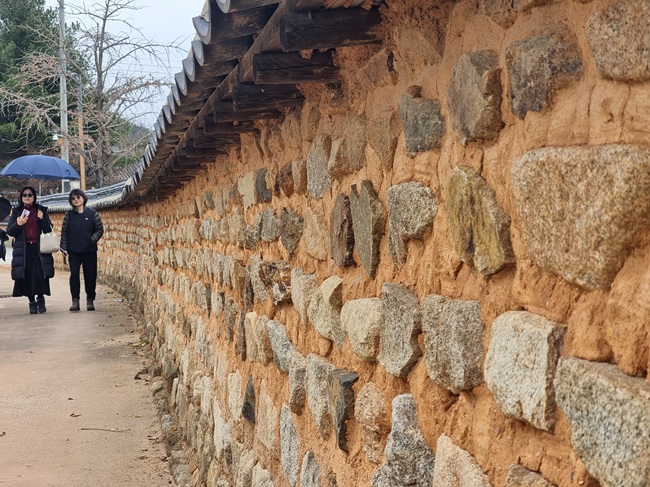 The specialty of Iksan's Hamra Village: earthen stone walls.
Iksan's Hamra Village is known as the place of exile for Heo Gyun, a literary figure of the Joseon Dynasty. In 1610, during the reign of King Gwanghae, Heo Gyun was impeached for allegedly unfairly passing his nephew and son-in-law while serving as Daedokgwan (chief examiner) and was exiled to Hamra (then Hamyeol) at the age of 43.
During his exile, which lasted until 1612, Heo Gyun compiled 64 volumes of his collected writings, "Seongso Bubugo," authored the Hangeul novel "The Tale of Hong Gildong," and wrote "Domun Daejak" (屠門大嚼), a culinary critique introducing dishes from all over the country.
"Domun Daejak" means 'smacking one's lips while imagining desired food.' Today, in Hamra Village, the 'Hamra Hanok Experience Center' allows visitors to glimpse Heo Gyun's footsteps and culinary world while enjoying a lodging experience.
Kim Byeong-sun, Yi Bae-won, and Jo Hae-young: The Three Wealthy Families of Iksan
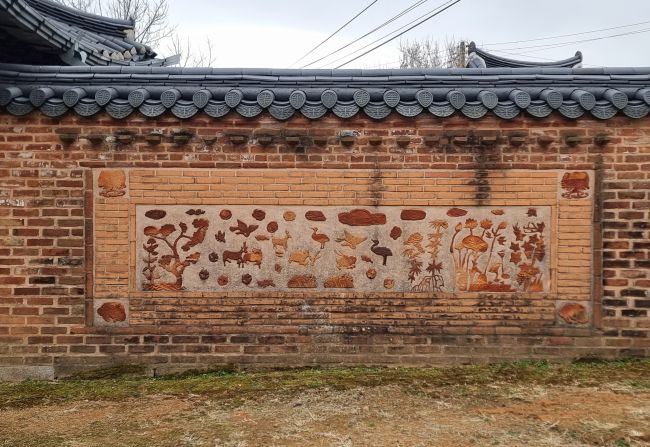 The Jo Hae-young House features a 'kkotdam' (flower wall) decorated with motifs of the ten symbols of longevity, such as cranes, deer, clouds, and lotus flowers, separating the inner and outer quarters.
In the early 1900s, long after Heo Gyun's exile, three extremely wealthy individuals—Kim Byeong-sun, Yi Bae-won, and Jo Hae-young—lived in Hamra Village. Considering the scarcity of rice during that era, a 'mansekkun' (a person who harvested over 10,000 'seok' of rice) was equivalent to a modern-day billionaire. Each household of tenant farmers numbered about 540.
They not only accumulated wealth but also were known for their immense generosity to their neighbors, to the extent that the saying 'kindness is in Hamyeol' originated. During times of famine, they opened their granaries to distribute grain to the starving. The three families even competed with each other, and if news spread about one having distributed 'X seok,' the others would strive to distribute even more.
Furthermore, the three wealthy families engaged in a spirited, benevolent competition to feed travelers. If one house was known for grilling croaker fish, the next would offer grilled meat, demonstrating fierce yet friendly rivalry.
Among the residences of these three affluent families, only the Jo Hae-young House is currently open to the public. This house is exceptionally large. It was known as the 'Twelve-Gate House' because it had 12 main gates.
Given that each gate typically requires at least one building to support it, one can only imagine the sheer size of the estate from its name alone. The main gate was so wide that tanks could pass through it during the Korean War.
The Jo Hae-young House, a beautiful fusion of a traditional Korean house built with white magnolias and red red pine, is renowned as a picturesque spot, especially in spring. In summer, crape myrtles bloom, and there is also a Japanese-style annex in the backyard.
Additionally, it features stained glass in its doors, a rarity in the 1920s, and a 'kkotdam' (flower wall) adorned with motifs of the ten symbols of longevity—cranes, deer, clouds, and lotus flowers—separating the inner and outer quarters. This house has been designated as a 'Beautiful Traditional Garden' by the Korea Forest Service.
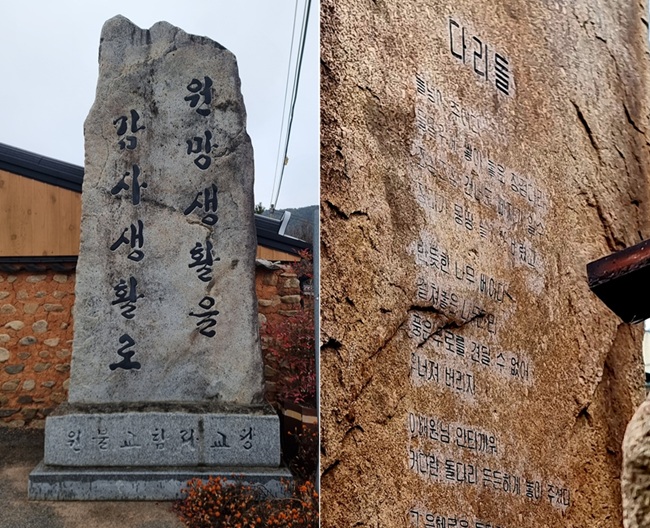 The standing stone of the Won Buddhism Hamra Shrine, placed at the entrance of the Hanok, was originally a bridge stone over a stream in front of the house.
The Yi Bae-won House, currently used as the Won Buddhism Hamra Shrine, is not normally open to the public, but the press was given a tour. An impressive feature was the door made of assembled stained glass, a luxury during the Japanese colonial period when glass was scarce. Etch marks remain on the glass, offering a unique sight.
The standing stone of the Won Buddhism Hamra Shrine, placed at the entrance of the Hanok, was originally a bridge stone over a stream in front of the house. The words 'bridge stone' are indeed engraved on the back of the standing stone.
The last house visited was the Kim Byeong-sun (1894-1936) old house, the largest Hanok in Iksan. It is also known as the Kim An-gyun Old House, named after his son. Built in the 1920s, this house maintained the traditional Hanok style while actively incorporating modern architectural techniques and materials such as glass sliding doors and tin awnings.
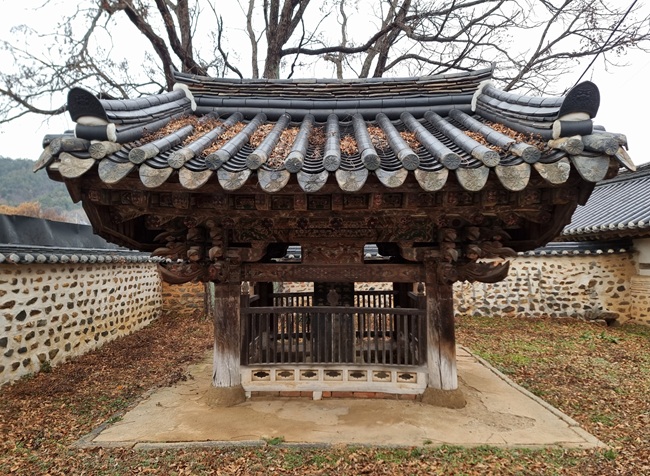 The Jeongnyeogak at the Kim Byeong-sun Old House, the largest Hanok in Iksan. The Jeongnyeogak is a structure bestowed by the state to honor the filial piety of Kim Byeong-sun's grandfather, Kim Gi-hyeong.
Wanggung Good Farmers: An Experiential Farm
Wanggung Good Farmers at Milsaek Healing Farm in Wanggung-myeon, Iksan-si, is an experiential farm located alongside Wanggung Reservoir. It cultivates and distributes various food crops, including wheat sprouts.
While wheat is typically sown in December and sprouts in February, this farm produces wheat sprouts 365 days a year. By storing wheat in a cold storage and sowing it in soil in greenhouses, fresh sprouts can be harvested anytime.
The farm is divided into an outdoor farm cultivating blueberries, greenhouses producing wheat sprouts and fresh vegetables, and a cafe for tea and meals. The cafe offers soy milk made with wheat sprouts and sells freeze-dried wheat sprout powder.
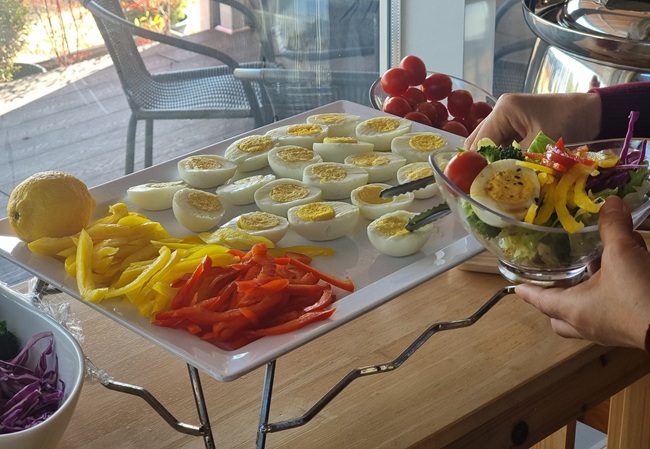 Wanggung Good Farmers at Milsaek Healing Farm in Wanggung-myeon, Iksan-si, is an experiential farm located alongside Wanggung Reservoir, where visitors can enjoy healthy meals at the cafe.
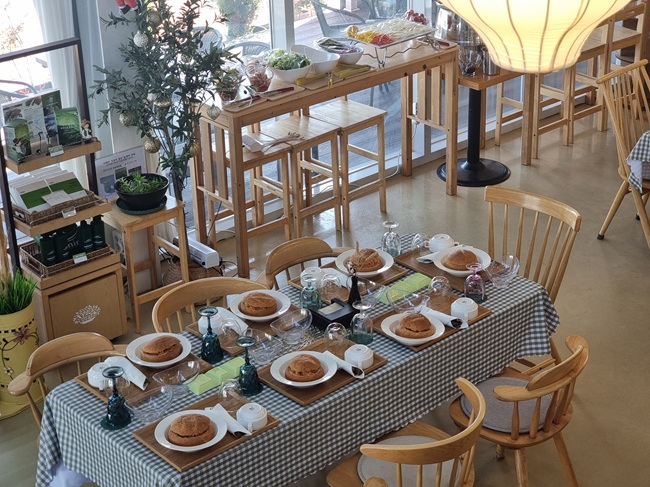 The cafe at Wanggung Good Farmers at Milsaek Healing Farm in Wanggung-myeon, Iksan-si.
On the second floor of the cafe building, there is a tea bag making experience using wheat sprouts. Making wheat sprout tea involves a process comparable to making green tea. After harvesting young wheat sprouts, they undergo a sterilization process in a cauldron, followed by a hand-rolling process, and then moved to a drying room. The finished tea reduces to one-tenth of its original volume.
While green tea pairs well with brown rice, wheat sprouts are a perfect match with barley. Each disposable tea bag contains 0.5g of dried wheat sprouts and a teaspoon of barley. The tea bags are made from corn starch, so there is no need to worry about harmful substances.
Wheat sprouts are known for their potent antioxidant properties, rich in vitamins, minerals, and amino acids, and have benefits for liver detoxification. Recently, they have shown remarkable effectiveness in blood sugar regulation and are widely consumed in the form of juices and teas.
Text and photos by Reporter Lim Yo-hee

 Iranian Foreign Ministry: "Continuing Message Exchanges with the U.S. and Activities of Mediating Countries"
Esmaeil Baghaei, Spokesperson for the Iranian Ministry of Foreign Affairs [Xinhua, Yonhap News file photo]Esmaeil Baghaei, spokesperson for the Iranian Ministry of Foreign Affairs, stated on the 26th
Iranian Foreign Ministry: "Continuing Message Exchanges with the U.S. and Activities of Mediating Countries"
Esmaeil Baghaei, Spokesperson for the Iranian Ministry of Foreign Affairs [Xinhua, Yonhap News file photo]Esmaeil Baghaei, spokesperson for the Iranian Ministry of Foreign Affairs, stated on the 26th
 President Yoon: "Do You Think You Are Safe from the Special Counsel?"... Final Statement Video Released
President Yoon Suk Yeol rebuking the special prosecutor on the 24th. [Court video / @birds_justice X account subtitle GIF] A video of President Yoon Suk Yeol's closing statement at his trial rega
President Yoon: "Do You Think You Are Safe from the Special Counsel?"... Final Statement Video Released
President Yoon Suk Yeol rebuking the special prosecutor on the 24th. [Court video / @birds_justice X account subtitle GIF] A video of President Yoon Suk Yeol's closing statement at his trial rega
 President Yoon, regarding the first-instance ruling on the Public Official Election Act: “An excessive political verdict that distorts the facts… We will appeal immediately.”
The first-instance sentencing hearing for President Yoon Suk Yeol regarding violations of the Public Official Election Act is being broadcast live at Seoul Station on the 27th. [Photo=Yonhap News]Pres
President Yoon, regarding the first-instance ruling on the Public Official Election Act: “An excessive political verdict that distorts the facts… We will appeal immediately.”
The first-instance sentencing hearing for President Yoon Suk Yeol regarding violations of the Public Official Election Act is being broadcast live at Seoul Station on the 27th. [Photo=Yonhap News]Pres
 WSJ: "SK Hynix ADR Premium Is a Sign of AI Trading Overheat"
Advertisement for SK Hynix ADR listing in New York's Times Square [Reuters=Yonhap News file photo]The Wall Street Journal (WSJ) has pointed out that the price of SK Hynix’s American Depositary Recei
WSJ: "SK Hynix ADR Premium Is a Sign of AI Trading Overheat"
Advertisement for SK Hynix ADR listing in New York's Times Square [Reuters=Yonhap News file photo]The Wall Street Journal (WSJ) has pointed out that the price of SK Hynix’s American Depositary Recei
 'Godfather of Japanese Mystery Novels' Keigo Higashino Passes Away After Battle with Cancer at 68
Famous Japanese mystery novelist Keigo Higashino [AFP=Yonhap News]It has been belatedly reported that Keigo Higashino, the "godfather of Japanese mystery novels" and author of bestsellers such as "The
'Godfather of Japanese Mystery Novels' Keigo Higashino Passes Away After Battle with Cancer at 68
Famous Japanese mystery novelist Keigo Higashino [AFP=Yonhap News]It has been belatedly reported that Keigo Higashino, the "godfather of Japanese mystery novels" and author of bestsellers such as "The
 [Park Pil-kyu Security Column] To the Ignorant Trying to Clothe a Beast in Sheep's Clothing
Rep. Kim Byung-joo of the Democratic Party of Korea [Photo=Yonhap News]“The Air Force Academy doesn't teach you how to fly a plane!” “The Army, Navy, and Air Force academies are exactly the
[Park Pil-kyu Security Column] To the Ignorant Trying to Clothe a Beast in Sheep's Clothing
Rep. Kim Byung-joo of the Democratic Party of Korea [Photo=Yonhap News]“The Air Force Academy doesn't teach you how to fly a plane!” “The Army, Navy, and Air Force academies are exactly the
 [Issue Diagnosis] Two Effects of the Election Petition Review
 [Photo] Evidence of Election Fraud Flooding U.S. Media… Trump Had 2.7 Million Votes Stolen
 [Video] U.S. Semiquincentennial Air Show... 'Art in the Sky' streaks across New York
 [Editorial Cartoon] A Draconian Law That Undermines Freedom of Expression

 List
List









