 Steel products piled up at Pyeongtaek Port. Yonhap News
Concerns are rising for Korean companies as U.S. businesses are requesting the Trump administration to significantly expand the list of products subject to the 50% steel and aluminum tariffs.
Notably, U.S. companies are indiscriminately requesting tariffs on products that use little to no steel or aluminum, and this includes key Korean export items such as battery components and transformers.
According to foreign media reports on the 22nd (local time), the Aluminum Association of America requested that battery parts (parts of electric storage batteries) be classified as aluminum derivative products.
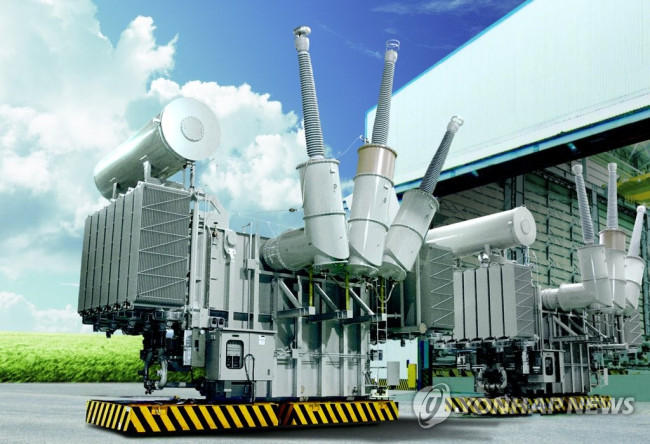 A transformer from HD Hyundai Electric. Courtesy of HD Hyundai
The Trump administration is imposing a 50% tariff on steel and aluminum, as well as on derivative products made from steel and aluminum, based on the value of their steel and aluminum content.
The Aluminum Association's request means that a 50% tariff would be applied to battery components based on their aluminum content.
In response, Samsung SDI submitted a dissenting opinion to the Department of Commerce on October 21st.
The reason cited was that the Aluminum Association's request is too broad and could encompass various types of batteries and related products, which contain little to no aluminum or steel.
Samsung SDI explained that battery components include separators, which do not use aluminum or steel, and that even completed battery cells are frequently imported under the specified product codes.
Furthermore, they argued that applying the steel and aluminum tariffs to battery components, which are already subject to a 25% tariff as automotive parts, would lead to double taxation and exacerbate the administrative burden for battery manufacturers.
U.S. companies have also requested that transformers be designated as steel and aluminum derivative products.
While some transformers were included in the additional list of 407 derivative products announced by the Department of Commerce in August, U.S. companies are now requesting tariffs on a wider range of transformers.
LS Electric stated that designating grain-oriented electrical steel (GOES), used in the manufacturing of transformers essential for the U.S. artificial intelligence (AI), data center, and renewable energy industries, as a derivative product would worsen the already severe transformer supply shortage and harm the U.S. economy.
In its opinion submitted to the Department of Commerce, LS Electric emphasized, "Imports from allies like South Korea provide a reliable and secure alternative to Chinese supply, directly supporting the U.S. policy objective of de-risking and reducing reliance on adversarial sources."
HD Hyundai Electric also argued in its submission that applying item-specific tariffs to transformers would deepen supply shortages, delay energy infrastructure projects, disrupt defense and public facilities, and exacerbate national security risks.
The Trump administration has established a procedure for adding products to the list of steel and aluminum derivative products and periodically solicits feedback from U.S. businesses.
After receiving industry requests for the first time in May, the Department of Commerce included home appliances such as refrigerators, dryers, washing machines, dishwashers, freezers, cooking stoves, ranges, ovens, and garbage disposals in the list of steel derivative products.
In this regard, LG Electronics pointed out that the expansion of the derivative product list seems to deviate from its original purpose and that a continued expansion of tariff targets could impose excessive and significant economic and administrative burdens on downstream manufacturers who rely on imports of such derivative products to produce finished goods in the U.S.
LG Electronics requested a review of whether home appliances and other items need to be excluded from the list, stating that the amount of steel and aluminum used in home appliance manufacturing is very small and does not pose a meaningful threat to U.S. security interests.
The Department of Commerce initiated its second round of public comment in September but has not yet announced any items to be added to the derivative product list.
The industry harbors cautious optimism that the Department of Commerce may be approaching the second expansion more carefully, given the significant industry confusion and economic repercussions caused by the inclusion of too many items in the first list expansion.

 Iranian Foreign Ministry: "Continuing Message Exchanges with the U.S. and Activities of Mediating Countries"
Esmaeil Baghaei, Spokesperson for the Iranian Ministry of Foreign Affairs [Xinhua, Yonhap News file photo]Esmaeil Baghaei, spokesperson for the Iranian Ministry of Foreign Affairs, stated on the 26th
Iranian Foreign Ministry: "Continuing Message Exchanges with the U.S. and Activities of Mediating Countries"
Esmaeil Baghaei, Spokesperson for the Iranian Ministry of Foreign Affairs [Xinhua, Yonhap News file photo]Esmaeil Baghaei, spokesperson for the Iranian Ministry of Foreign Affairs, stated on the 26th
 President Yoon: "Do You Think You Are Safe from the Special Counsel?"... Final Statement Video Released
President Yoon Suk Yeol rebuking the special prosecutor on the 24th. [Court video / @birds_justice X account subtitle GIF] A video of President Yoon Suk Yeol's closing statement at his trial rega
President Yoon: "Do You Think You Are Safe from the Special Counsel?"... Final Statement Video Released
President Yoon Suk Yeol rebuking the special prosecutor on the 24th. [Court video / @birds_justice X account subtitle GIF] A video of President Yoon Suk Yeol's closing statement at his trial rega
 President Yoon, regarding the first-instance ruling on the Public Official Election Act: “An excessive political verdict that distorts the facts… We will appeal immediately.”
The first-instance sentencing hearing for President Yoon Suk Yeol regarding violations of the Public Official Election Act is being broadcast live at Seoul Station on the 27th. [Photo=Yonhap News]Pres
President Yoon, regarding the first-instance ruling on the Public Official Election Act: “An excessive political verdict that distorts the facts… We will appeal immediately.”
The first-instance sentencing hearing for President Yoon Suk Yeol regarding violations of the Public Official Election Act is being broadcast live at Seoul Station on the 27th. [Photo=Yonhap News]Pres
 WSJ: "SK Hynix ADR Premium Is a Sign of AI Trading Overheat"
Advertisement for SK Hynix ADR listing in New York's Times Square [Reuters=Yonhap News file photo]The Wall Street Journal (WSJ) has pointed out that the price of SK Hynix’s American Depositary Recei
WSJ: "SK Hynix ADR Premium Is a Sign of AI Trading Overheat"
Advertisement for SK Hynix ADR listing in New York's Times Square [Reuters=Yonhap News file photo]The Wall Street Journal (WSJ) has pointed out that the price of SK Hynix’s American Depositary Recei
 'Godfather of Japanese Mystery Novels' Keigo Higashino Passes Away After Battle with Cancer at 68
Famous Japanese mystery novelist Keigo Higashino [AFP=Yonhap News]It has been belatedly reported that Keigo Higashino, the "godfather of Japanese mystery novels" and author of bestsellers such as "The
'Godfather of Japanese Mystery Novels' Keigo Higashino Passes Away After Battle with Cancer at 68
Famous Japanese mystery novelist Keigo Higashino [AFP=Yonhap News]It has been belatedly reported that Keigo Higashino, the "godfather of Japanese mystery novels" and author of bestsellers such as "The
 [Park Pil-kyu Security Column] To the Ignorant Trying to Clothe a Beast in Sheep's Clothing
Rep. Kim Byung-joo of the Democratic Party of Korea [Photo=Yonhap News]“The Air Force Academy doesn't teach you how to fly a plane!” “The Army, Navy, and Air Force academies are exactly the
[Park Pil-kyu Security Column] To the Ignorant Trying to Clothe a Beast in Sheep's Clothing
Rep. Kim Byung-joo of the Democratic Party of Korea [Photo=Yonhap News]“The Air Force Academy doesn't teach you how to fly a plane!” “The Army, Navy, and Air Force academies are exactly the
 [Issue Diagnosis] Two Effects of the Election Petition Review
 [Photo] Evidence of Election Fraud Flooding U.S. Media… Trump Had 2.7 Million Votes Stolen
 [Video] U.S. Semiquincentennial Air Show... 'Art in the Sky' streaks across New York
 [Editorial Cartoon] A Draconian Law That Undermines Freedom of Expression

 List
List









