2025년 한 해를 마무리하는 마지막 몇 주 동안, 도널드 트럼프 미국 대통령과 그의 측근들은 역사적인 경제적 성과를 나타내는 수치를 홍보하고 있다. 전임 조 바이든 행정부의 마지막 전체 분기였던 2024년 4분기 이후 미국의 국내총생산(GDP) 성장률이 79%나 상승했다는 것이다.
 U.S. President Donald Trump. [Photo courtesy of the White House]
In the final weeks of 2025, U.S. President Donald Trump and his close aides are promoting figures that indicate historic economic achievements.
His predecessor, Biden, left office with a sluggish GDP growth rate of 2.4%, barely above recession levels, at the end of his term. According to the U.S. Bureau of Economic Analysis (BEA), Trump's economic policies have ignited an economic boom, with an annualized growth rate of 4.3% as of the third quarter of 2025, less than a year after taking office.
Comparing the growth rate from the fourth quarter of 2024 (2.4%) to the third quarter of 2025 (4.3%), the growth speed has increased by approximately 79%.
U.S. Economy Enters "Golden Age" After Overcoming Failures of the Biden Administration
President Trump declared on his social media platform, Truth Social, that the U.S. economy has entered a "golden age." Administration officials analyzed that a series of policy measures, including tax cuts, tariffs, deregulation, and energy strategy, have driven this remarkable growth.
Kevin Hassett, Chairman of the National Economic Council (NEC), criticized, "While the 4.3% GDP growth is a result of Trump's policies, the Biden administration's policies have led to a decrease in real income by $3,000."
According to a White House memo circulated last week, Trump's core agenda has fueled growth in the following ways:
Trump's Key Policies Driving Economic Growth
△ The so-called "One Big Beautiful Bill Act" comprehensively reformed the tax and budget system, leading to a simultaneous increase in corporate investment and household income.
△ Increased tariffs helped reduce the trade deficit and support domestic manufacturing in the U.S.
△ Deregulation across the energy, finance, and environmental sectors reduced the burden of regulatory compliance for businesses and stimulated their activities.
△ As part of the "energy independence" strategy, oil and gas prices were stabilized, achieving both cost reduction for businesses and increased consumer spending.
△ Supported interest rate cuts and advocated for a low-interest rate environment, easing financial costs and thereby stimulating corporate investment and private consumption.
Trump's Tariff Policy Accelerating Economic Momentum
Following the recent GDP report, President Trump reiterated on Truth Social that his policies are strengthening economic momentum.
He added, "The numbers will get even better."
Tariff policy has been a cornerstone of Trump's economic strategy. According to U.S. government tariff data, import tariffs increased sharply in 2025.
Trump supporters evaluate the tariff policy as having protected the domestic market and strengthened manufacturing competitiveness. They particularly highlight the notable reduction in the current account deficit as an achievement.
Conversely, critics and independent analysts point out that tariffs can lead to increased consumer prices and retaliatory measures from trading partners. Furthermore, they warn that this trend will hinder economic growth in the long run. However, such predictions have not materialized to date.
Domestic U.S. Economy Showing Green Lights Despite Critics' Concerns
Oil prices are also declining, and consumers are feeling the effects at the gas pump.
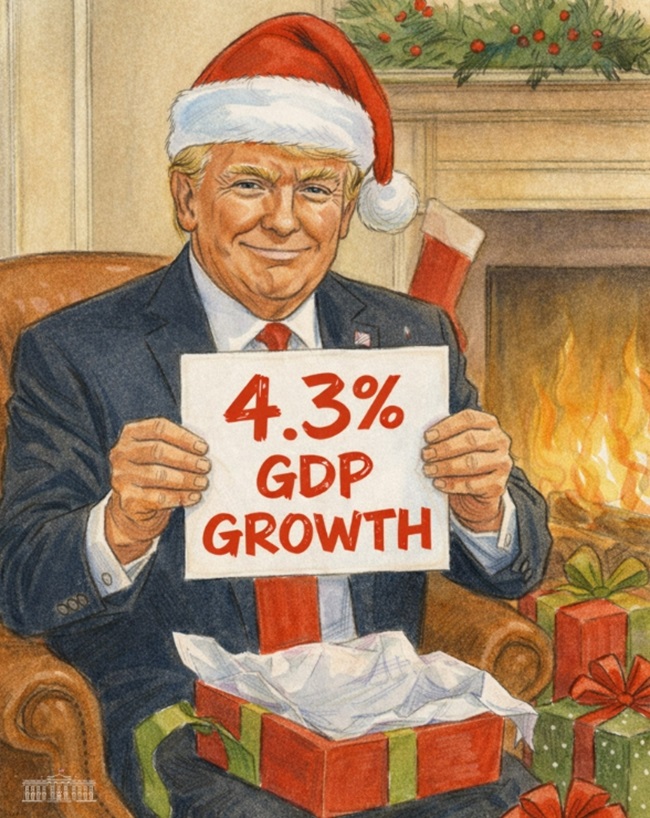 President Donald Trump's Christmas message celebrating the 4.3% annualized growth rate as of the third quarter of 2025. [Illustration by the White House]
While Brent crude averaged around $81 per barrel in 2024, it averaged $69 this year as a result of the Trump administration's "Drill, Baby, Drill" policy (expanding oil drilling), and is expected to fall further next year.
Furthermore, nothing impacts the consumer economy as significantly as interest rates and debt costs.
When Trump took office in January of this year, the federal funds rate set by the Federal Reserve was as high as 4.5%. The current rate range has been lowered to 3.5%, a decrease of 100 basis points (1 percentage point) in less than a year.
The financial markets are vibrant, fueled by economic surprises, and major indices like the S&P 500 reached all-time highs at the end of 2025 amid optimism about growth prospects.
"Wealth Effect" Driving U.S. Economic Growth
The so-called "wealth effect" has led to double-digit growth in Americans' personal asset portfolios and 401(k) retirement plans. This, in turn, is leading to strong consumption and driving U.S. economic growth.
The S&P 500 index surged in 2025, and the Nasdaq Composite and Dow Jones Industrial Average also saw gains of 14-18% this year alone. As the 2026 election approaches, economic performance will continue to be a key issue.
Trump's allies are expected to continue arguing that policy measures are transforming the economy, while critics will demand a more precise interpretation of the data.
The outcome will be reflected in the symbolic value of cash in voters' "wallets" and will determine the direction of the upcoming midterm elections next year.
Doctor of Public Administration, Chairman of the National Union for Freedom and Unification
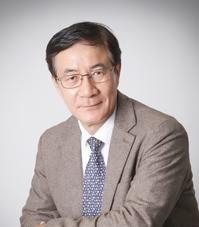
◆ Dr. Shin Dong-choon
Doctor of Public Administration, Chairman of the National Union for Freedom and Unification. After passing the 21st Higher Civil Service Examination, he had a career in public service, followed by active roles as a CEO, university professor, media contributor, author, and Chairman of the Global Aerospace Industry Association.

 Iranian Foreign Ministry: "Continuing Message Exchanges with the U.S. and Activities of Mediating Countries"
Esmaeil Baghaei, Spokesperson for the Iranian Ministry of Foreign Affairs [Xinhua, Yonhap News file photo]Esmaeil Baghaei, spokesperson for the Iranian Ministry of Foreign Affairs, stated on the 26th
Iranian Foreign Ministry: "Continuing Message Exchanges with the U.S. and Activities of Mediating Countries"
Esmaeil Baghaei, Spokesperson for the Iranian Ministry of Foreign Affairs [Xinhua, Yonhap News file photo]Esmaeil Baghaei, spokesperson for the Iranian Ministry of Foreign Affairs, stated on the 26th
 President Yoon: "Do You Think You Are Safe from the Special Counsel?"... Final Statement Video Released
President Yoon Suk Yeol rebuking the special prosecutor on the 24th. [Court video / @birds_justice X account subtitle GIF] A video of President Yoon Suk Yeol's closing statement at his trial rega
President Yoon: "Do You Think You Are Safe from the Special Counsel?"... Final Statement Video Released
President Yoon Suk Yeol rebuking the special prosecutor on the 24th. [Court video / @birds_justice X account subtitle GIF] A video of President Yoon Suk Yeol's closing statement at his trial rega
 President Yoon, regarding the first-instance ruling on the Public Official Election Act: “An excessive political verdict that distorts the facts… We will appeal immediately.”
The first-instance sentencing hearing for President Yoon Suk Yeol regarding violations of the Public Official Election Act is being broadcast live at Seoul Station on the 27th. [Photo=Yonhap News]Pres
President Yoon, regarding the first-instance ruling on the Public Official Election Act: “An excessive political verdict that distorts the facts… We will appeal immediately.”
The first-instance sentencing hearing for President Yoon Suk Yeol regarding violations of the Public Official Election Act is being broadcast live at Seoul Station on the 27th. [Photo=Yonhap News]Pres
 WSJ: "SK Hynix ADR Premium Is a Sign of AI Trading Overheat"
Advertisement for SK Hynix ADR listing in New York's Times Square [Reuters=Yonhap News file photo]The Wall Street Journal (WSJ) has pointed out that the price of SK Hynix’s American Depositary Recei
WSJ: "SK Hynix ADR Premium Is a Sign of AI Trading Overheat"
Advertisement for SK Hynix ADR listing in New York's Times Square [Reuters=Yonhap News file photo]The Wall Street Journal (WSJ) has pointed out that the price of SK Hynix’s American Depositary Recei
 'Godfather of Japanese Mystery Novels' Keigo Higashino Passes Away After Battle with Cancer at 68
Famous Japanese mystery novelist Keigo Higashino [AFP=Yonhap News]It has been belatedly reported that Keigo Higashino, the "godfather of Japanese mystery novels" and author of bestsellers such as "The
'Godfather of Japanese Mystery Novels' Keigo Higashino Passes Away After Battle with Cancer at 68
Famous Japanese mystery novelist Keigo Higashino [AFP=Yonhap News]It has been belatedly reported that Keigo Higashino, the "godfather of Japanese mystery novels" and author of bestsellers such as "The
 [Park Pil-kyu Security Column] To the Ignorant Trying to Clothe a Beast in Sheep's Clothing
Rep. Kim Byung-joo of the Democratic Party of Korea [Photo=Yonhap News]“The Air Force Academy doesn't teach you how to fly a plane!” “The Army, Navy, and Air Force academies are exactly the
[Park Pil-kyu Security Column] To the Ignorant Trying to Clothe a Beast in Sheep's Clothing
Rep. Kim Byung-joo of the Democratic Party of Korea [Photo=Yonhap News]“The Air Force Academy doesn't teach you how to fly a plane!” “The Army, Navy, and Air Force academies are exactly the
 [Issue Diagnosis] Two Effects of the Election Petition Review
 [Photo] Evidence of Election Fraud Flooding U.S. Media… Trump Had 2.7 Million Votes Stolen
 [Video] U.S. Semiquincentennial Air Show... 'Art in the Sky' streaks across New York
 [Editorial Cartoon] A Draconian Law That Undermines Freedom of Expression

 List
List









