Trump answers reporters' questions on his plane [Reuters Yonhap News]
Following his surprise arrest and extradition of Venezuelan President Nicolás Maduro on the 3rd (local time), U.S. President Donald Trump's next move is drawing attention as he has issued warnings to other countries in the Western Hemisphere.
On the 4th, aboard his plane returning to Washington D.C. from Florida, President Trump made significant remarks not only about Venezuela, where a major military operation has already been carried out, but also about other Western Hemisphere countries such as Colombia, Mexico, and Cuba.
In particular, President Trump warned Colombia, stating, "It's a very sick country. It's led by a nasty guy who loves to make cocaine and sell it to the United States, and he won't be around for much longer," and when asked if operations would also be conducted in Colombia, he replied, "Good idea."
He also stated that Mexico needs to do more to stop drug trafficking, saying, "Drugs are pouring through Mexico, and we have to do something about it."
When asked if he would take action to acquire Greenland, an autonomous territory of Denmark and a NATO member, he avoided a clear answer but emphasized, "We need Greenland from a national security perspective."
These remarks by President Trump are significant because he is acting within the framework of Trump's new isolationism, dubbed "Donroism" (a portmanteau of Monroe Doctrine and Donald Trump), which represents his 21st-century approach to isolationism.
The Monroe Doctrine is based on two core principles: the U.S. would not interfere in European conflicts, and in return, the Americas, considered the U.S. "backyard," would be kept strictly under U.S. influence. Currently, based on Donroism, President Trump appears to be delegating the European security threat arising from Russia's invasion of Ukraine primarily to European NATO members, while dedicating his diplomatic and military capabilities to solidifying his control over the Western Hemisphere.
Many believe it is uncertain how Maduro's arrest and extradition will affect U.S. national interests in the medium to long term.
However, judging from his remarks after the Venezuelan operation, President Trump seems to have strengthened his conviction in his decisions for military operations and the Donroism that underpins them.
At least militarily, the U.S. special forces succeeded in arresting and extraditing Maduro without casualties. Furthermore, the Vice President of Venezuela, Delcy Rodríguez, who replaced Maduro, initially showed a will to resist but soon expressed cooperation with the U.S., which may have boosted President Trump's confidence.
However, there are significant analyses suggesting that even the U.S. may face considerable challenges in repeatedly conducting military operations against other countries amidst controversy over violations of international law. This is because while a political landscape favorable to President Trump is emerging with conservative and right-wing candidates winning consecutive elections in Latin American countries, excessive reliance on military force could provoke a "backlash" of strong anti-American sentiment in Latin America.
Most importantly, the reason President Trump's core supporters, the MAGA (Make America Great Again) movement, elected him was their desire for him to refrain from external military intervention and focus on domestic issues such as the economy and immigration.
There are also predictions that President Trump will find it difficult to tolerate risks that could negatively impact public sentiment among his supporters due to excessive foreign intervention at a time when the November midterm elections are approaching, which will significantly influence the momentum of his administration in its second term by determining the composition of the U.S. Congress.
Nevertheless, unlike his first term (2017-2021), voices within the administration that would check President Trump have largely disappeared. With figures like Secretary of Defense Pete Heges and Chairman of the Joint Chiefs of Staff Dan Kain faithfully executing President Trump's military operation plans, there are considerable views that it is difficult to prematurely conclude that military operations in the Western Hemisphere will end with Venezuela.

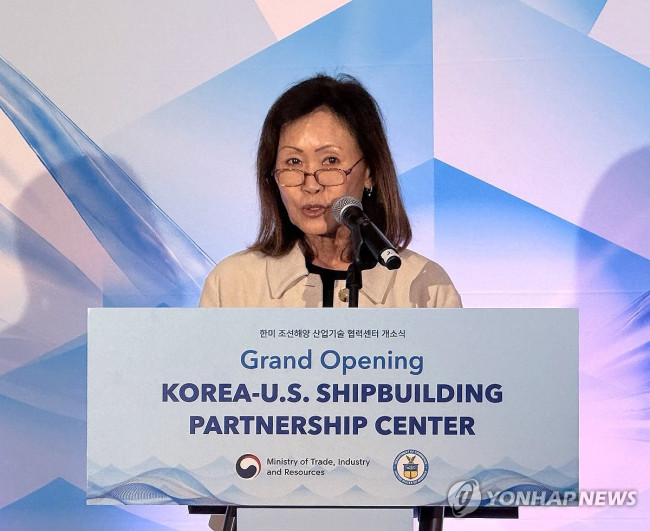 First U.S. Ambassador of Trump's Second Term to Arrive This Week… Will It Provide Momentum to Resolve Pending Issues?
U.S. Ambassador to South Korea Michelle Steel speaks at the opening ceremony of the Korea-U.S. Shipbuilding Cooperation Center held at the Mayflower Hotel in Washington, D.C., on the 23rd (local time)
First U.S. Ambassador of Trump's Second Term to Arrive This Week… Will It Provide Momentum to Resolve Pending Issues?
U.S. Ambassador to South Korea Michelle Steel speaks at the opening ceremony of the Korea-U.S. Shipbuilding Cooperation Center held at the Mayflower Hotel in Washington, D.C., on the 23rd (local time)
 President Yoon, regarding the first-instance ruling on the Public Official Election Act: “An excessive political verdict that distorts the facts… We will appeal immediately.”
The first-instance sentencing hearing for President Yoon Suk Yeol regarding violations of the Public Official Election Act is being broadcast live at Seoul Station on the 27th. [Photo=Yonhap News]Pres
President Yoon, regarding the first-instance ruling on the Public Official Election Act: “An excessive political verdict that distorts the facts… We will appeal immediately.”
The first-instance sentencing hearing for President Yoon Suk Yeol regarding violations of the Public Official Election Act is being broadcast live at Seoul Station on the 27th. [Photo=Yonhap News]Pres
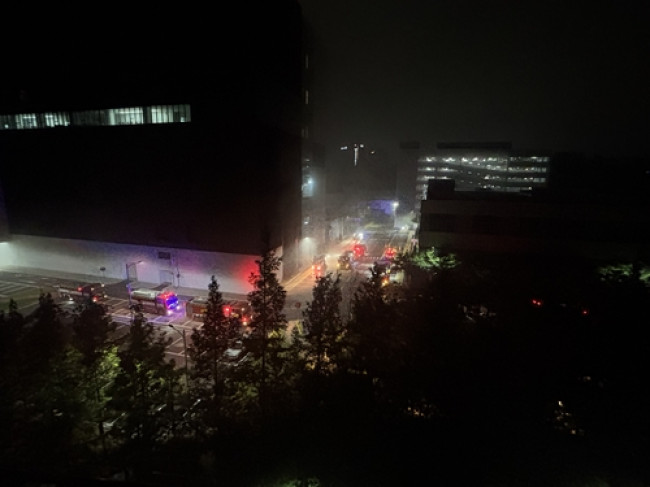 Fire at Hyundai Motor Group Battery Research Facility in Uiwang… Ignited in Waste Storage Room
A fire broke out at the Hyundai Motor Group battery research building at its Uiwang Research Center in Sam-dong, Uiwang-si, Gyeonggi-do, at 12:48 a.m. on the 28th and was extinguished after approximat
Fire at Hyundai Motor Group Battery Research Facility in Uiwang… Ignited in Waste Storage Room
A fire broke out at the Hyundai Motor Group battery research building at its Uiwang Research Center in Sam-dong, Uiwang-si, Gyeonggi-do, at 12:48 a.m. on the 28th and was extinguished after approximat
 'Godfather of Japanese Mystery Novels' Keigo Higashino Passes Away After Battle with Cancer at 68
Famous Japanese mystery novelist Keigo Higashino [AFP=Yonhap News]It has been belatedly reported that Keigo Higashino, the "godfather of Japanese mystery novels" and author of bestsellers such as "The
'Godfather of Japanese Mystery Novels' Keigo Higashino Passes Away After Battle with Cancer at 68
Famous Japanese mystery novelist Keigo Higashino [AFP=Yonhap News]It has been belatedly reported that Keigo Higashino, the "godfather of Japanese mystery novels" and author of bestsellers such as "The
 [Park Pil-kyu Security Column] To the Ignorant Trying to Clothe a Beast in Sheep's Clothing
Rep. Kim Byung-joo of the Democratic Party of Korea [Photo=Yonhap News]“The Air Force Academy doesn't teach you how to fly a plane!” “The Army, Navy, and Air Force academies are exactly the
[Park Pil-kyu Security Column] To the Ignorant Trying to Clothe a Beast in Sheep's Clothing
Rep. Kim Byung-joo of the Democratic Party of Korea [Photo=Yonhap News]“The Air Force Academy doesn't teach you how to fly a plane!” “The Army, Navy, and Air Force academies are exactly the
 [Issue Diagnosis] Two Effects of the Election Petition Review
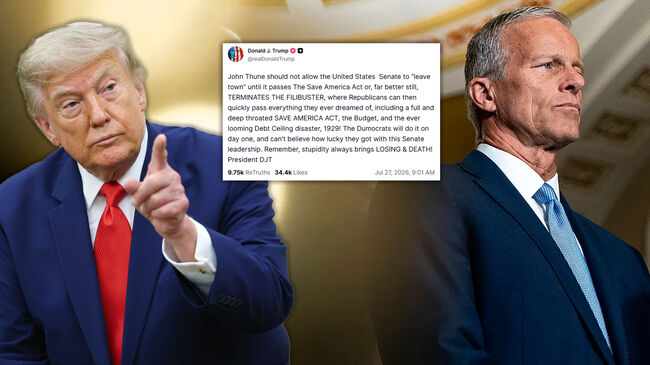 Trump Demands Passage of ‘SAVE Act’ Before Senate Recess
 [Photo] Evidence of Election Fraud Flooding U.S. Media… Trump Had 2.7 Million Votes Stolen
 [Video] U.S. Semiquincentennial Air Show... 'Art in the Sky' streaks across New York
 [Editorial Cartoon] A Draconian Law That Undermines Freedom of Expression

 List
List