 Nicolás Maduro gestures with a V-sign in Caracas, Venezuela, in January 2024. [EPA=Yonhap News]
News broke that Maduro had been arrested by the Delta Force special unit and swiftly extradited to the United States. The world suddenly seemed different from the day before. It was as if the world had been divided into before and after Maduro's arrest. The news of his apprehension was that astonishing and drastically changed the hue of the world.
Until yesterday, everything was uncertain. The world didn't know where it was heading, and the outcome of events could not be assured. One had to recall instances in history where evil, injustice, and falsehood often triumphed. It was a continuous sequence of dejection, regret, and sorrow.
Why is the End of a Dictator Often Tragic?
The events unfolding within the country amplified the anxiety that our own experiences might end in a similar fashion. They said a verdict would be delivered and that another arrest warrant had been issued. Everything felt unjust.
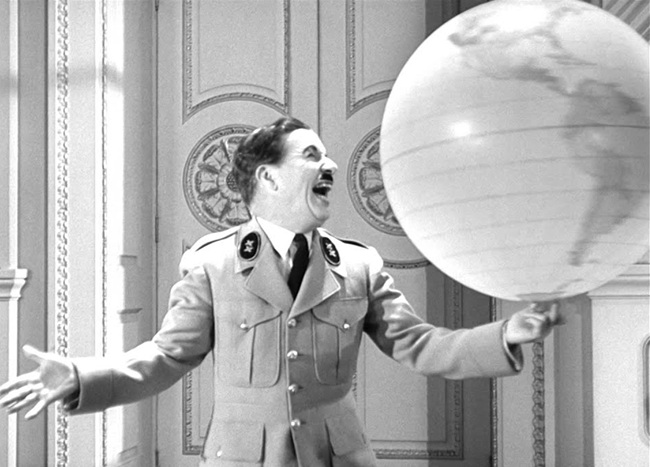 Dictators on the verge of their downfall often appear comically absurd. A scene from Charlie Chaplin's film 'The Great Dictator'. [Photo=The Great Dictator]
Though it was glaringly obvious to the enlightened eyes of common sense that it was false, the scales held by those in judicial robes were entirely different. Twenty, thirty times we hoped and wondered if perhaps this time would be different, but each time, the small resolutions delivered the outcome of pain and sorrow.
My word, Maduro overturned such a world. It was reported that he couldn't evade pursuit even while hiding in a military base safe house. He couldn't even escape arrest by entering a 'safe room' within it.
Maduro, dragged out with bloodstains on his clothes, a limping Maduro, a Maduro in Nike sneakers, a Maduro transported by helicopter to a ship, a Maduro who was soon transferred to a facility near New York, a Maduro nonchalantly giving a 'thumbs up' to the camera... Maduro transformed into hope and light.
Dictators nearing their end often appear particularly theatrical. Like the fervent orator in Charlie Chaplin's 'The Great Dictator,' a dictator unaware of their impending doom is truly endearing and comical.
Maduro, pounding his fist on the desk and shouting, Maduro, proudly displaying cheap trinkets he claimed were gifts from foreign leaders, Maduro in military uniform, exuding confidence and bravado, Maduro, surveying the people gathered before him, the puppet witnesses of his power, and confidently pointing to a bright future for his country, Maduro, chuckling as if no one knows his secrets or his shame, like the Emperor in his New Clothes, but then quickly adopting a solemn expression...
What will become of Maduro now?
Noriega, Gaddafi, Ceaușescu, Chávez, and Maduro
Panama's Noriega, upon the invasion by US forces, ran to the Vatican embassy and pounded on the closed door. The door opened, and he expected a path to safety. It turned out not to be a secure haven for asylum. After days of commotion, Noriega was captured and taken to the United States, receiving a 40-year sentence and spending his final days moving between prisons in the US, France, and Panama.
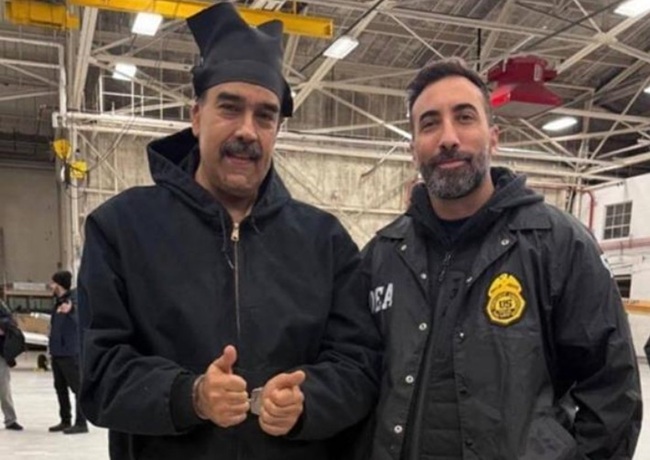 Nicolás Maduro, captured by the United States, poses for a commemorative photo with law enforcement officers who escorted him as he was transferred to the Metropolitan Detention Center in Brooklyn, New York. [Photo=UN News] Gaddafi of the 'Green Revolution' also met a tragic end. Gaddafi, who ruled Libya for a long 42 years, was hiding in a concrete drainage pipe in his hometown when he was discovered by anti-government forces. In his later years, Gaddafi seemed like a drug addict, intoxicated by the taste of power.
Ceaușescu of Romania, who failed to escape by helicopter, ruled for 24 years and met his end through a stern court verdict. Saddam Hussein of Iraq also became a prisoner of the war led by Bush and departed the world by court judgment.
Maduro is still full of vigor. He claims he is still the president and merely a prisoner of war. Is he truly president? Or has he merely been acting as president? Who elected him as a representative of the people? Wasn't it a machine that did that? Having lost his fake power, isn't he merely a criminal?
Maduro, who sacrificed his destiny to bring laughter, Maduro, who cast even his wife as an actress in his tragicomic drama, allowed those thirsting for justice to be cheerful for a few days. This in itself seems miraculous enough. However, what has Maduro truly given us?
For a year, people debated whether 'it' existed or not. In today's world, in the bright 21st century, how could such a thing happen, they asked.
The election committee chairman with 'glasses' asked if we couldn't trust him, showing a look of pity and innocence, tut-tutting. After Maduro's arrest, 'it' became a natural occurrence without anyone needing to reveal it.
Legacy media outlets still remain silent about 'it.' They claim Maduro's arrest was due to America's desire for oil, or because of drug cartels. Some also cite the activation of hegemony. They even express concern over Trump's 'behavior,' citing violations of international law.
However, 'it' transcended this silence and instantly took root in people's minds as something that had occurred. The equation was established: if Maduro's Venezuela did it, then it must have happened here as well.
Maduro called his government, which began with manipulation of electronic vote counting, a 'government of national sovereignty.' The Venezuelan people, cheering as they tore down Maduro's statue, proved how false this slogan was.
If it happened in Venezuela, what about Korea's 'government of national sovereignty'? This government's benchmarking of Venezuela has led people to interpret events in Venezuela through parallel reasoning.
The 'Bolivarian Revolution' in Venezuela, which began with Hugo Chávez, and its 'Socialism of the 21st Century,' provoke much thought. His ascent to power occurred about 20 years after the end of the Cold War.
In a historical context where it became undeniable that socialism materialized in reality was merely a system of plunder against the people, Chávez advocated for 'new' socialism, 'democratic socialism,' and 'electoral socialism' while pursuing an anti-imperialist line. He promised welfare for the poor by 'recovering' the oil industry from imperialist capital.
'Fortuitously,' Chávez was called to heaven and passed away shortly before the 'revolution' faced a crisis. The unpopular Maduro inherited the task. The Maduro regime, from its inception, attempted to overcome the 'revolution's' crisis through coercive rule by the prosecution and police, purges of political opponents, massacres of residents, and 21st-century fraudulent elections.
Maduro Finds a Breakthrough Through Election Fraud
It sought to maintain its precarious power by forming international networks with outdated, anachronistic, and anti-people dictatorial regimes. Recent news indicates that these allies could even be found within the United States. Electronic vote counting machines like 'Smartmatic' and 'Dominion' performed their 'intended functions' within this international network.
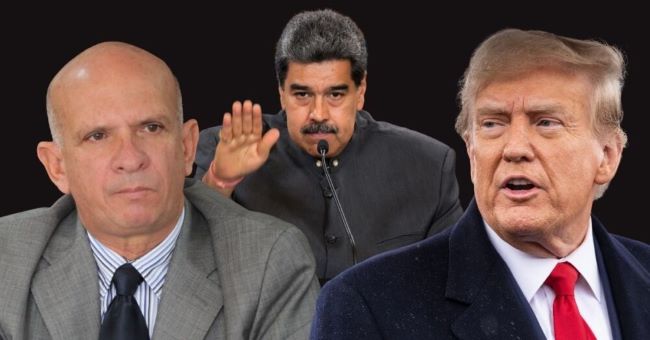 It was revealed that Hugo Carvajal Barrios (left), former top intelligence official of Venezuela, sent a letter to U.S. President Donald Trump (right) on December 2, 2025, confessing that "the Venezuelan regime participated in espionage and election fraud in the United States." Nicolás Maduro is in the center. [Photo=Dallas Express]
Maduro's arrest delivered a profound psychological shock to those who still believe themselves to be radical. Dogmatic socialists who have not learned from the fate of extinguished regimes, those who still cling to the authority of the 'vanguard party,' those who have seized the rights of the masses in the name of serving them, those who attempt to monopolize truths dogmatized under the pursuit of political correctness, those who seek to overturn the world with animosity, hatred, and antagonism instead of bonds and understanding between generations, genders, and classes—for them, Maduro's Venezuela was a 'third way.' It was a different possibility from 'ruined' 'socialism.' This 'possibility' has been 'unjustly' arrested, extradited, and brought to trial.
They refer to the 'one person, one vote' electoral system as bourgeois democracy. They claim it is merely a democracy managed and controlled by capital, the state, and bureaucrats, for the bourgeoisie, and cannot be for the people or the masses.
If that is the case, then such actions are acceptable, and can be overcome for the sake of grand ideals. If one cannot overcome numbers, if one can create them, then it is permissible. It is not such a grave sin. The people simply cannot grasp the profound meaning; there is no inherent good or evil in politics.
I can understand this 'despair.' I can sympathize with those for whom Maduro's arrest is as painful as their own. This is because what happened in Venezuela is also happening in this country.
Professor at Seoul National University, Poet
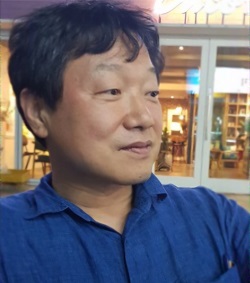
◆ Professor Bang Min-ho
Ph.D. in Literature, Professor of Korean Language and Literature at Seoul National University. He has been active as the editor-in-chief of the quarterly literary magazine 'Maek' (2022~) and as a poet, novelist, and literary critic. His published works include 'Lover Simcheong' (2015), 'The Language of Pain' (2019), 'Revisiting Korean Criticism' (2021), and 'Seoul Literary Journeys' (2024).

 Iranian Foreign Ministry: "Continuing Message Exchanges with the U.S. and Activities of Mediating Countries"
Esmaeil Baghaei, Spokesperson for the Iranian Ministry of Foreign Affairs [Xinhua, Yonhap News file photo]Esmaeil Baghaei, spokesperson for the Iranian Ministry of Foreign Affairs, stated on the 26th
Iranian Foreign Ministry: "Continuing Message Exchanges with the U.S. and Activities of Mediating Countries"
Esmaeil Baghaei, Spokesperson for the Iranian Ministry of Foreign Affairs [Xinhua, Yonhap News file photo]Esmaeil Baghaei, spokesperson for the Iranian Ministry of Foreign Affairs, stated on the 26th
 President Yoon: "Do You Think You Are Safe from the Special Counsel?"... Final Statement Video Released
President Yoon Suk Yeol rebuking the special prosecutor on the 24th. [Court video / @birds_justice X account subtitle GIF] A video of President Yoon Suk Yeol's closing statement at his trial rega
President Yoon: "Do You Think You Are Safe from the Special Counsel?"... Final Statement Video Released
President Yoon Suk Yeol rebuking the special prosecutor on the 24th. [Court video / @birds_justice X account subtitle GIF] A video of President Yoon Suk Yeol's closing statement at his trial rega
 President Yoon, regarding the first-instance ruling on the Public Official Election Act: “An excessive political verdict that distorts the facts… We will appeal immediately.”
The first-instance sentencing hearing for President Yoon Suk Yeol regarding violations of the Public Official Election Act is being broadcast live at Seoul Station on the 27th. [Photo=Yonhap News]Pres
President Yoon, regarding the first-instance ruling on the Public Official Election Act: “An excessive political verdict that distorts the facts… We will appeal immediately.”
The first-instance sentencing hearing for President Yoon Suk Yeol regarding violations of the Public Official Election Act is being broadcast live at Seoul Station on the 27th. [Photo=Yonhap News]Pres
 WSJ: "SK Hynix ADR Premium Is a Sign of AI Trading Overheat"
Advertisement for SK Hynix ADR listing in New York's Times Square [Reuters=Yonhap News file photo]The Wall Street Journal (WSJ) has pointed out that the price of SK Hynix’s American Depositary Recei
WSJ: "SK Hynix ADR Premium Is a Sign of AI Trading Overheat"
Advertisement for SK Hynix ADR listing in New York's Times Square [Reuters=Yonhap News file photo]The Wall Street Journal (WSJ) has pointed out that the price of SK Hynix’s American Depositary Recei
 'Godfather of Japanese Mystery Novels' Keigo Higashino Passes Away After Battle with Cancer at 68
Famous Japanese mystery novelist Keigo Higashino [AFP=Yonhap News]It has been belatedly reported that Keigo Higashino, the "godfather of Japanese mystery novels" and author of bestsellers such as "The
'Godfather of Japanese Mystery Novels' Keigo Higashino Passes Away After Battle with Cancer at 68
Famous Japanese mystery novelist Keigo Higashino [AFP=Yonhap News]It has been belatedly reported that Keigo Higashino, the "godfather of Japanese mystery novels" and author of bestsellers such as "The
 [Park Pil-kyu Security Column] To the Ignorant Trying to Clothe a Beast in Sheep's Clothing
Rep. Kim Byung-joo of the Democratic Party of Korea [Photo=Yonhap News]“The Air Force Academy doesn't teach you how to fly a plane!” “The Army, Navy, and Air Force academies are exactly the
[Park Pil-kyu Security Column] To the Ignorant Trying to Clothe a Beast in Sheep's Clothing
Rep. Kim Byung-joo of the Democratic Party of Korea [Photo=Yonhap News]“The Air Force Academy doesn't teach you how to fly a plane!” “The Army, Navy, and Air Force academies are exactly the
 [Issue Diagnosis] Two Effects of the Election Petition Review
 [Photo] Evidence of Election Fraud Flooding U.S. Media… Trump Had 2.7 Million Votes Stolen
 [Video] U.S. Semiquincentennial Air Show... 'Art in the Sky' streaks across New York
 [Editorial Cartoon] A Draconian Law That Undermines Freedom of Expression

 List
List










