- "Demand for regulation from tech CEOs may have conflict of interest... we should be concerned about regulatory capture."
 Jensen Huang, CEO of Nvidia, speaks about AI. [Yonhap News]
Jensen Huang, CEO of Nvidia, has strongly criticized the "AI apocalypse" theories emerging in the tech industry.
Huang stated on the recent podcast 'No Priors' that "last year was a year of narrative warfare," and that "prominent figures have spread apocalyptic or science-fiction-like narratives (about the future AI will bring), causing much harm," as reported by the U.S. business publication Business Insider on the 10th (local time).
He pointed out that such AI apocalypse theories are not beneficial to industry, society, or government.
"Ninety percent of the overall message is apocalyptic and pessimistic," he emphasized. "This is even stifling investments aimed at making AI safer, more productive, and more beneficial to society."
In particular, he expressed concern about "regulatory capture" when referring to individuals within the tech industry calling for stronger government regulations.
Regulatory capture refers to the phenomenon where regulatory agencies or legislators, intended to serve the public interest, become beholden to specific industries or interest groups they are supposed to regulate, and end up serving their interests.
Huang commented on tech industry figures demanding strong regulations, stating, "Their intentions are clearly conflicted," and "their intentions are not for the best interests of society."
"They are clearly CEOs, and they are companies," he emphasized. "They are representing themselves."
While Huang did not name the individuals he was criticizing, Business Insider noted that he has previously disagreed with predictions such as those by Dario Amodei, CEO of Anthropic, who predicted that AI would replace half of entry-level white-collar jobs.
Sam Altman, CEO of OpenAI, is another prominent figure in the tech industry who has repeatedly stressed the need for stronger regulations.
Meanwhile, Satya Nadella, CEO of Microsoft (MS), recently stated that society needs to move beyond labeling AI content as "low quality," indicating that leaders of major tech companies are striving to reverse negative public opinion on AI.
What do you think of this article?

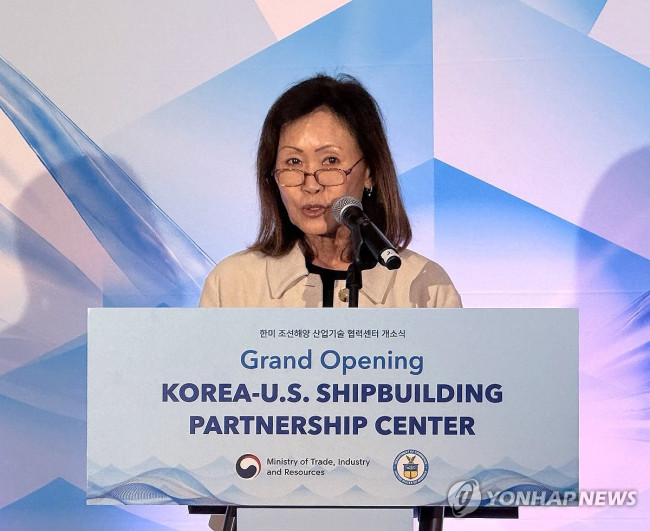 First U.S. Ambassador of Trump's Second Term to Arrive This Week… Will It Provide Momentum to Resolve Pending Issues?
U.S. Ambassador to South Korea Michelle Steel speaks at the opening ceremony of the Korea-U.S. Shipbuilding Cooperation Center held at the Mayflower Hotel in Washington, D.C., on the 23rd (local time)
First U.S. Ambassador of Trump's Second Term to Arrive This Week… Will It Provide Momentum to Resolve Pending Issues?
U.S. Ambassador to South Korea Michelle Steel speaks at the opening ceremony of the Korea-U.S. Shipbuilding Cooperation Center held at the Mayflower Hotel in Washington, D.C., on the 23rd (local time)
 President Yoon, regarding the first-instance ruling on the Public Official Election Act: “An excessive political verdict that distorts the facts… We will appeal immediately.”
The first-instance sentencing hearing for President Yoon Suk Yeol regarding violations of the Public Official Election Act is being broadcast live at Seoul Station on the 27th. [Photo=Yonhap News]Pres
President Yoon, regarding the first-instance ruling on the Public Official Election Act: “An excessive political verdict that distorts the facts… We will appeal immediately.”
The first-instance sentencing hearing for President Yoon Suk Yeol regarding violations of the Public Official Election Act is being broadcast live at Seoul Station on the 27th. [Photo=Yonhap News]Pres
 Fire at Hyundai Motor Group Battery Research Facility in Uiwang… Ignited in Waste Storage Room
A fire broke out at the Hyundai Motor Group battery research building at its Uiwang Research Center in Sam-dong, Uiwang-si, Gyeonggi-do, at 12:48 a.m. on the 28th and was extinguished after approximat
Fire at Hyundai Motor Group Battery Research Facility in Uiwang… Ignited in Waste Storage Room
A fire broke out at the Hyundai Motor Group battery research building at its Uiwang Research Center in Sam-dong, Uiwang-si, Gyeonggi-do, at 12:48 a.m. on the 28th and was extinguished after approximat
 'Godfather of Japanese Mystery Novels' Keigo Higashino Passes Away After Battle with Cancer at 68
Famous Japanese mystery novelist Keigo Higashino [AFP=Yonhap News]It has been belatedly reported that Keigo Higashino, the "godfather of Japanese mystery novels" and author of bestsellers such as "The
'Godfather of Japanese Mystery Novels' Keigo Higashino Passes Away After Battle with Cancer at 68
Famous Japanese mystery novelist Keigo Higashino [AFP=Yonhap News]It has been belatedly reported that Keigo Higashino, the "godfather of Japanese mystery novels" and author of bestsellers such as "The
 [Park Pil-kyu Security Column] To the Ignorant Trying to Clothe a Beast in Sheep's Clothing
Rep. Kim Byung-joo of the Democratic Party of Korea [Photo=Yonhap News]“The Air Force Academy doesn't teach you how to fly a plane!” “The Army, Navy, and Air Force academies are exactly the
[Park Pil-kyu Security Column] To the Ignorant Trying to Clothe a Beast in Sheep's Clothing
Rep. Kim Byung-joo of the Democratic Party of Korea [Photo=Yonhap News]“The Air Force Academy doesn't teach you how to fly a plane!” “The Army, Navy, and Air Force academies are exactly the
 [Issue Diagnosis] Two Effects of the Election Petition Review
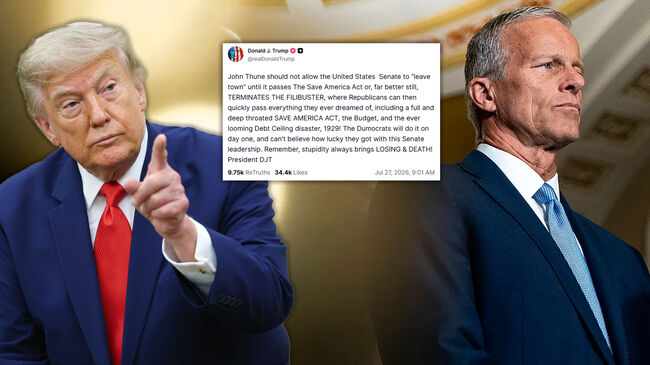 Trump Demands Passage of ‘SAVE Act’ Before Senate Recess
 [Photo] Evidence of Election Fraud Flooding U.S. Media… Trump Had 2.7 Million Votes Stolen
 [Video] U.S. Semiquincentennial Air Show... 'Art in the Sky' streaks across New York
 [Editorial Cartoon] A Draconian Law That Undermines Freedom of Expression

 List
List