 Japanese Prime Minister Sanae Takaichi announces at the Prime Minister's official residence on the 19th that the House of Representatives (lower house) will be dissolved on the 23rd. [Yonhap News]
Japanese Prime Minister Sanae Takaichi's official announcement of his intention to dissolve the House of Representatives (lower house) early on the 19th has plunged Japanese politics into an election mode from the beginning of the year.
At a press conference on the same day, Prime Minister Takaichi announced that he would dissolve the House of Representatives simultaneously with the opening of the ordinary Diet session on the 23rd, and hold a general election on the 8th of next month.
This dissolution of the House of Representatives is being evaluated as unusual in many respects.
According to the Asahi Shimbun, the dissolution on the first day of the ordinary Diet session is the first in 60 years since 1966. The dissolution of the House of Representatives in January is the first in 36 years since 1990.
Past Japanese Prime Ministers have refrained from dissolving the House of Representatives at the beginning of the year to pass the government's budget before the start of the fiscal year in April.
Furthermore, it is considered unprecedented to decide on a dissolution for political reasons at a time when less than one-third of the four-year term for members of the House of Representatives has passed. The previous general election was held in late October 2024.
The period from dissolution to voting is 16 days, the shortest in history since the end of the Pacific War.
In Japan, the dissolution of the House of Representatives is called a "trump card" and a "double-edged sword" held by the Prime Minister. If used well, it can consolidate the base of power, but if the Prime Minister loses the subsequent general election, their central authority can be rapidly weakened, leading to a crisis of resignation.
Prime Minister Takaichi, seemingly mindful of this, stated that he would "stake his position as Prime Minister."
The primary factor behind his bold decision to abruptly dissolve the House of Representatives early, just three months after forming his cabinet, is undoubtedly the high approval rating of his cabinet.
The approval rating for the Takaichi cabinet has remained in the 60-70% range this month. Considering that the approval rating for the previous cabinet of Shigeru Ishiba was generally in the 30% range just before he stepped down, this is effectively double.
Cabinet approval ratings typically tend to decline over time.
Former Prime Minister Yoshihide Suga also enjoyed popularity comparable to Prime Minister Takaichi in the early days of his premiership in September 2020, but his support waned due to his lukewarm response to COVID-19, and he eventually stepped down about a year later.
Although Prime Minister Takaichi's approval rating is currently high, it is difficult to predict how long this surge in support will last, and challenges remain.
First, price increases continue, with the rice price, which rose last year, not falling.
Additionally, China, which has been increasing pressure on Japan since Prime Minister Takaichi's remarks implying intervention in case of a Taiwan contingency in November last year, is also considering export controls on some goods, including rare earths, which increases the possibility of negative economic impacts.
There is also concern that if Prime Minister Takaichi had proceeded with the ordinary Diet session without dissolving the House of Representatives, he would have been exposed to concentrated attacks from the opposition parties regarding these issues, which appears to have influenced the decision to dissolve.
It is also analyzed that Prime Minister Takaichi intends to break through the situation where opposition party members hold key positions such as chairman of the Budget Committee and chairman of the Constitutional Review Committee in the House of Representatives, and the ruling party's seats are insufficient, in order to seize the initiative in national governance.
The House of Representatives has 465 seats, and the combined seats of the ruling Liberal Democratic Party and its coalition partner, the Japan Innovation Party, barely exceed half with 233 seats based on party affiliations (groups of lawmakers).
In a press conference on the same day, Prime Minister Takaichi recalled the difficult circumstances under which he was elected Prime Minister in October last year amidst a minority government in the House of Representatives, emphasizing that "numerical superiority" is necessary to push policies forcefully.
Furthermore, analyses suggest that Prime Minister Takaichi aims to achieve an "LDP single-party majority" through an early dissolution of the House of Representatives and to lay the groundwork for a long-term administration.
If the general election for the House of Representatives is held in early next month, it is unlikely that major national elections will be held until the House of Councillors (upper house) election in the summer of 2028.
The Mainichi Shimbun commented, "The LDP is operating the government with difficulty in the House of Representatives, and it appears that Prime Minister Takaichi is attempting to stabilize the administration's foundation by dissolving it when the cabinet approval rating is high."
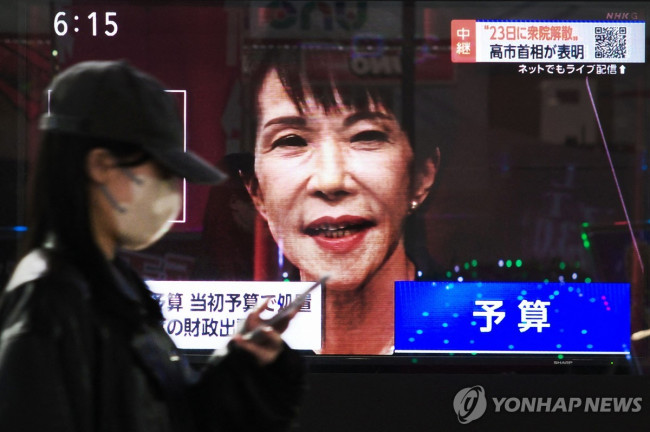 On the 19th, a woman walks past a TV in Tokyo displaying reports of Japanese Prime Minister Sanae Takaichi's dissolution announcement. [Yonhap News]
However, Prime Minister Takaichi's unusual policy of dissolution is expected to be a burden as the political landscape is being shaken, with the main opposition Constitutional Democratic Party and the third largest opposition Komeito forming a new party called the "Centrist Reform Alliance." The combined seats of the Constitutional Democratic Party and Komeito are 172.
With the launch of the Centrist Reform Alliance, the upcoming election is being assessed as a clear confrontation between the conservative forces centered on the LDP and the Innovation Party, and the centrist forces aiming for consolidation by the Constitutional Democratic Party and Komeito.
However, Prime Minister Takaichi expressed caution regarding the "conservative vs. centrist" framing, stating that the policies he has pursued are not about right-wing extremism but about becoming a normal country.
In addition, with Komeito, a long-time supporter of the LDP, effectively shifting its support to the Constitutional Democratic Party, there are predictions that the LDP may be at a disadvantage in some key electoral districts.
Komeito's parent organization is the religious group Soka Gakkai, and it is known to wield influence of about 10,000 to 20,000 votes in local constituencies.
The Yomiuri Shimbun predicted, "In the House of Representatives election, measures against high prices, which are of great public concern, are expected to be the main issue. Debates are also likely to take place regarding Prime Minister Takaichi's promotion of active fiscal policy and strengthening defense capabilities through the early revision of three key security documents."

 Iranian Foreign Ministry: "Continuing Message Exchanges with the U.S. and Activities of Mediating Countries"
Esmaeil Baghaei, Spokesperson for the Iranian Ministry of Foreign Affairs [Xinhua, Yonhap News file photo]Esmaeil Baghaei, spokesperson for the Iranian Ministry of Foreign Affairs, stated on the 26th
Iranian Foreign Ministry: "Continuing Message Exchanges with the U.S. and Activities of Mediating Countries"
Esmaeil Baghaei, Spokesperson for the Iranian Ministry of Foreign Affairs [Xinhua, Yonhap News file photo]Esmaeil Baghaei, spokesperson for the Iranian Ministry of Foreign Affairs, stated on the 26th
 President Yoon: "Do You Think You Are Safe from the Special Counsel?"... Final Statement Video Released
President Yoon Suk Yeol rebuking the special prosecutor on the 24th. [Court video / @birds_justice X account subtitle GIF] A video of President Yoon Suk Yeol's closing statement at his trial rega
President Yoon: "Do You Think You Are Safe from the Special Counsel?"... Final Statement Video Released
President Yoon Suk Yeol rebuking the special prosecutor on the 24th. [Court video / @birds_justice X account subtitle GIF] A video of President Yoon Suk Yeol's closing statement at his trial rega
 President Yoon, regarding the first-instance ruling on the Public Official Election Act: “An excessive political verdict that distorts the facts… We will appeal immediately.”
The first-instance sentencing hearing for President Yoon Suk Yeol regarding violations of the Public Official Election Act is being broadcast live at Seoul Station on the 27th. [Photo=Yonhap News]Pres
President Yoon, regarding the first-instance ruling on the Public Official Election Act: “An excessive political verdict that distorts the facts… We will appeal immediately.”
The first-instance sentencing hearing for President Yoon Suk Yeol regarding violations of the Public Official Election Act is being broadcast live at Seoul Station on the 27th. [Photo=Yonhap News]Pres
 WSJ: "SK Hynix ADR Premium Is a Sign of AI Trading Overheat"
Advertisement for SK Hynix ADR listing in New York's Times Square [Reuters=Yonhap News file photo]The Wall Street Journal (WSJ) has pointed out that the price of SK Hynix’s American Depositary Recei
WSJ: "SK Hynix ADR Premium Is a Sign of AI Trading Overheat"
Advertisement for SK Hynix ADR listing in New York's Times Square [Reuters=Yonhap News file photo]The Wall Street Journal (WSJ) has pointed out that the price of SK Hynix’s American Depositary Recei
 'Godfather of Japanese Mystery Novels' Keigo Higashino Passes Away After Battle with Cancer at 68
Famous Japanese mystery novelist Keigo Higashino [AFP=Yonhap News]It has been belatedly reported that Keigo Higashino, the "godfather of Japanese mystery novels" and author of bestsellers such as "The
'Godfather of Japanese Mystery Novels' Keigo Higashino Passes Away After Battle with Cancer at 68
Famous Japanese mystery novelist Keigo Higashino [AFP=Yonhap News]It has been belatedly reported that Keigo Higashino, the "godfather of Japanese mystery novels" and author of bestsellers such as "The
 [Park Pil-kyu Security Column] To the Ignorant Trying to Clothe a Beast in Sheep's Clothing
Rep. Kim Byung-joo of the Democratic Party of Korea [Photo=Yonhap News]“The Air Force Academy doesn't teach you how to fly a plane!” “The Army, Navy, and Air Force academies are exactly the
[Park Pil-kyu Security Column] To the Ignorant Trying to Clothe a Beast in Sheep's Clothing
Rep. Kim Byung-joo of the Democratic Party of Korea [Photo=Yonhap News]“The Air Force Academy doesn't teach you how to fly a plane!” “The Army, Navy, and Air Force academies are exactly the
 [Issue Diagnosis] Two Effects of the Election Petition Review
 [Photo] Evidence of Election Fraud Flooding U.S. Media… Trump Had 2.7 Million Votes Stolen
 [Video] U.S. Semiquincentennial Air Show... 'Art in the Sky' streaks across New York
 [Editorial Cartoon] A Draconian Law That Undermines Freedom of Expression

 List
List










