 Japanese Prime Minister Sanae Takaichi [Reuters Yonhap News]
The snap general election, called after Prime Minister Sanae Takaichi dissolved the House of Representatives (lower house) on the 23rd of last month, is just three days away.
According to major Japanese media outlets on the 5th, the ruling Liberal Democratic Party (LDP) and its coalition partner, the Japan Innovation Party, are expected to significantly exceed Takaichi's goal of securing a majority of seats.
If the ruling party achieves a landslide victory in the general election on the 8th, Prime Minister Takaichi is expected to take the lead in governing the nation and more strongly push forward with his conservative security policies, such as strengthening defense capabilities, which he has pursued since taking office in October last year, as well as economic policies represented by "active finance."
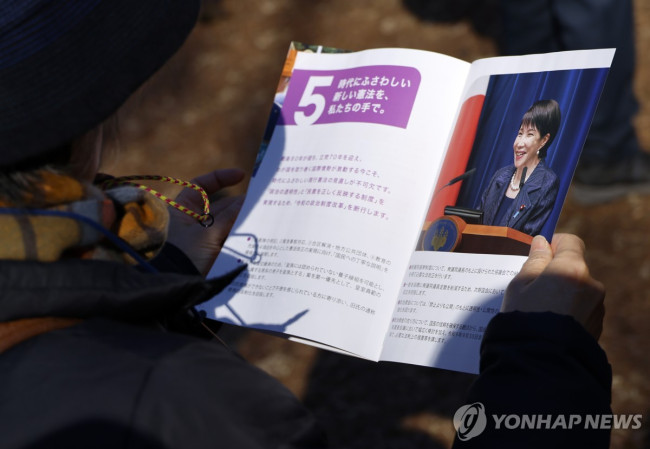 Japanese reading LDP pledges [EPA Yonhap News]
◇ LDP expected to surge from 198 seats to over 300, securing a landslide victory
Japan's media's election forecasts suggest a high probability of the LDP's significant gains and the decline of the largest opposition party, the "Centrist Reform Alliance."
The House of Representatives has a total of 465 seats. Before the official campaign for the general election began, the LDP held 198 seats and the Centrist Reform Alliance held 167, forming a two-party structure.
However, the Asahi Shimbun reported on the 1st that based on opinion polls conducted from the 31st of last month to the 1st of this month, the LDP is projected to win 278 to 306 seats, while the Centrist Reform Alliance is expected to win 60 to 87 seats.
The Japan Innovation Party and the Constitutional Democratic Party, the second-largest opposition party, are both expected to win around 30 seats, similar to their previous numbers. The right-leaning Constitutional Democratic Party is expected to see its seats increase from 2 to 11, according to Asahi.
Surveys conducted during the same period by the Sankei Shimbun and Fuji News Network (FNN) also indicated that the LDP could aim for over 300 seats. The Centrist Reform Alliance's seats were projected to halve, making it difficult to reach 100 seats.
Synthesizing these reports, it appears the LDP will secure dozens more seats than the majority requirement of 233, establishing a dominant one-party system.
The LDP regained power in the December 2012 general election, winning 294 out of 480 seats, after losing it to the Democratic Party in 2009. Since then, it has maintained a solo dominance through three more general elections until 2021.
During the 2021 general election under Prime Minister Fumio Kishida, the LDP won 261 out of 465 seats, and in the 2017 election under Prime Minister Shinzo Abe's administration, it secured 284 out of 465 seats.
In 2017, the LDP, together with the now-dissolved coalition partner Komeito, secured 313 seats, giving them an overwhelming advantage in the House of Representatives.
In this election, the combined seats of the LDP and the Japan Innovation Party are expected to exceed 310, the number required to propose constitutional amendments. The conservative Japan Innovation Party has positioned itself as an accelerator for Takaichi's conservative policies.
There are also predictions that if the Constitutional Democratic Party, the former main opposition party, and Komeito, the third-largest opposition party, which formed the Centrist Reform Alliance just before the general election, see a sharp decline in seats, accountability issues within the leadership may arise, potentially leading to the party's dissolution.
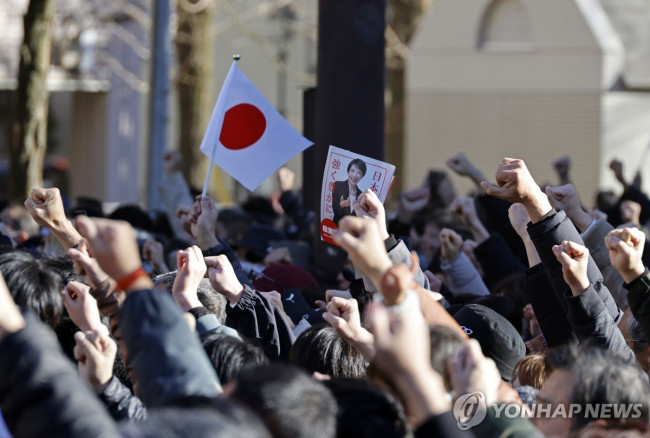 People attending Prime Minister Sanae Takaichi's rally [EPA Yonhap News]
◇ Takaichi overcomes negative public opinion on dissolving the Diet... also succeeds in appealing to conservative voters
The primary reason for the LDP's anticipated victory in this election is, above all, Prime Minister Takaichi's personal popularity.
In fact, when Prime Minister Takaichi dissolved the House of Representatives, the political atmosphere was not very favorable to the LDP. Immediately after the dissolution, some opinion polls showed a 10-point drop in cabinet approval ratings, and negative assessments of the dissolution were prevalent.
Although Prime Minister Takaichi had declared that prioritizing inflation control policies was his aim, he faced criticism that the budget for fiscal year 2026 (April 2026-March 2027) would be difficult to pass by March of this year due to the dissolution of the House of Representatives.
Furthermore, the election landscape shifted dramatically when Komeito, which had maintained a cooperative relationship with the LDP for a long time and was said to influence 10,000 to 20,000 votes in each electoral district, joined forces with the Constitutional Democratic Party.
However, as Prime Minister Takaichi traveled across the country campaigning, the situation gradually changed. Crowds gathered at every rally to see Prime Minister Takaichi, and the election outlook began to favor the LDP.
It is also analyzed that Prime Minister Takaichi's focus on economic policies during his rallies, rather than potentially controversial conservative policies, had some influence on this shift.
Additionally, when the Centrist Reform Alliance proposed a reduction in the consumption tax on food as a key pledge, the LDP responded by considering a two-year tax reduction, thereby preventing the issue from becoming a major point of contention.
The Asahi Shimbun commented, "High approval ratings are a tailwind for Prime Minister Takaichi," and explained that the return of conservative voters to the LDP after Prime Minister Takaichi took office, who had previously leaned towards the Constitutional Democratic Party in the July upper house elections, is also a factor in the LDP's strong performance.
The Sankei Shimbun also noted, "Prime Minister Takaichi's strategy of asking, 'Will you stake your neck?' and questioning his suitability for the prime ministership, while urging voters to support the LDP, seems to have succeeded," and pointed out that the Centrist Reform Alliance failed to attract protest votes against the government.
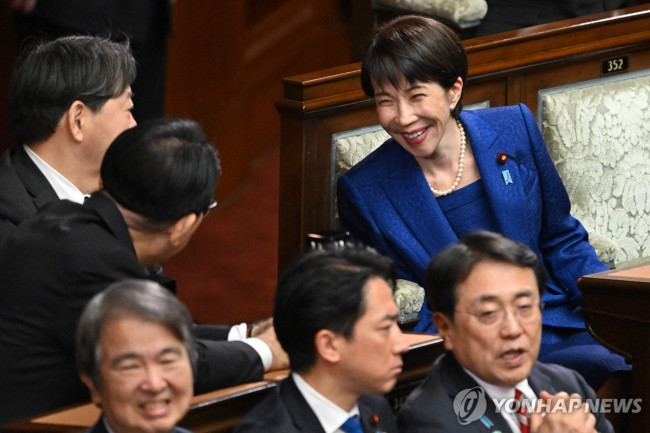 Japanese Prime Minister Sanae Takaichi [AFP Yonhap News]
◇ Focus on "bold reforms"... momentum for strengthening defense capabilities, early revision of three security documents, constitutional revision, etc.
If Prime Minister Takaichi leads the LDP to victory in the general election, as former Prime Minister Abe did in 2017, the promotion of hawkish security policies, including strengthening defense capabilities, increasing defense spending, early revision of the three security documents, enhancing intelligence gathering capabilities, and constitutional revision, is expected to gain further momentum.
In a press conference announcing his intention to dissolve the House of Representatives on the 19th of last month, he stated, "I intend to shift gears to realize my policies," and declared his willingness to boldly challenge bold reforms that could divide national opinion.
The Mainichi Shimbun identified policies that could divide national opinion as responsible fiscal policy, revision of the three security documents, establishment of a National Intelligence Agency, constitutional revision, and the enactment of a law against desecration of the national flag, predicting that many of these could be initiated within the year.
Prime Minister Takaichi has already decided to revise the three security documents this year, and the establishment of a National Intelligence Agency is expected within the year. The enactment of a law against desecration of the national flag is also possible within the year.
The Mainichi commented, "The focus of the revision of the three security documents will be whether the re-examination of the Three Principles of Nuclear Disarmament, which can be considered Japan's national policy since World War II, will be mentioned." The Three Principles of Nuclear Disarmament prohibit the possession, manufacture, and introduction of nuclear weapons.
With no further national elections expected in Japan until the summer of 2028 after this general election concludes, Prime Minister Takaichi may accelerate constitutional revision based on a stable foundation.
There is also an analysis that if the Japanese constitution is revised as the Japanese conservatives desire, Japan could transform into a "country capable of waging war" for the first time in about 80 years since the end of the war.
However, even if the LDP achieves a major victory, it is not expected that Prime Minister Takaichi's cabinet will significantly alter its foreign policy, including its relations with South Korea.
He has expressed his stance of strengthening relations with friendly nations such as South Korea, Australia, and the Philippines, centered on the US-Japan alliance, to counter the military cooperation of China, North Korea, and Russia.
In particular, given the difficulty in finding a breakthrough to ease the tense confrontation with China that has continued since his remarks in November last year hinting at "intervention in case of a Taiwan contingency," relations with South Korea are expected to remain friendly, with considerations for cooperation in security and supply chains.
Prime Minister Takaichi stated at a joint press conference following his meeting with President Lee Jae-myung in Nara Prefecture on the 13th of last month that he would promote the development of South Korea-Japan relations and trilateral cooperation among South Korea, the United States, and Japan.

 Iranian Foreign Ministry: "Continuing Message Exchanges with the U.S. and Activities of Mediating Countries"
Esmaeil Baghaei, Spokesperson for the Iranian Ministry of Foreign Affairs [Xinhua, Yonhap News file photo]Esmaeil Baghaei, spokesperson for the Iranian Ministry of Foreign Affairs, stated on the 26th
Iranian Foreign Ministry: "Continuing Message Exchanges with the U.S. and Activities of Mediating Countries"
Esmaeil Baghaei, Spokesperson for the Iranian Ministry of Foreign Affairs [Xinhua, Yonhap News file photo]Esmaeil Baghaei, spokesperson for the Iranian Ministry of Foreign Affairs, stated on the 26th
 President Yoon: "Do You Think You Are Safe from the Special Counsel?"... Final Statement Video Released
President Yoon Suk Yeol rebuking the special prosecutor on the 24th. [Court video / @birds_justice X account subtitle GIF] A video of President Yoon Suk Yeol's closing statement at his trial rega
President Yoon: "Do You Think You Are Safe from the Special Counsel?"... Final Statement Video Released
President Yoon Suk Yeol rebuking the special prosecutor on the 24th. [Court video / @birds_justice X account subtitle GIF] A video of President Yoon Suk Yeol's closing statement at his trial rega
 President Yoon, regarding the first-instance ruling on the Public Official Election Act: “An excessive political verdict that distorts the facts… We will appeal immediately.”
The first-instance sentencing hearing for President Yoon Suk Yeol regarding violations of the Public Official Election Act is being broadcast live at Seoul Station on the 27th. [Photo=Yonhap News]Pres
President Yoon, regarding the first-instance ruling on the Public Official Election Act: “An excessive political verdict that distorts the facts… We will appeal immediately.”
The first-instance sentencing hearing for President Yoon Suk Yeol regarding violations of the Public Official Election Act is being broadcast live at Seoul Station on the 27th. [Photo=Yonhap News]Pres
 WSJ: "SK Hynix ADR Premium Is a Sign of AI Trading Overheat"
Advertisement for SK Hynix ADR listing in New York's Times Square [Reuters=Yonhap News file photo]The Wall Street Journal (WSJ) has pointed out that the price of SK Hynix’s American Depositary Recei
WSJ: "SK Hynix ADR Premium Is a Sign of AI Trading Overheat"
Advertisement for SK Hynix ADR listing in New York's Times Square [Reuters=Yonhap News file photo]The Wall Street Journal (WSJ) has pointed out that the price of SK Hynix’s American Depositary Recei
 'Godfather of Japanese Mystery Novels' Keigo Higashino Passes Away After Battle with Cancer at 68
Famous Japanese mystery novelist Keigo Higashino [AFP=Yonhap News]It has been belatedly reported that Keigo Higashino, the "godfather of Japanese mystery novels" and author of bestsellers such as "The
'Godfather of Japanese Mystery Novels' Keigo Higashino Passes Away After Battle with Cancer at 68
Famous Japanese mystery novelist Keigo Higashino [AFP=Yonhap News]It has been belatedly reported that Keigo Higashino, the "godfather of Japanese mystery novels" and author of bestsellers such as "The
 [Park Pil-kyu Security Column] To the Ignorant Trying to Clothe a Beast in Sheep's Clothing
Rep. Kim Byung-joo of the Democratic Party of Korea [Photo=Yonhap News]“The Air Force Academy doesn't teach you how to fly a plane!” “The Army, Navy, and Air Force academies are exactly the
[Park Pil-kyu Security Column] To the Ignorant Trying to Clothe a Beast in Sheep's Clothing
Rep. Kim Byung-joo of the Democratic Party of Korea [Photo=Yonhap News]“The Air Force Academy doesn't teach you how to fly a plane!” “The Army, Navy, and Air Force academies are exactly the
 [Issue Diagnosis] Two Effects of the Election Petition Review
 [Photo] Evidence of Election Fraud Flooding U.S. Media… Trump Had 2.7 Million Votes Stolen
 [Video] U.S. Semiquincentennial Air Show... 'Art in the Sky' streaks across New York
 [Editorial Cartoon] A Draconian Law That Undermines Freedom of Expression

 List
List









