 Iranian Foreign Minister Abbas Araghchi (left), who visited Oman for nuclear talks with the United States, is on his way to the meeting venue. [Yonhap News]
The United States and Iran resumed negotiations in Muscat, the capital of Oman, on February 6 (local time) to discuss Iran's nuclear program. This marks eight months since the talks were suspended in June last year, following successive airstrikes on Iranian nuclear facilities by Israel and the United States.
According to AFP, IRNA, and other news agencies, the talks between the delegations of the two countries began around 10 a.m. on the day in Muscat and continued for about eight hours until 6 p.m., with several breaks.
Steve Wictor, U.S. Special Envoy for Middle East Affairs at the White House, and Jared Kushner, the eldest son-in-law of President Donald Trump, attended on the U.S. side. Abbas Araghchi, the Foreign Minister, represented Iran.
Photos released by Omani media show that Brad Cooper, Commander of the U.S. Central Command (CENTCOM), which oversees U.S. military operations in the Middle East, was also spotted at the meeting venue.
The meeting was held indirectly, with Omani Foreign Minister Badr Albusaidi shuttling between the two sides to convey messages, rather than direct face-to-face talks between the U.S. and Iranian representatives. Last year's negotiations between the two countries also involved indirect talks with Oman acting as a mediator.
Araghchi told reporters after the talks concluded, "The positions of both sides, which had been disconnected for a long time, were conveyed in a very positive atmosphere," and he assessed it as "a good start."
Araghchi stated that both sides agreed on holding follow-up meetings, adding, "The timing, method, and schedule will be determined through Minister Albusaidi."
There were no immediate public statements from the U.S. delegation. Instead, the U.S. State Department announced sanctions against 15 entities, 2 individuals, and 14 vessels involved in the illicit trade of Iranian oil and petrochemical products, maintaining pressure on Iran.
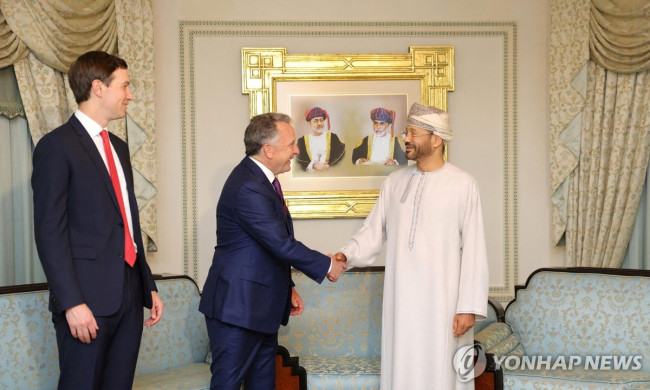 On February 6 (local time), U.S. Special Envoy Steve Wictor (center) and Jared Kushner (left) of the U.S. delegation, who visited Oman for nuclear talks with the U.S., are welcomed by Omani officials. [Yonhap News]
The United States had been pressuring Iran to resume nuclear negotiations, hinting at the possibility of military intervention following the anti-government protests that began in Iran in December.
The biggest point of contention in this round of talks is Iran's uranium enrichment activities.
The U.S. demands that Iran completely abandon uranium enrichment, a demand Iran strongly rejects as a matter of sovereignty. Iran insists on continuing uranium enrichment activities, even if it's done with the participation of a third country in the Middle East.
The U.S. also wishes to address Iran's ballistic missile development program and its support for proxy armed groups in the region, in addition to its nuclear program, during the negotiations.
On February 4, U.S. Secretary of State Mike Pompeo stated, "For the dialogue to lead to meaningful results, ballistic missile range, support for terrorist organizations in the region, the nuclear program, and the treatment of their own citizens must be included (as negotiation agendas)."
Iran, facing threats to the stability of its Islamic theocratic system due to the aftermath of anti-government protests, has agreed to dialogue. However, it has drawn a line, stating that no defense or security matters other than its nuclear program can be part of the negotiation agenda.
Initially, the meeting was planned to be held in Istanbul, Turkey. However, Iran requested a change to Muscat just before the meeting. Iran also insisted that the meeting should be between the U.S. and Iran alone, excluding officials from neighboring countries in the Middle East, which nearly caused the talks to collapse.
Before the meeting began, Araghchi posted on X (formerly Twitter), "Iran will approach diplomacy with a firm memory of the past year," and added, "We will definitively assert our rights."
He further emphasized that "equal status, mutual respect, and mutual interests must be upheld as essential conditions," indicating that unilateral concessions would not be accepted.
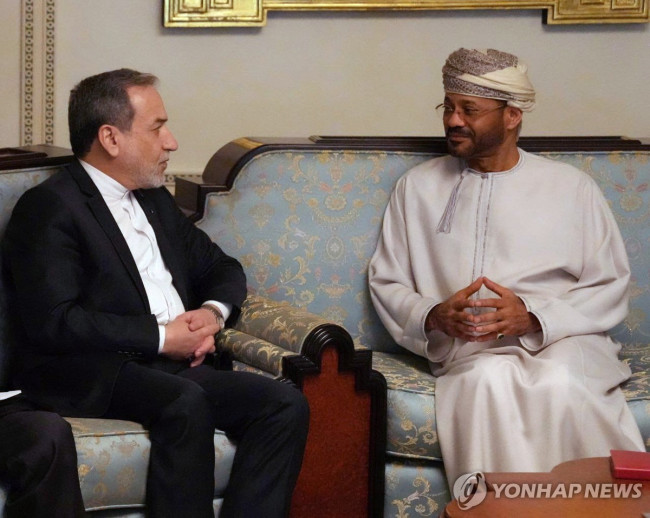 On February 6 (local time), Iranian Foreign Minister Abbas Araghchi (left) and Omani Foreign Minister Badr Albusaidi are in conversation, having met in Oman for nuclear talks with the U.S. [Yonhap News]

 Iranian Foreign Ministry: "Continuing Message Exchanges with the U.S. and Activities of Mediating Countries"
Esmaeil Baghaei, Spokesperson for the Iranian Ministry of Foreign Affairs [Xinhua, Yonhap News file photo]Esmaeil Baghaei, spokesperson for the Iranian Ministry of Foreign Affairs, stated on the 26th
Iranian Foreign Ministry: "Continuing Message Exchanges with the U.S. and Activities of Mediating Countries"
Esmaeil Baghaei, Spokesperson for the Iranian Ministry of Foreign Affairs [Xinhua, Yonhap News file photo]Esmaeil Baghaei, spokesperson for the Iranian Ministry of Foreign Affairs, stated on the 26th
 President Yoon: "Do You Think You Are Safe from the Special Counsel?"... Final Statement Video Released
President Yoon Suk Yeol rebuking the special prosecutor on the 24th. [Court video / @birds_justice X account subtitle GIF] A video of President Yoon Suk Yeol's closing statement at his trial rega
President Yoon: "Do You Think You Are Safe from the Special Counsel?"... Final Statement Video Released
President Yoon Suk Yeol rebuking the special prosecutor on the 24th. [Court video / @birds_justice X account subtitle GIF] A video of President Yoon Suk Yeol's closing statement at his trial rega
 President Yoon, regarding the first-instance ruling on the Public Official Election Act: “An excessive political verdict that distorts the facts… We will appeal immediately.”
The first-instance sentencing hearing for President Yoon Suk Yeol regarding violations of the Public Official Election Act is being broadcast live at Seoul Station on the 27th. [Photo=Yonhap News]Pres
President Yoon, regarding the first-instance ruling on the Public Official Election Act: “An excessive political verdict that distorts the facts… We will appeal immediately.”
The first-instance sentencing hearing for President Yoon Suk Yeol regarding violations of the Public Official Election Act is being broadcast live at Seoul Station on the 27th. [Photo=Yonhap News]Pres
 WSJ: "SK Hynix ADR Premium Is a Sign of AI Trading Overheat"
Advertisement for SK Hynix ADR listing in New York's Times Square [Reuters=Yonhap News file photo]The Wall Street Journal (WSJ) has pointed out that the price of SK Hynix’s American Depositary Recei
WSJ: "SK Hynix ADR Premium Is a Sign of AI Trading Overheat"
Advertisement for SK Hynix ADR listing in New York's Times Square [Reuters=Yonhap News file photo]The Wall Street Journal (WSJ) has pointed out that the price of SK Hynix’s American Depositary Recei
 'Godfather of Japanese Mystery Novels' Keigo Higashino Passes Away After Battle with Cancer at 68
Famous Japanese mystery novelist Keigo Higashino [AFP=Yonhap News]It has been belatedly reported that Keigo Higashino, the "godfather of Japanese mystery novels" and author of bestsellers such as "The
'Godfather of Japanese Mystery Novels' Keigo Higashino Passes Away After Battle with Cancer at 68
Famous Japanese mystery novelist Keigo Higashino [AFP=Yonhap News]It has been belatedly reported that Keigo Higashino, the "godfather of Japanese mystery novels" and author of bestsellers such as "The
 [Park Pil-kyu Security Column] To the Ignorant Trying to Clothe a Beast in Sheep's Clothing
Rep. Kim Byung-joo of the Democratic Party of Korea [Photo=Yonhap News]“The Air Force Academy doesn't teach you how to fly a plane!” “The Army, Navy, and Air Force academies are exactly the
[Park Pil-kyu Security Column] To the Ignorant Trying to Clothe a Beast in Sheep's Clothing
Rep. Kim Byung-joo of the Democratic Party of Korea [Photo=Yonhap News]“The Air Force Academy doesn't teach you how to fly a plane!” “The Army, Navy, and Air Force academies are exactly the
 [Issue Diagnosis] Two Effects of the Election Petition Review
 [Photo] Evidence of Election Fraud Flooding U.S. Media… Trump Had 2.7 Million Votes Stolen
 [Video] U.S. Semiquincentennial Air Show... 'Art in the Sky' streaks across New York
 [Editorial Cartoon] A Draconian Law That Undermines Freedom of Expression

 List
List









