 Deceased Supreme Leader of Iran, Ali Khamenei [EPA Yonhap News]
The "peace through strength" doctrine pursued by President Donald Trump appears to be becoming bolder, following the U.S. and Israeli airstrikes on Iran on the 28th (local time) and the presumed death of Supreme Leader Ayatollah Seyed Ali Khamenei.
This doctrine, stemming from the Roman Empire's adage "If you want peace, prepare for war," is based on an ideology championed by the traditional base of the U.S. Republican Party, particularly neoconservatives.
It sparked an arms race against the former Soviet Union during the Cold War and has recently expanded its targets to adversarial forces like China and Iran. It is a deterrence strategy based on overwhelming military superiority, a slogan that frequently appears in the Trump administration's foreign policy.
Trump's assertive actions have once again drawn attention, as he, along with Israeli Prime Minister Benjamin Netanyahu, announced not only the surprise airstrikes on Iran but also the elimination of Ayatollah Ali Seyed Khamenei, the Supreme Leader of Iran, just 15 hours after the strikes.
Despite his promises to refrain from foreign military intervention based on "America First" isolationism after taking office, President Trump has not hesitated to use force at crucial junctures.
The "Midnight Hammer" operation, which targeted three Iranian nuclear facilities in Fordow, Natanz, and Isfahan with bunker busters five months into his presidency last June, was the beginning. That operation concluded the "12-Day War" between Israel and Iran.
Earlier this year, President Trump, who effectively declared the Western Hemisphere America's domain, launched "Operation Absolute Resolve" against Venezuela, ousting President Nicolas Maduro, a strongman ruler.
The swift nighttime raid on a foreign leader's residence, resulting in his arrest and extradition, stunned the world. The image of Maduro and his wife detained in the U.S. and brought before a court vividly revealed President Trump's worldview, where power supersedes international law.
The airstrikes conducted two months later once again demonstrated audacity. While engaged in nuclear negotiations with Iran, the U.S. seemed to leave the door open for further dialogue, yet bombed and eliminated the dialogue partner's supreme leader.
This was because, despite ongoing negotiations, it was judged that the Iranian regime would not abandon its nuclear weapons program. However, Washington Post reported that some U.S. officials claimed it was because they "detected signs that Iran was about to attack."
In terms of the scale and nature of the military action, "Epic Fury," the operation conducted this time, was far more extensive and comprehensive than those in June of last year or January of this year. President Trump has also signaled further airstrikes aimed at neutralizing Iran's missiles and devastating its navy.
The Trump administration had been amassing air power, estimated to be the largest since the 2003 Iraq War, in the Middle East, not only to pressure Iran into abandoning its nuclear program but also to prepare for the possibility of using military force as "Plan B" in case negotiations failed.
Some analysts suggest that this military action is, in fact, "Plan A." They argue that the administration merely stalled for time to secure the necessary resources for airstrikes and counterattacks against Iran, and its actual intention was military action, not the "diplomacy first" approach it outwardly espoused.
Trump's foreign policy strategy of achieving objectives through physical force appears to have proven effective militarily through the arrest of Maduro and the elimination of Khamenei. Both operations were swift and unexpected, with minimal U.S. casualties.
In a video message immediately after the commencement of hostilities, President Trump foreshadowed "overwhelming power and destructive force" against Iran, and based on the developments so far, this was no empty threat.
Furthermore, by announcing Khamenei's death, he stated it was "a singular, great opportunity for the people of Iran to reclaim their destiny," clearly indicating that the ultimate objective of the operation was the end of the Iranian theocratic regime.
His repeated calls for regime change in Iran are intertwined with the perception that for his doctrine to be validated, Iran, the world's third-largest oil producer, must, like Venezuela, lead to the establishment of a pro-American government.
He appears to view this not just as a means of subjugating adversarial nations with military force, but as a way to solidify America's economic and geopolitical dominance in South America and the Middle East.
From President Trump's perspective, this airstrike is seen as a gamble to overcome domestic political crises ahead of the November midterm elections, making tangible results that align with American interests particularly urgent. Some speculate that this move is intended to pivot the political landscape, especially after the Supreme Court ruled his global tariffs illegal.
His demand for exclusive access to Greenland, a Danish territory, and the discussion of imposing high tariffs on European countries that opposed it, are also interpreted as measures within the same context of expanding control over strategic strongholds in the Western Hemisphere.
On another front, this hardline foreign policy stance may have been seen as appealing to voters by highlighting America's global leadership, providing "psychological satisfaction," and helping to rally the traditional Republican base.
However, if the overthrow of the Iranian regime does not go as planned and is met with armed resistance, leading to a prolonged war or increased U.S. casualties, the political burden on the Trump administration could rapidly escalate, potentially leading to a backlash in public opinion.
The reaction of Trump's core supporters, known as MAGA (Make America Great Again), will likely be a key factor.
The MAGA movement, which propelled President Trump to victory in the 2016 and 2024 presidential elections, has historically been highly critical of long-term, costly foreign interventions like the Iraq War.
zheng@yna.co.kr
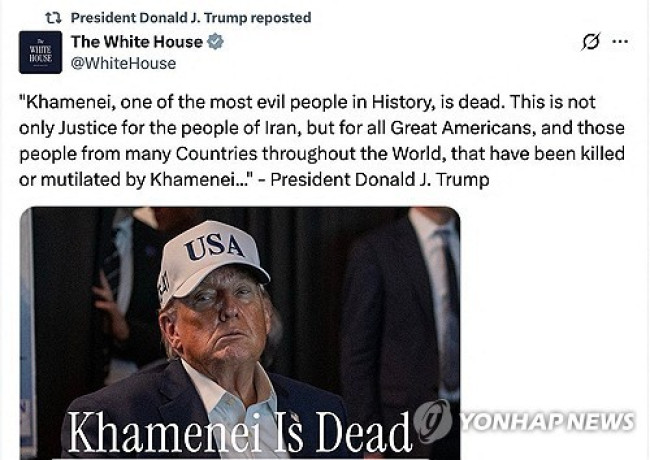 White House SNS announcing Trump's 'Khamenei Death Announcement' [AFP Yonhap News]

 Iranian Foreign Ministry: "Continuing Message Exchanges with the U.S. and Activities of Mediating Countries"
Esmaeil Baghaei, Spokesperson for the Iranian Ministry of Foreign Affairs [Xinhua, Yonhap News file photo]Esmaeil Baghaei, spokesperson for the Iranian Ministry of Foreign Affairs, stated on the 26th
Iranian Foreign Ministry: "Continuing Message Exchanges with the U.S. and Activities of Mediating Countries"
Esmaeil Baghaei, Spokesperson for the Iranian Ministry of Foreign Affairs [Xinhua, Yonhap News file photo]Esmaeil Baghaei, spokesperson for the Iranian Ministry of Foreign Affairs, stated on the 26th
 President Yoon: "Do You Think You Are Safe from the Special Counsel?"... Final Statement Video Released
President Yoon Suk Yeol rebuking the special prosecutor on the 24th. [Court video / @birds_justice X account subtitle GIF] A video of President Yoon Suk Yeol's closing statement at his trial rega
President Yoon: "Do You Think You Are Safe from the Special Counsel?"... Final Statement Video Released
President Yoon Suk Yeol rebuking the special prosecutor on the 24th. [Court video / @birds_justice X account subtitle GIF] A video of President Yoon Suk Yeol's closing statement at his trial rega
 President Yoon, regarding the first-instance ruling on the Public Official Election Act: “An excessive political verdict that distorts the facts… We will appeal immediately.”
The first-instance sentencing hearing for President Yoon Suk Yeol regarding violations of the Public Official Election Act is being broadcast live at Seoul Station on the 27th. [Photo=Yonhap News]Pres
President Yoon, regarding the first-instance ruling on the Public Official Election Act: “An excessive political verdict that distorts the facts… We will appeal immediately.”
The first-instance sentencing hearing for President Yoon Suk Yeol regarding violations of the Public Official Election Act is being broadcast live at Seoul Station on the 27th. [Photo=Yonhap News]Pres
 WSJ: "SK Hynix ADR Premium Is a Sign of AI Trading Overheat"
Advertisement for SK Hynix ADR listing in New York's Times Square [Reuters=Yonhap News file photo]The Wall Street Journal (WSJ) has pointed out that the price of SK Hynix’s American Depositary Recei
WSJ: "SK Hynix ADR Premium Is a Sign of AI Trading Overheat"
Advertisement for SK Hynix ADR listing in New York's Times Square [Reuters=Yonhap News file photo]The Wall Street Journal (WSJ) has pointed out that the price of SK Hynix’s American Depositary Recei
 'Godfather of Japanese Mystery Novels' Keigo Higashino Passes Away After Battle with Cancer at 68
Famous Japanese mystery novelist Keigo Higashino [AFP=Yonhap News]It has been belatedly reported that Keigo Higashino, the "godfather of Japanese mystery novels" and author of bestsellers such as "The
'Godfather of Japanese Mystery Novels' Keigo Higashino Passes Away After Battle with Cancer at 68
Famous Japanese mystery novelist Keigo Higashino [AFP=Yonhap News]It has been belatedly reported that Keigo Higashino, the "godfather of Japanese mystery novels" and author of bestsellers such as "The
 [Park Pil-kyu Security Column] To the Ignorant Trying to Clothe a Beast in Sheep's Clothing
Rep. Kim Byung-joo of the Democratic Party of Korea [Photo=Yonhap News]“The Air Force Academy doesn't teach you how to fly a plane!” “The Army, Navy, and Air Force academies are exactly the
[Park Pil-kyu Security Column] To the Ignorant Trying to Clothe a Beast in Sheep's Clothing
Rep. Kim Byung-joo of the Democratic Party of Korea [Photo=Yonhap News]“The Air Force Academy doesn't teach you how to fly a plane!” “The Army, Navy, and Air Force academies are exactly the
 [Issue Diagnosis] Two Effects of the Election Petition Review
 [Photo] Evidence of Election Fraud Flooding U.S. Media… Trump Had 2.7 Million Votes Stolen
 [Video] U.S. Semiquincentennial Air Show... 'Art in the Sky' streaks across New York
 [Editorial Cartoon] A Draconian Law That Undermines Freedom of Expression

 List
List










