 The KOSPI is displayed on the status board at the Hana Bank headquarters in Jung-gu, Seoul on the 3rd. The KOSPI opened at 6,165.15, down 78.98 points (1.26%) from the previous trading day, while the KOSDAQ opened at 1,169.82, down 22.96 points (1.92%). The won/dollar exchange rate opened at 1,462.3 won, up 22.6 won. [Yonhap News]
The KOSPI could not withstand the extreme turmoil in the Middle East caused by the war between the United States and Iran, and eventually declined.
While individual net buying seemed to defend the bottom of the index, it was pushed down by strong foreign selling from the afternoon, ultimately recording a 'Black Tuesday'.
According to the Korea Exchange on the 3rd, the KOSPI started at 6,165.15, down 78.98 points (1.26%) from the previous trading day, paused briefly, and then reduced its decline to recover to 6,180.45.
Around 10:30 AM that day, foreigners net sold over 2 trillion won, but individuals net bought about 1.9 trillion won, defending the index's decline.
The fierce supply and demand battle gradually shifted to individuals being pushed aside by the 'twin' net selling of foreigners and institutions.
The decline rapidly widened, and by 11:21 AM, it fell to 5,987.15, even dropping below the 6,000 mark.
The index, which had fluctuated around the 6,000 mark, began to fall in earnest from the afternoon, with the rate of decline widening to over 5%. The circuit breaker for program sell orders was triggered on the KOSPI market for the first time in a month.
The exchange triggered the KOSPI sell circuit breaker at approximately 12:05:53 PM that day. The sell circuit breaker is triggered when the KOSPI 200 futures index falls by more than 5% and this continues for one minute.
As of 12:50 PM, the KOSPI is trading at 5,971.46, down 272.67 points (4.37%) from the previous trading day.
Individuals are net buying 4.1581 trillion won, while foreigners are net selling 4.3266 trillion won, driving down the index.
At the same time, the KOSDAQ index is down 20.53 points (1.72%) at 1,172.74.
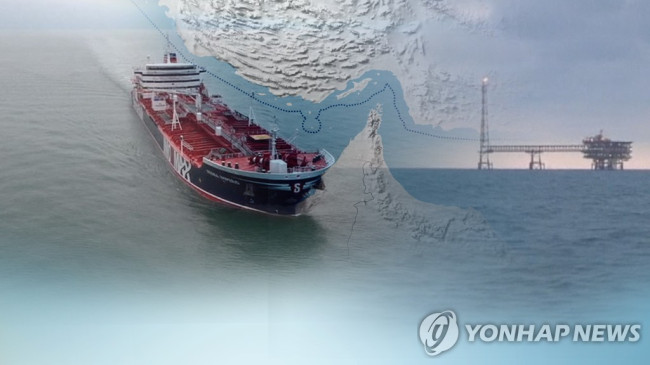 Focus on the 39km wide Strait of Hormuz... "20% of World's Oil Transported" (CG) [Yonhap News TV]
The main downward factor in the domestic stock market today is Middle East risk.
Volatility has increased as the war between the US and Iran intensified over the weekend and uncertainty in the Middle East heightened.
In particular, as international oil prices surged due to Iran's threat to blockade the Strait of Hormuz, oil and shipping stocks soared, while airlines, chemicals, and steel-related stocks, facing the burden of rising fuel and raw material costs, showed weakness.
Lee Jae-won, a researcher at Shinhan Investment & Securities, analyzed, "The key is the volatility of oil prices and interest rates. Despite the issue of blockading the Strait of Hormuz, the actual impact remains uncertain, and the stock market is likely to be secondarily affected by the fluctuations in oil prices and interest rates."
Kim Doo-eon, a researcher at Hana Securities, judged, "Due to the Middle East situation, the KOSPI may face a period of adjustment in the short term. Additionally, the won/dollar exchange rate has encountered a 'risk-off' variable that opens up the upper range of 1,480 won."
He further predicted, "The crucial factors are oil prices and the Strait of Hormuz. In the worst-case scenario, oil prices could reach $120, but there are limitations to the blockade being prolonged. The exchange rate is also expected to gradually stabilize around 1,430 won."

 Iranian Foreign Ministry: "Continuing Message Exchanges with the U.S. and Activities of Mediating Countries"
Esmaeil Baghaei, Spokesperson for the Iranian Ministry of Foreign Affairs [Xinhua, Yonhap News file photo]Esmaeil Baghaei, spokesperson for the Iranian Ministry of Foreign Affairs, stated on the 26th
Iranian Foreign Ministry: "Continuing Message Exchanges with the U.S. and Activities of Mediating Countries"
Esmaeil Baghaei, Spokesperson for the Iranian Ministry of Foreign Affairs [Xinhua, Yonhap News file photo]Esmaeil Baghaei, spokesperson for the Iranian Ministry of Foreign Affairs, stated on the 26th
 President Yoon: "Do You Think You Are Safe from the Special Counsel?"... Final Statement Video Released
President Yoon Suk Yeol rebuking the special prosecutor on the 24th. [Court video / @birds_justice X account subtitle GIF] A video of President Yoon Suk Yeol's closing statement at his trial rega
President Yoon: "Do You Think You Are Safe from the Special Counsel?"... Final Statement Video Released
President Yoon Suk Yeol rebuking the special prosecutor on the 24th. [Court video / @birds_justice X account subtitle GIF] A video of President Yoon Suk Yeol's closing statement at his trial rega
 President Yoon, regarding the first-instance ruling on the Public Official Election Act: “An excessive political verdict that distorts the facts… We will appeal immediately.”
The first-instance sentencing hearing for President Yoon Suk Yeol regarding violations of the Public Official Election Act is being broadcast live at Seoul Station on the 27th. [Photo=Yonhap News]Pres
President Yoon, regarding the first-instance ruling on the Public Official Election Act: “An excessive political verdict that distorts the facts… We will appeal immediately.”
The first-instance sentencing hearing for President Yoon Suk Yeol regarding violations of the Public Official Election Act is being broadcast live at Seoul Station on the 27th. [Photo=Yonhap News]Pres
 WSJ: "SK Hynix ADR Premium Is a Sign of AI Trading Overheat"
Advertisement for SK Hynix ADR listing in New York's Times Square [Reuters=Yonhap News file photo]The Wall Street Journal (WSJ) has pointed out that the price of SK Hynix’s American Depositary Recei
WSJ: "SK Hynix ADR Premium Is a Sign of AI Trading Overheat"
Advertisement for SK Hynix ADR listing in New York's Times Square [Reuters=Yonhap News file photo]The Wall Street Journal (WSJ) has pointed out that the price of SK Hynix’s American Depositary Recei
 'Godfather of Japanese Mystery Novels' Keigo Higashino Passes Away After Battle with Cancer at 68
Famous Japanese mystery novelist Keigo Higashino [AFP=Yonhap News]It has been belatedly reported that Keigo Higashino, the "godfather of Japanese mystery novels" and author of bestsellers such as "The
'Godfather of Japanese Mystery Novels' Keigo Higashino Passes Away After Battle with Cancer at 68
Famous Japanese mystery novelist Keigo Higashino [AFP=Yonhap News]It has been belatedly reported that Keigo Higashino, the "godfather of Japanese mystery novels" and author of bestsellers such as "The
 [Park Pil-kyu Security Column] To the Ignorant Trying to Clothe a Beast in Sheep's Clothing
Rep. Kim Byung-joo of the Democratic Party of Korea [Photo=Yonhap News]“The Air Force Academy doesn't teach you how to fly a plane!” “The Army, Navy, and Air Force academies are exactly the
[Park Pil-kyu Security Column] To the Ignorant Trying to Clothe a Beast in Sheep's Clothing
Rep. Kim Byung-joo of the Democratic Party of Korea [Photo=Yonhap News]“The Air Force Academy doesn't teach you how to fly a plane!” “The Army, Navy, and Air Force academies are exactly the
 [Issue Diagnosis] Two Effects of the Election Petition Review
 [Photo] Evidence of Election Fraud Flooding U.S. Media… Trump Had 2.7 Million Votes Stolen
 [Video] U.S. Semiquincentennial Air Show... 'Art in the Sky' streaks across New York
 [Editorial Cartoon] A Draconian Law That Undermines Freedom of Expression

 List
List









