 The price of gasoline and diesel at domestic gas stations is rapidly increasing due to the aftermath of airstrikes by the United States and Israel on Iran, which began on the 28th of last month (local time). Pictured is a gas station in Seoul on the 5th displaying fuel prices. [Yonhap News]
As volatility in international oil prices heightens due to the situation in the Middle East, domestic gasoline and diesel prices are surging as demand increases due to rising anxiety.
In response to the sharp rise in gas station prices, the government is considering a 'maximum price designation' measure to prevent gasoline prices at gas stations from exceeding a certain level.
According to Korea National Oil Corporation's oil price information system, Opinet, as of 10 a.m. today, the national average gasoline price was recorded at 1,807.1 won per liter, an increase of 29.6 won from the previous day.
This is the first time the national average gasoline price has exceeded 1,800 won in approximately 3 years and 7 months, since August 12, 2022 (1,805.9 won).
The average gasoline price in Seoul recorded 1,874.4 won, an increase of 31.8 won from the previous day.
Diesel prices are also rising sharply.
The national average diesel price recorded 1,785.3 won, an increase of 56.5 won in one day, and the average diesel price in Seoul rose by 61.4 won to 1,865.4 won.
The recent rise in domestic oil prices is interpreted as a result of increased volatility in international oil prices due to escalating geopolitical tensions in the Middle East.
International crude oil prices are on the rise with growing concerns about supply disruptions, which is exerting upward pressure on domestic petroleum product prices.
While fluctuations in international oil prices are typically reflected in domestic gas station prices with a lag of about 2-3 weeks, this time, domestic oil prices are soaring without any noticeable delay.
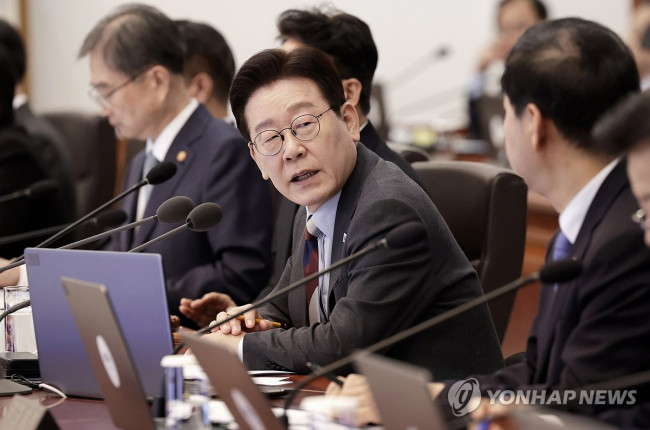 President Lee Jae-myung is speaking at an extraordinary cabinet meeting held at Cheong Wa Dae on the 5th to discuss countermeasures for the Middle East situation. [Cheong Wa Dae Tongshin Photojournalist Group]
President Lee Jae-myung stated at an extraordinary cabinet meeting presided over at Cheong Wa Dae today, "Despite no objective significant disruptions occurring yet, prices have suddenly soared. Prices differ from morning to afternoon to evening, and I've heard some places have increased prices by nearly 200 won per liter," ordering the development of countermeasures.
In response, Deputy Prime Minister and Minister of Economy and Finance Gu Yoon-cheol replied, "Article 23 of the Petroleum Business Act stipulates that a maximum price can be designated in cases of sharp price increases. We will review prices this afternoon and consider designating a maximum price through public notice if they are high."
The Korea Oil Station Association agreed that an investigation is necessary into the abnormal price increases but stated that the management conditions of gas stations need to be considered in the development of countermeasures.
Gas stations typically set their consumer retail prices by adding a certain profit margin to the price supplied by oil refiners. According to industry sources, the profit margin for gas stations is generally around 4-5%.
An official from the association said, "This proposed measure is essentially close to a price announcement system, appearing to be a stronger action than the existing low-price gas station policy. The association has previously requested the government to set prices considering gas station profit margins."
The oil refining industry appears to be in a difficult position regarding the government's consideration of price controls.
This is because most domestic gas stations operate as independent businesses rather than being directly managed by oil refiners, making it difficult for refiners to control retail sales prices.
An industry official commented, "The impact of the Iran situation has not yet been fully reflected in the volumes currently supplied by refiners to gas stations. However, it seems that some gas stations have preemptively raised prices due to increased demand driven by concerns about price hikes."
Some speculate that if the government intervenes in price management, oil refiners may bear the burden by setting supply prices lower than the factors for increase or by reducing distribution margins.
Another industry official said, "Even if refiners increase their supply volume, it is difficult to be certain whether it will be immediately reflected in retail prices."

 Iranian Foreign Ministry: "Continuing Message Exchanges with the U.S. and Activities of Mediating Countries"
Esmaeil Baghaei, Spokesperson for the Iranian Ministry of Foreign Affairs [Xinhua, Yonhap News file photo]Esmaeil Baghaei, spokesperson for the Iranian Ministry of Foreign Affairs, stated on the 26th
Iranian Foreign Ministry: "Continuing Message Exchanges with the U.S. and Activities of Mediating Countries"
Esmaeil Baghaei, Spokesperson for the Iranian Ministry of Foreign Affairs [Xinhua, Yonhap News file photo]Esmaeil Baghaei, spokesperson for the Iranian Ministry of Foreign Affairs, stated on the 26th
 President Yoon: "Do You Think You Are Safe from the Special Counsel?"... Final Statement Video Released
President Yoon Suk Yeol rebuking the special prosecutor on the 24th. [Court video / @birds_justice X account subtitle GIF] A video of President Yoon Suk Yeol's closing statement at his trial rega
President Yoon: "Do You Think You Are Safe from the Special Counsel?"... Final Statement Video Released
President Yoon Suk Yeol rebuking the special prosecutor on the 24th. [Court video / @birds_justice X account subtitle GIF] A video of President Yoon Suk Yeol's closing statement at his trial rega
 President Yoon, regarding the first-instance ruling on the Public Official Election Act: “An excessive political verdict that distorts the facts… We will appeal immediately.”
The first-instance sentencing hearing for President Yoon Suk Yeol regarding violations of the Public Official Election Act is being broadcast live at Seoul Station on the 27th. [Photo=Yonhap News]Pres
President Yoon, regarding the first-instance ruling on the Public Official Election Act: “An excessive political verdict that distorts the facts… We will appeal immediately.”
The first-instance sentencing hearing for President Yoon Suk Yeol regarding violations of the Public Official Election Act is being broadcast live at Seoul Station on the 27th. [Photo=Yonhap News]Pres
 WSJ: "SK Hynix ADR Premium Is a Sign of AI Trading Overheat"
Advertisement for SK Hynix ADR listing in New York's Times Square [Reuters=Yonhap News file photo]The Wall Street Journal (WSJ) has pointed out that the price of SK Hynix’s American Depositary Recei
WSJ: "SK Hynix ADR Premium Is a Sign of AI Trading Overheat"
Advertisement for SK Hynix ADR listing in New York's Times Square [Reuters=Yonhap News file photo]The Wall Street Journal (WSJ) has pointed out that the price of SK Hynix’s American Depositary Recei
 'Godfather of Japanese Mystery Novels' Keigo Higashino Passes Away After Battle with Cancer at 68
Famous Japanese mystery novelist Keigo Higashino [AFP=Yonhap News]It has been belatedly reported that Keigo Higashino, the "godfather of Japanese mystery novels" and author of bestsellers such as "The
'Godfather of Japanese Mystery Novels' Keigo Higashino Passes Away After Battle with Cancer at 68
Famous Japanese mystery novelist Keigo Higashino [AFP=Yonhap News]It has been belatedly reported that Keigo Higashino, the "godfather of Japanese mystery novels" and author of bestsellers such as "The
 [Park Pil-kyu Security Column] To the Ignorant Trying to Clothe a Beast in Sheep's Clothing
Rep. Kim Byung-joo of the Democratic Party of Korea [Photo=Yonhap News]“The Air Force Academy doesn't teach you how to fly a plane!” “The Army, Navy, and Air Force academies are exactly the
[Park Pil-kyu Security Column] To the Ignorant Trying to Clothe a Beast in Sheep's Clothing
Rep. Kim Byung-joo of the Democratic Party of Korea [Photo=Yonhap News]“The Air Force Academy doesn't teach you how to fly a plane!” “The Army, Navy, and Air Force academies are exactly the
 [Issue Diagnosis] Two Effects of the Election Petition Review
 [Photo] Evidence of Election Fraud Flooding U.S. Media… Trump Had 2.7 Million Votes Stolen
 [Video] U.S. Semiquincentennial Air Show... 'Art in the Sky' streaks across New York
 [Editorial Cartoon] A Draconian Law That Undermines Freedom of Expression

 List
List









