 Argentine President Milei and US President Trump [AP Yonhap News]
Argentine President Javier Milei has characterized the escalating tensions in the Middle East due to the conflict between the United States, Israel, and Iran as a geopolitical clash related to the reshaping of the international political order, predicting that China's international isolation could deepen as a result.
In a radio interview on the 9th (local time), President Milei criticized some analysts who interpret the current conflict as a dispute over oil, calling it a "conceptually very weak and erroneous argument."
He emphasized that the situation should be understood within the framework of strategic competition among the world's major powers.
Specifically, regarding the US response, he stated that they are "acting entirely from a geopolitical perspective," explaining that strategic objectives such as strengthening influence in the Americas and countering international terrorism are at play.
President Milei also argued that Iran's nuclear program is one of the core factors in the conflict.
He said that Iran has continued its uranium enrichment, which could lead to military capabilities that pose a threat to the international community.
Furthermore, he claimed that the Iranian regime is linked to international terrorist activities and is exerting influence in Latin America through Cuba and Venezuela.
President Milei acknowledged that the current conflict could be a destabilizing factor for the global economy in the short term, but predicted that it would ultimately promote the reshaping of the international political order in the long term.
"There may be a temporary deterioration in the global economy, but ultimately, a very strong political realignment will follow," he said.
Meanwhile, he raised the possibility that China's international standing could weaken amidst these changes.
"China will become more isolated," President Milei asserted. "If some countries that have cooperated with China weaken or collapse, China's strategic environment could also worsen." He further described some of China's partner countries as "bad alliances that tarnish China's name," suggesting that their weakening could accelerate changes in the international order.
These remarks are interpreted as stemming from the recognition that the current conflict surrounding the Middle East extends beyond regional security issues involving the US, Iran, and Israel, and is linked to a shift in the balance of power among global powers.
Specifically, it is interpreted as a statement considering that if the US and Western bloc strengthen security cooperation, the positions of some countries strategically close to China could weaken.
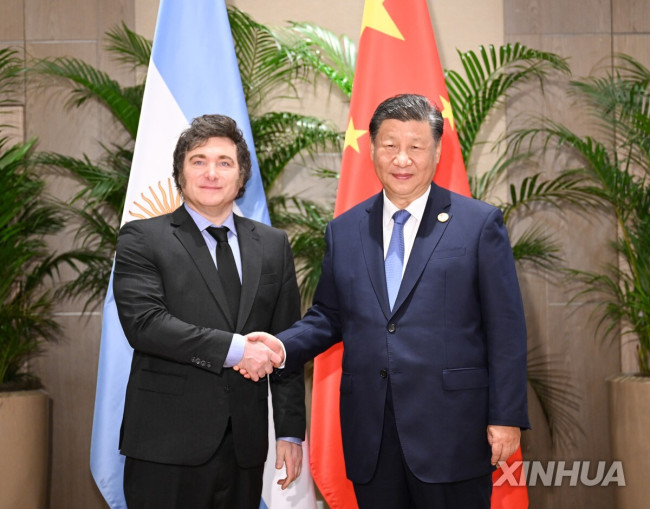 Argentine President Milei and Chinese President Xi Jinping [Xinhua Yonhap News]
However, a more complex reality exists in actual diplomatic and economic relations.
Since taking office, President Milei has clearly pursued a pro-Western foreign policy by emphasizing strategic cooperation with the United States and Israel, while simultaneously maintaining economic relations with China.
Analysis suggests that while prioritizing strategic cooperation with the US in diplomacy and security, Argentina is maintaining its relationship with China in terms of economy and trade, a pragmatic diplomatic stance of "security with the US, trade with China."
This is evaluated as reflecting the structural situation where the Milei administration, which emphasizes a US-centric political and security line, finds it difficult to completely exclude the Chinese market and investment economically. China is Argentina's second-largest trading partner and plays a significant role in agricultural exports and investments in energy and infrastructure.
For this reason, the Argentine government is assessed to be continuing a "tightrope diplomacy," emphasizing a US-centric line politically and diplomatically while maintaining economic cooperation with China.

 Iranian Foreign Ministry: "Continuing Message Exchanges with the U.S. and Activities of Mediating Countries"
Esmaeil Baghaei, Spokesperson for the Iranian Ministry of Foreign Affairs [Xinhua, Yonhap News file photo]Esmaeil Baghaei, spokesperson for the Iranian Ministry of Foreign Affairs, stated on the 26th
Iranian Foreign Ministry: "Continuing Message Exchanges with the U.S. and Activities of Mediating Countries"
Esmaeil Baghaei, Spokesperson for the Iranian Ministry of Foreign Affairs [Xinhua, Yonhap News file photo]Esmaeil Baghaei, spokesperson for the Iranian Ministry of Foreign Affairs, stated on the 26th
 President Yoon: "Do You Think You Are Safe from the Special Counsel?"... Final Statement Video Released
President Yoon Suk Yeol rebuking the special prosecutor on the 24th. [Court video / @birds_justice X account subtitle GIF] A video of President Yoon Suk Yeol's closing statement at his trial rega
President Yoon: "Do You Think You Are Safe from the Special Counsel?"... Final Statement Video Released
President Yoon Suk Yeol rebuking the special prosecutor on the 24th. [Court video / @birds_justice X account subtitle GIF] A video of President Yoon Suk Yeol's closing statement at his trial rega
 President Yoon, regarding the first-instance ruling on the Public Official Election Act: “An excessive political verdict that distorts the facts… We will appeal immediately.”
The first-instance sentencing hearing for President Yoon Suk Yeol regarding violations of the Public Official Election Act is being broadcast live at Seoul Station on the 27th. [Photo=Yonhap News]Pres
President Yoon, regarding the first-instance ruling on the Public Official Election Act: “An excessive political verdict that distorts the facts… We will appeal immediately.”
The first-instance sentencing hearing for President Yoon Suk Yeol regarding violations of the Public Official Election Act is being broadcast live at Seoul Station on the 27th. [Photo=Yonhap News]Pres
 WSJ: "SK Hynix ADR Premium Is a Sign of AI Trading Overheat"
Advertisement for SK Hynix ADR listing in New York's Times Square [Reuters=Yonhap News file photo]The Wall Street Journal (WSJ) has pointed out that the price of SK Hynix’s American Depositary Recei
WSJ: "SK Hynix ADR Premium Is a Sign of AI Trading Overheat"
Advertisement for SK Hynix ADR listing in New York's Times Square [Reuters=Yonhap News file photo]The Wall Street Journal (WSJ) has pointed out that the price of SK Hynix’s American Depositary Recei
 'Godfather of Japanese Mystery Novels' Keigo Higashino Passes Away After Battle with Cancer at 68
Famous Japanese mystery novelist Keigo Higashino [AFP=Yonhap News]It has been belatedly reported that Keigo Higashino, the "godfather of Japanese mystery novels" and author of bestsellers such as "The
'Godfather of Japanese Mystery Novels' Keigo Higashino Passes Away After Battle with Cancer at 68
Famous Japanese mystery novelist Keigo Higashino [AFP=Yonhap News]It has been belatedly reported that Keigo Higashino, the "godfather of Japanese mystery novels" and author of bestsellers such as "The
 [Park Pil-kyu Security Column] To the Ignorant Trying to Clothe a Beast in Sheep's Clothing
Rep. Kim Byung-joo of the Democratic Party of Korea [Photo=Yonhap News]“The Air Force Academy doesn't teach you how to fly a plane!” “The Army, Navy, and Air Force academies are exactly the
[Park Pil-kyu Security Column] To the Ignorant Trying to Clothe a Beast in Sheep's Clothing
Rep. Kim Byung-joo of the Democratic Party of Korea [Photo=Yonhap News]“The Air Force Academy doesn't teach you how to fly a plane!” “The Army, Navy, and Air Force academies are exactly the
 [Issue Diagnosis] Two Effects of the Election Petition Review
 [Photo] Evidence of Election Fraud Flooding U.S. Media… Trump Had 2.7 Million Votes Stolen
 [Video] U.S. Semiquincentennial Air Show... 'Art in the Sky' streaks across New York
 [Editorial Cartoon] A Draconian Law That Undermines Freedom of Expression

 List
List









