 U.S. President Trump (left) and Japanese Prime Minister Takaichi in a summit meeting in October 2025 [UPI Yonhap News]
Yomiuri Shimbun reported on the 11th that the United States is likely to request Japan's support in the Iran war during the US-Japan summit to be held in the U.S. on the 19th (local time).
The newspaper pointed out that Japanese Prime Minister Sanae Takaichi could face a difficult decision if U.S. President Donald Trump demands concrete support measures for the Iran war from Japan.
Prime Minister Takaichi has so far refrained from externally commenting on the U.S. attack on Iran, focusing on diplomatic roles.
On the 2nd, he showed a cautious attitude at a Budget Committee meeting of the Japanese House of Representatives, stating, "I do not have detailed information, so I will refrain from making a legal assessment" regarding the U.S. and Israeli attacks on Iran.
He emphasized, "We will continue to make all necessary diplomatic efforts in cooperation with the international community to ensure the situation de-escalates quickly."
On the 9th, Prime Minister Takaichi also expressed caution at a Budget Committee meeting of the House of Representatives, saying, "I have not spoken with President Trump" and "The U.S. must have its own reasons. I will listen to them."
However, it is anticipated that President Trump may request more explicit "support" from Japan at the summit.
Regarding support measures, it is mentioned that the U.S. may request Japan's Self-Defense Forces to escort oil tankers or remove mines in the Strait of Hormuz.
Earlier, the Asahi Shimbun also reported that the Japanese government has begun reviewing response measures in preparation for a request for support from the U.S. regarding military action against Iran.
According to the Asahi Shimbun, options such as dispatching Self-Defense Force patrol aircraft or aerial refueling aircraft have been discussed within the Japanese government as response measures.
However, a key issue is expected to be whether the legal basis for the Self-Defense Forces to support the U.S. attack on Iran will be collective self-defense.
Collective self-defense refers to the right to jointly respond to an attack on a country with close relations, such as an ally, even if the country itself is not under attack.
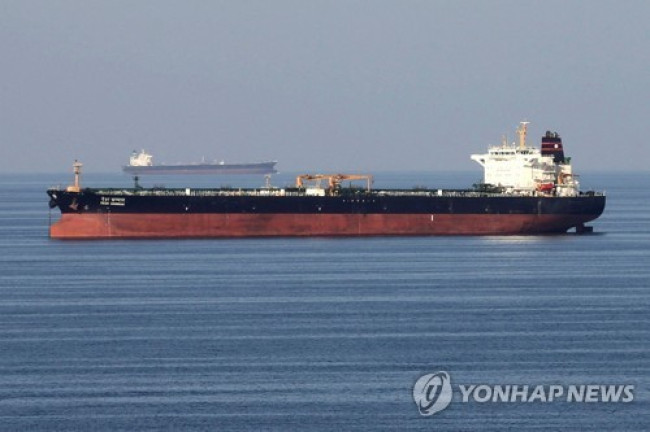 Oil tankers passing through the Strait of Hormuz [Reuters Yonhap News]
In 2015, during Prime Minister Shinzo Abe's tenure, Japan passed security-related laws that permitted collective self-defense.
At the time, Prime Minister Abe cited mine removal in the Strait of Hormuz as an example of a "life-threatening situation."
However, it is generally understood that Japan's current oil reserves are sufficient for about 250 days, making it difficult to consider it an immediate life-or-death issue.
Chief Cabinet Secretary Minoru Kiihara, the Japanese government's spokesperson, also stated on the 2nd that he does not believe the current situation constitutes a "life-threatening situation" that would allow for the exercise of collective self-defense in the event of Iran blockading the Strait of Hormuz.
Even if it does not fall under a "life-threatening situation," there is also the option of providing rear support, such as refueling U.S. warships, by deeming it a "situation that could have an important impact," which precedes a life-threatening situation.
A "situation that could have an important impact" refers to a situation where, if left unchecked, there is a risk of leading to a direct armed attack on Japan.
Even in this case, there are calls for consideration of how Middle Eastern countries would perceive such actions.
A Japanese government official told Yomiuri, "While we will essentially align with the United States to maintain the alliance's deterrence, we want to avoid getting too deeply involved in the Iran issue."

 Iranian Foreign Ministry: "Continuing Message Exchanges with the U.S. and Activities of Mediating Countries"
Esmaeil Baghaei, Spokesperson for the Iranian Ministry of Foreign Affairs [Xinhua, Yonhap News file photo]Esmaeil Baghaei, spokesperson for the Iranian Ministry of Foreign Affairs, stated on the 26th
Iranian Foreign Ministry: "Continuing Message Exchanges with the U.S. and Activities of Mediating Countries"
Esmaeil Baghaei, Spokesperson for the Iranian Ministry of Foreign Affairs [Xinhua, Yonhap News file photo]Esmaeil Baghaei, spokesperson for the Iranian Ministry of Foreign Affairs, stated on the 26th
 President Yoon: "Do You Think You Are Safe from the Special Counsel?"... Final Statement Video Released
President Yoon Suk Yeol rebuking the special prosecutor on the 24th. [Court video / @birds_justice X account subtitle GIF] A video of President Yoon Suk Yeol's closing statement at his trial rega
President Yoon: "Do You Think You Are Safe from the Special Counsel?"... Final Statement Video Released
President Yoon Suk Yeol rebuking the special prosecutor on the 24th. [Court video / @birds_justice X account subtitle GIF] A video of President Yoon Suk Yeol's closing statement at his trial rega
 President Yoon, regarding the first-instance ruling on the Public Official Election Act: “An excessive political verdict that distorts the facts… We will appeal immediately.”
The first-instance sentencing hearing for President Yoon Suk Yeol regarding violations of the Public Official Election Act is being broadcast live at Seoul Station on the 27th. [Photo=Yonhap News]Pres
President Yoon, regarding the first-instance ruling on the Public Official Election Act: “An excessive political verdict that distorts the facts… We will appeal immediately.”
The first-instance sentencing hearing for President Yoon Suk Yeol regarding violations of the Public Official Election Act is being broadcast live at Seoul Station on the 27th. [Photo=Yonhap News]Pres
 WSJ: "SK Hynix ADR Premium Is a Sign of AI Trading Overheat"
Advertisement for SK Hynix ADR listing in New York's Times Square [Reuters=Yonhap News file photo]The Wall Street Journal (WSJ) has pointed out that the price of SK Hynix’s American Depositary Recei
WSJ: "SK Hynix ADR Premium Is a Sign of AI Trading Overheat"
Advertisement for SK Hynix ADR listing in New York's Times Square [Reuters=Yonhap News file photo]The Wall Street Journal (WSJ) has pointed out that the price of SK Hynix’s American Depositary Recei
 'Godfather of Japanese Mystery Novels' Keigo Higashino Passes Away After Battle with Cancer at 68
Famous Japanese mystery novelist Keigo Higashino [AFP=Yonhap News]It has been belatedly reported that Keigo Higashino, the "godfather of Japanese mystery novels" and author of bestsellers such as "The
'Godfather of Japanese Mystery Novels' Keigo Higashino Passes Away After Battle with Cancer at 68
Famous Japanese mystery novelist Keigo Higashino [AFP=Yonhap News]It has been belatedly reported that Keigo Higashino, the "godfather of Japanese mystery novels" and author of bestsellers such as "The
 [Park Pil-kyu Security Column] To the Ignorant Trying to Clothe a Beast in Sheep's Clothing
Rep. Kim Byung-joo of the Democratic Party of Korea [Photo=Yonhap News]“The Air Force Academy doesn't teach you how to fly a plane!” “The Army, Navy, and Air Force academies are exactly the
[Park Pil-kyu Security Column] To the Ignorant Trying to Clothe a Beast in Sheep's Clothing
Rep. Kim Byung-joo of the Democratic Party of Korea [Photo=Yonhap News]“The Air Force Academy doesn't teach you how to fly a plane!” “The Army, Navy, and Air Force academies are exactly the
 [Issue Diagnosis] Two Effects of the Election Petition Review
 [Photo] Evidence of Election Fraud Flooding U.S. Media… Trump Had 2.7 Million Votes Stolen
 [Video] U.S. Semiquincentennial Air Show... 'Art in the Sky' streaks across New York
 [Editorial Cartoon] A Draconian Law That Undermines Freedom of Expression

 List
List










