China is concentrating its nuclear weapons in a single, centralized facility known as the "Base 67" or "Hongchuan" in the Qinling Mountains of Shaanxi Province, but its management system is inefficient, according to an analysis reported by Hong Kong's South China Morning Post (SCMP) on the 13th.
 JL-1 missiles capable of carrying nuclear weapons at China's V-Day parade [SCMP capture]
The SCMP cited a report from the China Aerospace Studies Institute at the U.S. Air Force Academy for its findings.
While China's nuclear weapon holdings and operational status have been closely guarded secrets, the institute reportedly conducted this analysis based on aerospace data.
The report pointed out that while China's facility is efficient against external attacks, its single narrow access road means that if the passage is blocked, it could cause serious delays in the Chinese military's operations.
China has recently shifted towards a system of storing nuclear weapons in a state ready for immediate launch. However, since nuclear warheads and delivery vehicles (missiles) are typically stored separately, access to storage facilities could be blocked during emergencies, hindering the transportation of warheads across China.
China has been operating a "nuclear triad" system across land, sea, and air since 2020, including Dongfeng intercontinental ballistic missiles like the DF-31 and DF-41, submarine-launched ballistic missiles (SLBMs) carried by Type 094 nuclear-powered submarines (SSBNs), and air-delivered warheads from H-6K bombers.
The report noted that frequent long-distance movements of nuclear warheads via rail and road increase the possibility of accidents. Despite this, Chinese authorities are reportedly planning to construct additional storage facilities in northwestern regions with environments similar to the existing Qinling Mountains storage, which are expected to become operational within the next few years.
The report also emphasized that while the Chinese military increased the number of missile brigades under the Rocket Force by 35% between 2016 and 2021, there was no corresponding increase in nuclear weapon support facilities.
Chinese President Xi Jinping reorganized the People's Liberation Army from seven military regions into five theater commands in February 2016. This was not merely a regional reorganization but a transition from an army-centric defense system to a modern offensive military capable of joint operations by the army, navy, air force, and Rocket Force. However, analyses suggest that there have been no significant changes in nuclear weapon holdings and operations compared to the past.
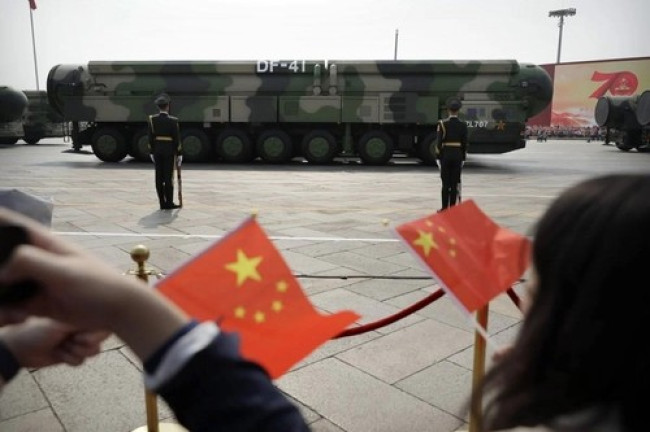 Nuclear weapons displayed at China's V-Day parade [SCMP capture]
The report further indicated that China's nuclear weapon management system, initially designed for "minimum deterrence," has reached its limits due to increased operational demands, and the potential exposure of personnel to radioactive materials is also a concern.
Earlier, the New York Times (NYT) reported on March 15th that, based on an analysis by geospatial intelligence expert Dr. Lenny Ben-David, Chinese authorities have been expanding and reinforcing secret nuclear facilities located in various mountainous areas of Sichuan Province in recent years.
According to the U.S. Department of Defense, China possessed approximately 600 nuclear warheads as of the end of 2024 and is projected to increase this number to 1,000 by 2030.
Concerns have recently been raised regarding potential nuclear weapons modernization experiments by China, after the Trump administration detected an explosion of magnitude 2.75 near China's Xinjiang nuclear testing site on June 22, 2020, stating it was different from a natural earthquake. China's Foreign Ministry refuted this on March 25th, calling it "baseless accusations."
Around the expiration of the New START treaty, which limits the strategic nuclear weapons of the U.S. and Russia, on May 5th, the Trump administration proposed trilateral negotiations involving the U.S., Russia, and China, including Russia. However, China refused, citing an imbalance in its nuclear weapon holdings.
According to estimates by the U.S. think tank Arms Control Association in January last year, there are 12,400 nuclear warheads worldwide, with the United States (5,225) and Russia (5,580) accounting for 90%.
The SCMP reported that Chinese authorities are known to have significantly increased their nuclear weapon stockpiles in recent years.
In the recently announced 15th Five-Year Plan (2026-2030), China stated its intention to "strengthen strategic deterrence and safeguard global strategic balance and stability," which is interpreted as a desire to increase its nuclear weapon holdings.
Amidst this, there is speculation both within and outside China regarding the timing of the U.S. Air Force Academy's report. High-ranking officials within the People's Liberation Army Rocket Force, the main body responsible for nuclear weapon operations, have undergone extensive purges over several years. Furthermore, in January 24th, Zhang Youxia, Vice Chairman of the Central Military Commission and a key figure in fostering the Rocket Force, along with Liu Zhenli, a member of the Central Military Commission and Chief of the Joint Staff Department, were abruptly purged.
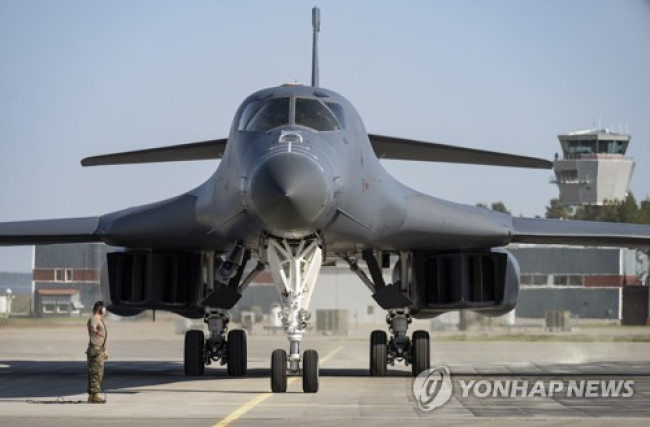 U.S. B-1B bomber [EPA Yonhap News]

 Iranian Foreign Ministry: "Continuing Message Exchanges with the U.S. and Activities of Mediating Countries"
Esmaeil Baghaei, Spokesperson for the Iranian Ministry of Foreign Affairs [Xinhua, Yonhap News file photo]Esmaeil Baghaei, spokesperson for the Iranian Ministry of Foreign Affairs, stated on the 26th
Iranian Foreign Ministry: "Continuing Message Exchanges with the U.S. and Activities of Mediating Countries"
Esmaeil Baghaei, Spokesperson for the Iranian Ministry of Foreign Affairs [Xinhua, Yonhap News file photo]Esmaeil Baghaei, spokesperson for the Iranian Ministry of Foreign Affairs, stated on the 26th
 President Yoon: "Do You Think You Are Safe from the Special Counsel?"... Final Statement Video Released
President Yoon Suk Yeol rebuking the special prosecutor on the 24th. [Court video / @birds_justice X account subtitle GIF] A video of President Yoon Suk Yeol's closing statement at his trial rega
President Yoon: "Do You Think You Are Safe from the Special Counsel?"... Final Statement Video Released
President Yoon Suk Yeol rebuking the special prosecutor on the 24th. [Court video / @birds_justice X account subtitle GIF] A video of President Yoon Suk Yeol's closing statement at his trial rega
 President Yoon, regarding the first-instance ruling on the Public Official Election Act: “An excessive political verdict that distorts the facts… We will appeal immediately.”
The first-instance sentencing hearing for President Yoon Suk Yeol regarding violations of the Public Official Election Act is being broadcast live at Seoul Station on the 27th. [Photo=Yonhap News]Pres
President Yoon, regarding the first-instance ruling on the Public Official Election Act: “An excessive political verdict that distorts the facts… We will appeal immediately.”
The first-instance sentencing hearing for President Yoon Suk Yeol regarding violations of the Public Official Election Act is being broadcast live at Seoul Station on the 27th. [Photo=Yonhap News]Pres
 WSJ: "SK Hynix ADR Premium Is a Sign of AI Trading Overheat"
Advertisement for SK Hynix ADR listing in New York's Times Square [Reuters=Yonhap News file photo]The Wall Street Journal (WSJ) has pointed out that the price of SK Hynix’s American Depositary Recei
WSJ: "SK Hynix ADR Premium Is a Sign of AI Trading Overheat"
Advertisement for SK Hynix ADR listing in New York's Times Square [Reuters=Yonhap News file photo]The Wall Street Journal (WSJ) has pointed out that the price of SK Hynix’s American Depositary Recei
 'Godfather of Japanese Mystery Novels' Keigo Higashino Passes Away After Battle with Cancer at 68
Famous Japanese mystery novelist Keigo Higashino [AFP=Yonhap News]It has been belatedly reported that Keigo Higashino, the "godfather of Japanese mystery novels" and author of bestsellers such as "The
'Godfather of Japanese Mystery Novels' Keigo Higashino Passes Away After Battle with Cancer at 68
Famous Japanese mystery novelist Keigo Higashino [AFP=Yonhap News]It has been belatedly reported that Keigo Higashino, the "godfather of Japanese mystery novels" and author of bestsellers such as "The
 [Park Pil-kyu Security Column] To the Ignorant Trying to Clothe a Beast in Sheep's Clothing
Rep. Kim Byung-joo of the Democratic Party of Korea [Photo=Yonhap News]“The Air Force Academy doesn't teach you how to fly a plane!” “The Army, Navy, and Air Force academies are exactly the
[Park Pil-kyu Security Column] To the Ignorant Trying to Clothe a Beast in Sheep's Clothing
Rep. Kim Byung-joo of the Democratic Party of Korea [Photo=Yonhap News]“The Air Force Academy doesn't teach you how to fly a plane!” “The Army, Navy, and Air Force academies are exactly the
 [Issue Diagnosis] Two Effects of the Election Petition Review
 [Photo] Evidence of Election Fraud Flooding U.S. Media… Trump Had 2.7 Million Votes Stolen
 [Video] U.S. Semiquincentennial Air Show... 'Art in the Sky' streaks across New York
 [Editorial Cartoon] A Draconian Law That Undermines Freedom of Expression

 List
List









