① Why India?
② Why did the automotive industry move to India first?
③ Batteries are already finding answers in India.
④ The next question for semiconductors.
⑤ Why did shipbuilding move away from China?
⑥ Companies moved, but the government did not
Policy Vacuum in India Strategy
The conclusion that runs through this series is simple.
Companies have already moved, but the nation has not yet designed a strategy.
As the growth formula premised on China falters, Korean companies have sought 'post-China' solutions in their own ways. The result, by chance, converged on India.
However, this trend is left to the judgment of the private sector and has not been formulated into a national strategy.
The automotive industry was the first to head to India.
In a transitional market where electrification, automotive electronics, software, and AI are being introduced simultaneously, Korean companies preemptively built a domestic-centric structure.
For batteries, practical solutions are already being found, centered on electric motorcycles. They are expanding their presence with quality and reliability as their strengths, even amidst competition with low-cost Chinese products.
Shipbuilding is even faster. Amidst the restructuring of security and energy order, a global ordering structure that effectively excludes China has been formed, and Korea has positioned itself at its center.
Only semiconductors remain at the question stage. While the potential is clear, it is an area that companies cannot bear alone.
All these trends reveal one fact.
India is no longer an experimental subject, but an already operational coordinate.
Nevertheless, Korea's strategy for India remains at the level of diplomatic and trade documents.
While phrases like "important partner" and "market with great growth potential" are repeated, there is no discernible plan for what to do and how to do it by industry.
The problem is not a lack of will, but a structural issue.
The current policy system is designed based on a supply chain centered on China. While accustomed to managing China risk, it is not prepared to newly design a post-China landscape.
As a result, industries where the market opens first, like automotive, batteries, and shipbuilding, forge their own paths through the private sector, while industries requiring national intervention, like semiconductors, remain stagnant, asking only questions.
The vacuum in India strategy is not simply an overseas expansion issue. It is a question about the method of industrial policy.
Korea's industrial policy has long been accustomed to a "method of identifying and supporting leading industries."
However, in the post-China world, this method no longer works.
What is needed is not a policy that picks specific industries, but a plan that helps companies make decisions based on a given coordinate.
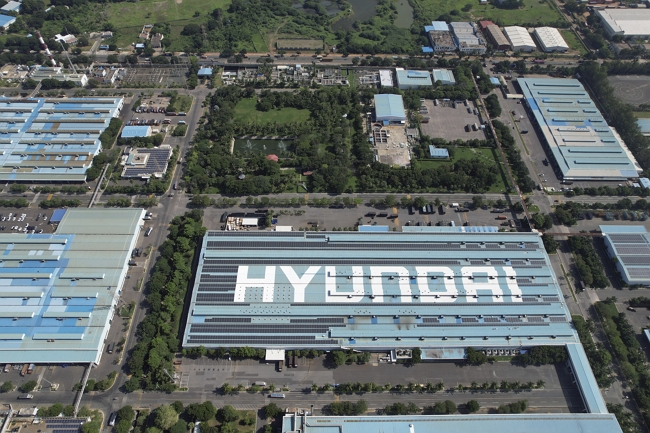 Since its entry into the Indian market in 1996, Hyundai Motor has grown to become the second-largest automobile manufacturer in India. [Photo=Hyundai Motor Homepage]
India is the most realistic point among those coordinates.
Especially, the international environment surrounding India is not unfavorable to Korea.
In India, China is a competitor but also a rival to be wary of.
On the other hand, Korea is a technological competitor but has no political or ethnic conflict assets.
With the additional strategy of the United States to foster India as a key axis for checking China, Korea is positioning itself as a manufacturing and technology partner in India with the least burden.
If this opportunity is not supported by institutions and policies, it would be closer to abandoning an opportunity than a lack of strategy.
The question is now clear.
In the process of designing a post-China era, what position will Korea assign to India?
Will the nation belatedly follow the coordinates already chosen by companies, or will it realign its industrial strategies based on those coordinates?
It is also a matter of choice whether to expand the trends seen in automotive, batteries, and shipbuilding to semiconductors, or to leave semiconductors as yet another exception.
This series is not written to praise India. Nor is it planned to deny China.
However, one fact is clear.
The growth formula premised on China has ended, and the process of designing its aftermath has already begun.
The site of that design is in India.
Companies moved first. What remains now is the role of the nation to bind that movement into a strategy.

 Iranian Foreign Ministry: "Continuing Message Exchanges with the U.S. and Activities of Mediating Countries"
Esmaeil Baghaei, Spokesperson for the Iranian Ministry of Foreign Affairs [Xinhua, Yonhap News file photo]Esmaeil Baghaei, spokesperson for the Iranian Ministry of Foreign Affairs, stated on the 26th
Iranian Foreign Ministry: "Continuing Message Exchanges with the U.S. and Activities of Mediating Countries"
Esmaeil Baghaei, Spokesperson for the Iranian Ministry of Foreign Affairs [Xinhua, Yonhap News file photo]Esmaeil Baghaei, spokesperson for the Iranian Ministry of Foreign Affairs, stated on the 26th
 President Yoon: "Do You Think You Are Safe from the Special Counsel?"... Final Statement Video Released
President Yoon Suk Yeol rebuking the special prosecutor on the 24th. [Court video / @birds_justice X account subtitle GIF] A video of President Yoon Suk Yeol's closing statement at his trial rega
President Yoon: "Do You Think You Are Safe from the Special Counsel?"... Final Statement Video Released
President Yoon Suk Yeol rebuking the special prosecutor on the 24th. [Court video / @birds_justice X account subtitle GIF] A video of President Yoon Suk Yeol's closing statement at his trial rega
 President Yoon, regarding the first-instance ruling on the Public Official Election Act: “An excessive political verdict that distorts the facts… We will appeal immediately.”
The first-instance sentencing hearing for President Yoon Suk Yeol regarding violations of the Public Official Election Act is being broadcast live at Seoul Station on the 27th. [Photo=Yonhap News]Pres
President Yoon, regarding the first-instance ruling on the Public Official Election Act: “An excessive political verdict that distorts the facts… We will appeal immediately.”
The first-instance sentencing hearing for President Yoon Suk Yeol regarding violations of the Public Official Election Act is being broadcast live at Seoul Station on the 27th. [Photo=Yonhap News]Pres
 WSJ: "SK Hynix ADR Premium Is a Sign of AI Trading Overheat"
Advertisement for SK Hynix ADR listing in New York's Times Square [Reuters=Yonhap News file photo]The Wall Street Journal (WSJ) has pointed out that the price of SK Hynix’s American Depositary Recei
WSJ: "SK Hynix ADR Premium Is a Sign of AI Trading Overheat"
Advertisement for SK Hynix ADR listing in New York's Times Square [Reuters=Yonhap News file photo]The Wall Street Journal (WSJ) has pointed out that the price of SK Hynix’s American Depositary Recei
 'Godfather of Japanese Mystery Novels' Keigo Higashino Passes Away After Battle with Cancer at 68
Famous Japanese mystery novelist Keigo Higashino [AFP=Yonhap News]It has been belatedly reported that Keigo Higashino, the "godfather of Japanese mystery novels" and author of bestsellers such as "The
'Godfather of Japanese Mystery Novels' Keigo Higashino Passes Away After Battle with Cancer at 68
Famous Japanese mystery novelist Keigo Higashino [AFP=Yonhap News]It has been belatedly reported that Keigo Higashino, the "godfather of Japanese mystery novels" and author of bestsellers such as "The
 [Park Pil-kyu Security Column] To the Ignorant Trying to Clothe a Beast in Sheep's Clothing
Rep. Kim Byung-joo of the Democratic Party of Korea [Photo=Yonhap News]“The Air Force Academy doesn't teach you how to fly a plane!” “The Army, Navy, and Air Force academies are exactly the
[Park Pil-kyu Security Column] To the Ignorant Trying to Clothe a Beast in Sheep's Clothing
Rep. Kim Byung-joo of the Democratic Party of Korea [Photo=Yonhap News]“The Air Force Academy doesn't teach you how to fly a plane!” “The Army, Navy, and Air Force academies are exactly the
 [Issue Diagnosis] Two Effects of the Election Petition Review
 [Photo] Evidence of Election Fraud Flooding U.S. Media… Trump Had 2.7 Million Votes Stolen
 [Video] U.S. Semiquincentennial Air Show... 'Art in the Sky' streaks across New York
 [Editorial Cartoon] A Draconian Law That Undermines Freedom of Expression

 List
List









