① The Boundary Between AI Writing and Responsibility
② Bias That Appears as Neutrality
③ The Silent Structure of AI Use
④ Sentences That Grow More Similar
⑤ The Difference Between Analysis and Judgment
⑥ Limitations of AI Information and Evidence
⑦ Standards of Creation in the Recombination Era
⑧ Sentence Structure Creates Skill
⑨ Redefining Media Ethics in the AI Era
⑩ Is the Editor Disappearing or Evolving?
Many people, after reading AI-generated responses, say, "But isn't AI neutral?"
This is the expectation that because AI has no emotions or vested interests, it will be fairer than humans.
However, the 'neutrality' that AI actually produces is of a different nature than the fairness we envision.
AI does not judge right from wrong.
Instead, it probabilistically selects the sentence that appears safest.
The balance created in this process is closer to a balance of expression than a balance of truth.
This difference becomes even clearer in political and social issues.
When there are conflicting claims, AI often constructs responses by placing both sides side-by-side rather than choosing one over the other.
While this may appear fair on the surface, the weight of factual accuracy or the difference in responsibility becomes blurred.
Readers feel "it's neutral because there are two sides to the opinion," but in reality, the core issue becomes obscured.
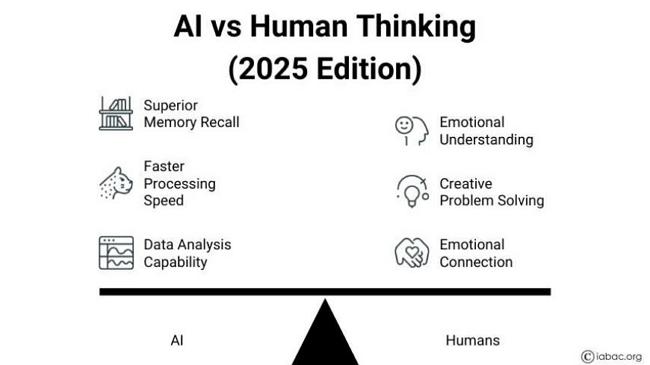 A conceptual image contrasting human thought processes with the data analysis structure of artificial intelligence. It symbolizes that AI's responses are the result of probability calculations, not judgment. [Photo=Captured from the International Association of Business Analytics Certifications (IABAC)]The balance chosen by a probabilistic model sometimes creates more ambiguity rather than resolving debate.
This phenomenon is a result of the structure, not the intention of the technology.
AI operates by learning from vast amounts of data and predicting the most probable sentences.
The more socially controversial a particular claim or interpretation, the more the model tends to choose cushioned language to mitigate risk.
Tentative statements increase over strong conclusions, and conditional explanations are emphasized over clear judgments.
As a result, readers perceive it as balanced information, but in reality, the core of the judgment is pushed back.
The problem is that these responses are beginning to influence human writing styles as well.
As the process of using AI to create drafts increases, the writing styles of news articles and reports are becoming increasingly similar.
Sentences that avoid conflict, expressions that minimize responsibility, and structures that few people would strongly object to are being repeated.
This is not merely a change in style.
It is a phenomenon where the very method of judgment is being reconstructed to match the language of probabilistic models.
Here, an important question arises.
Are responses that appear neutral truly neutral?
Listing facts with equal weight is not always a fair approach.
In some cases, there is an asymmetry in the facts, and the magnitude of responsibility differs.
However, AI does not judge these contexts. Instead, it chooses the safest mode of narration.
In this scenario, the role of humans is not to accept the balance as is, but to interpret how that balance was created.
This issue is even more sensitive in the realm of journalism.
Readers first ask how reliable the outcome is, rather than whether AI was involved.
If probabilistically safe sentences are repeated, readers will eventually feel that all writing sounds the same.
Trust is built not on the quantity of information, but on the clarity of judgment.
However, AI's language chooses cushioning over clarity.
Therefore, a paradox emerges: the more AI is used, the more clearly human judgment must be expressed.
The bias that appears as neutrality is less a flaw in technology and more a gap created between human expectations and the model's structure.
We believe AI is objective, but in reality, we encounter language designed to 'reduce controversy.'
This language may be useful for mitigating conflict, but it can be dangerous in situations that require clear accountability.
If only balance is emphasized in a situation that calls for judgment, readers will not know on what basis to form a conclusion.
Ultimately, what matters is not how neutral AI is, but how humans interpret that neutrality.
The moment we accept AI's responses as they are, the standard for judgment is entrusted to the probabilistic model.
Conversely, the moment we understand and reconstruct that structure, AI becomes a tool to aid judgment.
 Futuristic AI dashboard UI [Photo=dribbble.com]
Technology can mimic balance, but it cannot choose responsibility.
Therefore, the core task in the AI era lies not in obtaining more information, but in determining the criteria by which to interpret that information.
In the next installment, we will examine the background behind why a 'silent structure' is being created amidst the increasing reality of AI usage—a problem many people know but hesitate to discuss.
Why do people who use AI increasingly not disclose its use?
That question itself can be a clue that reveals another standard of our current era.

 Iranian Foreign Ministry: "Continuing Message Exchanges with the U.S. and Activities of Mediating Countries"
Esmaeil Baghaei, Spokesperson for the Iranian Ministry of Foreign Affairs [Xinhua, Yonhap News file photo]Esmaeil Baghaei, spokesperson for the Iranian Ministry of Foreign Affairs, stated on the 26th
Iranian Foreign Ministry: "Continuing Message Exchanges with the U.S. and Activities of Mediating Countries"
Esmaeil Baghaei, Spokesperson for the Iranian Ministry of Foreign Affairs [Xinhua, Yonhap News file photo]Esmaeil Baghaei, spokesperson for the Iranian Ministry of Foreign Affairs, stated on the 26th
 President Yoon: "Do You Think You Are Safe from the Special Counsel?"... Final Statement Video Released
President Yoon Suk Yeol rebuking the special prosecutor on the 24th. [Court video / @birds_justice X account subtitle GIF] A video of President Yoon Suk Yeol's closing statement at his trial rega
President Yoon: "Do You Think You Are Safe from the Special Counsel?"... Final Statement Video Released
President Yoon Suk Yeol rebuking the special prosecutor on the 24th. [Court video / @birds_justice X account subtitle GIF] A video of President Yoon Suk Yeol's closing statement at his trial rega
 President Yoon, regarding the first-instance ruling on the Public Official Election Act: “An excessive political verdict that distorts the facts… We will appeal immediately.”
The first-instance sentencing hearing for President Yoon Suk Yeol regarding violations of the Public Official Election Act is being broadcast live at Seoul Station on the 27th. [Photo=Yonhap News]Pres
President Yoon, regarding the first-instance ruling on the Public Official Election Act: “An excessive political verdict that distorts the facts… We will appeal immediately.”
The first-instance sentencing hearing for President Yoon Suk Yeol regarding violations of the Public Official Election Act is being broadcast live at Seoul Station on the 27th. [Photo=Yonhap News]Pres
 WSJ: "SK Hynix ADR Premium Is a Sign of AI Trading Overheat"
Advertisement for SK Hynix ADR listing in New York's Times Square [Reuters=Yonhap News file photo]The Wall Street Journal (WSJ) has pointed out that the price of SK Hynix’s American Depositary Recei
WSJ: "SK Hynix ADR Premium Is a Sign of AI Trading Overheat"
Advertisement for SK Hynix ADR listing in New York's Times Square [Reuters=Yonhap News file photo]The Wall Street Journal (WSJ) has pointed out that the price of SK Hynix’s American Depositary Recei
 'Godfather of Japanese Mystery Novels' Keigo Higashino Passes Away After Battle with Cancer at 68
Famous Japanese mystery novelist Keigo Higashino [AFP=Yonhap News]It has been belatedly reported that Keigo Higashino, the "godfather of Japanese mystery novels" and author of bestsellers such as "The
'Godfather of Japanese Mystery Novels' Keigo Higashino Passes Away After Battle with Cancer at 68
Famous Japanese mystery novelist Keigo Higashino [AFP=Yonhap News]It has been belatedly reported that Keigo Higashino, the "godfather of Japanese mystery novels" and author of bestsellers such as "The
 [Park Pil-kyu Security Column] To the Ignorant Trying to Clothe a Beast in Sheep's Clothing
Rep. Kim Byung-joo of the Democratic Party of Korea [Photo=Yonhap News]“The Air Force Academy doesn't teach you how to fly a plane!” “The Army, Navy, and Air Force academies are exactly the
[Park Pil-kyu Security Column] To the Ignorant Trying to Clothe a Beast in Sheep's Clothing
Rep. Kim Byung-joo of the Democratic Party of Korea [Photo=Yonhap News]“The Air Force Academy doesn't teach you how to fly a plane!” “The Army, Navy, and Air Force academies are exactly the
 [Issue Diagnosis] Two Effects of the Election Petition Review
 [Photo] Evidence of Election Fraud Flooding U.S. Media… Trump Had 2.7 Million Votes Stolen
 [Video] U.S. Semiquincentennial Air Show... 'Art in the Sky' streaks across New York
 [Editorial Cartoon] A Draconian Law That Undermines Freedom of Expression

 List
List









