 The red circle in the map is Jask Port. [Photo=tankertrackers.com]
Following the airstrikes on Kharg Island, the international energy market is naturally posing the next question.
“What is the next vulnerable point in Iran's crude oil export structure?”
A day before the Kharg airstrikes, on the 13th, Yonhap News reported on the possibility of airstrikes on Kharg. Military analysts have long identified this island as a strategic vulnerability for the Iranian economy.
In military strategy, bottlenecks where logistics or energy flows are concentrated are called choke points. These are logistics hubs in peacetime but naturally become targets of attack once war begins.
Following the Kharg airstrikes, analysts are focusing on Jask Port and the Goreh–Jask pipeline.
Jask Port is an oil export terminal located in the Gulf of Oman in southeastern Iran. Unlike Kharg in the northern Persian Gulf, this port is located outside the Strait of Hormuz.
The significance of this location is clear. Tankers departing from Jask can head directly to the Indian Ocean without passing through the Strait of Hormuz.
Iran has built the approximately 1,000 km long Goreh–Jask pipeline to alleviate its reliance on Kharg. This pipeline is designed to transport crude oil produced in the southwestern oil fields directly to Jask Port.
Once this system is fully operational, Iran will have secured an alternative route to maintain its crude oil exports without passing through the Strait of Hormuz. For this reason, Jask is often referred to as the core hub of the 'De-Hormuz Strategy'.
However, Jask is currently considered to not yet possess export infrastructure at a level that can fully replace Kharg.
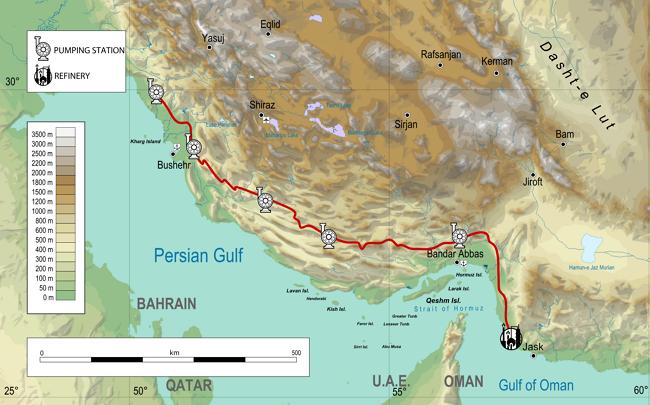 The red line in the photo is the Goreh-Jask pipeline. [Photo=Wikimedia Commons]
Firstly, the scale of storage facilities is limited.
Jask's crude oil storage capacity is known to be around 4 to 5 million barrels. In contrast, Kharg is a large export terminal with storage capacity in the tens of millions of barrels.
The loading infrastructure is also not yet complete.
Jask Port has only partially installed Single Point Mooring (SPM) facilities for loading crude oil onto Very Large Crude Carriers (VLCCs), and the planned full facilities have not yet been established.
Another bottleneck is the transportation capacity of the pipeline itself.
The design capacity of the Goreh–Jask pipeline is around 1 million barrels per day, but its actual operational capacity is estimated to be lower.
Moreover, the fact that most of the approximately 1,000 km pipeline passes through desert areas is also pointed out as a structural vulnerability.
Long-distance pipelines are difficult to defend militarily and are infrastructure that can be easily damaged by relatively small attacks in wartime.
For this reason, some military analysts view Jask Port and the pipeline as a single energy export system and discuss them together as potential attack targets.
Currently, Iran has been exporting around 1.5 to 1.7 million barrels of crude oil per day. A significant portion of this still goes to the global market via Kharg.
If Kharg is Iran's current oil export route, then Jask and the Goreh–Jask pipeline represent the future export structure.
And the logic of war always leads to the same question.
What is the next point of attack?

 Iranian Foreign Ministry: "Continuing Message Exchanges with the U.S. and Activities of Mediating Countries"
Esmaeil Baghaei, Spokesperson for the Iranian Ministry of Foreign Affairs [Xinhua, Yonhap News file photo]Esmaeil Baghaei, spokesperson for the Iranian Ministry of Foreign Affairs, stated on the 26th
Iranian Foreign Ministry: "Continuing Message Exchanges with the U.S. and Activities of Mediating Countries"
Esmaeil Baghaei, Spokesperson for the Iranian Ministry of Foreign Affairs [Xinhua, Yonhap News file photo]Esmaeil Baghaei, spokesperson for the Iranian Ministry of Foreign Affairs, stated on the 26th
 President Yoon: "Do You Think You Are Safe from the Special Counsel?"... Final Statement Video Released
President Yoon Suk Yeol rebuking the special prosecutor on the 24th. [Court video / @birds_justice X account subtitle GIF] A video of President Yoon Suk Yeol's closing statement at his trial rega
President Yoon: "Do You Think You Are Safe from the Special Counsel?"... Final Statement Video Released
President Yoon Suk Yeol rebuking the special prosecutor on the 24th. [Court video / @birds_justice X account subtitle GIF] A video of President Yoon Suk Yeol's closing statement at his trial rega
 President Yoon, regarding the first-instance ruling on the Public Official Election Act: “An excessive political verdict that distorts the facts… We will appeal immediately.”
The first-instance sentencing hearing for President Yoon Suk Yeol regarding violations of the Public Official Election Act is being broadcast live at Seoul Station on the 27th. [Photo=Yonhap News]Pres
President Yoon, regarding the first-instance ruling on the Public Official Election Act: “An excessive political verdict that distorts the facts… We will appeal immediately.”
The first-instance sentencing hearing for President Yoon Suk Yeol regarding violations of the Public Official Election Act is being broadcast live at Seoul Station on the 27th. [Photo=Yonhap News]Pres
 WSJ: "SK Hynix ADR Premium Is a Sign of AI Trading Overheat"
Advertisement for SK Hynix ADR listing in New York's Times Square [Reuters=Yonhap News file photo]The Wall Street Journal (WSJ) has pointed out that the price of SK Hynix’s American Depositary Recei
WSJ: "SK Hynix ADR Premium Is a Sign of AI Trading Overheat"
Advertisement for SK Hynix ADR listing in New York's Times Square [Reuters=Yonhap News file photo]The Wall Street Journal (WSJ) has pointed out that the price of SK Hynix’s American Depositary Recei
 'Godfather of Japanese Mystery Novels' Keigo Higashino Passes Away After Battle with Cancer at 68
Famous Japanese mystery novelist Keigo Higashino [AFP=Yonhap News]It has been belatedly reported that Keigo Higashino, the "godfather of Japanese mystery novels" and author of bestsellers such as "The
'Godfather of Japanese Mystery Novels' Keigo Higashino Passes Away After Battle with Cancer at 68
Famous Japanese mystery novelist Keigo Higashino [AFP=Yonhap News]It has been belatedly reported that Keigo Higashino, the "godfather of Japanese mystery novels" and author of bestsellers such as "The
 [Park Pil-kyu Security Column] To the Ignorant Trying to Clothe a Beast in Sheep's Clothing
Rep. Kim Byung-joo of the Democratic Party of Korea [Photo=Yonhap News]“The Air Force Academy doesn't teach you how to fly a plane!” “The Army, Navy, and Air Force academies are exactly the
[Park Pil-kyu Security Column] To the Ignorant Trying to Clothe a Beast in Sheep's Clothing
Rep. Kim Byung-joo of the Democratic Party of Korea [Photo=Yonhap News]“The Air Force Academy doesn't teach you how to fly a plane!” “The Army, Navy, and Air Force academies are exactly the
 [Issue Diagnosis] Two Effects of the Election Petition Review
 [Photo] Evidence of Election Fraud Flooding U.S. Media… Trump Had 2.7 Million Votes Stolen
 [Video] U.S. Semiquincentennial Air Show... 'Art in the Sky' streaks across New York
 [Editorial Cartoon] A Draconian Law That Undermines Freedom of Expression

 List
List









