 Minister Bassant (left) and Representative Greer explain the results of negotiations [AP Yonhap News]
The United States and China concluded their two-day high-level trade talks in Paris on the 16th (local time), held as a prelude to a summit between the leaders of the two countries.
While both sides described the discussions as "constructive," they reportedly pressured each other by highlighting points such as "China sources 50% of its energy from the Gulf region" and "We oppose unilateral investigations under U.S. Section 301."
Scott Bassant, the U.S. Secretary of the Treasury, told reporters after the high-level U.S.-China economic and trade talks in Paris, France, that "China sources about 50% of its energy demand from the Gulf region," adding that "there was a discussion on that issue (at the meeting)."
This is related to President Donald Trump's remarks emphasizing that parties with an interest in resolving the blockade of the Strait of Hormuz, which is in conflict with the U.S. and Israel, should play a military role.
In a social media post on the 14th, President Trump mentioned five countries, including South Korea, China, Japan, France, and the United Kingdom, and requested the dispatch of warships to ensure stability in the Strait of Hormuz.
However, Secretary Bassant stated, "These were economic discussions," and "We are not the State Department. We are not holding meetings between defense ministers. So, we spoke more about the economic implications and made recommendations to the Chinese side."
He explained, "China has halted exports of refined products and fertilizers (to Iran)," and "We have recommended that they be good international partners."
Jamie S. Gorelick, the U.S. Trade Representative (USTR) representative, stated that at the meeting, both sides "concluded on the general terms of the work plan that will apply to the meeting between the two leaders (President Trump and President Xi Jinping)," and expressed belief that "potential outcomes will emerge from the meeting of the (U.S.-China) leaders."
Specifically, he said, "We discussed the implementation of the 'Busan Agreement' (agreement from the U.S.-China summit in the fall of last year). This refers to matters related to rare earths and the like," adding, "We are receiving information from U.S. companies and stakeholders regarding the supply and demand of rare earths, and we have addressed issues related to that (Busan) agreement."
He also reported that they discussed "expanding exports of agricultural products and energy (from the U.S.) to China."
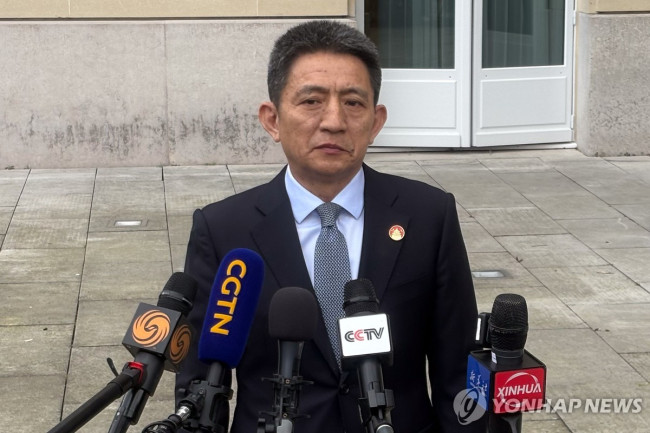 Li Chenggang, China's International Trade Representative and Vice Minister of Commerce [AP Yonhap News]
On the other hand, Li Chenggang, China's International Trade Representative and Vice Minister of Commerce, told reporters after the talks with the U.S. that "both sides agreed to maintain the stability of tariff levels," according to Reuters.
Li stated that both sides "discussed the possibility of extending the bilateral tariffs and tariff deferrals under new circumstances" and also exchanged views on bilateral trade and investment mechanisms.
China's official Xinhua News Agency also reported that Li said, "Over the past day and a half, the Chinese and U.S. teams have engaged in in-depth, frank, and constructive consultations. Through this negotiation, both sides have reached an initial consensus on some agendas and will continue to maintain the consultation process for the next stage."
Li stated that both sides agreed that stable economic and trade relations between the U.S. and China are beneficial to both countries and the world. Xinhua also reported that the establishment of a working mechanism to promote bilateral trade and investment was discussed at the meeting.
Li also mentioned that China conveyed its position and concerns to the U.S. regarding the U.S. investigation into "imports of goods produced by forced labor" targeting China and other countries under Section 301 of the Trade Act.
He emphasized, "We oppose unilateral investigations. We will closely monitor the progress of the relevant investigation."
He added, "We hope that the U.S. and China will meet (compromise) at a 'middle ground,' and we hope that the U.S. will keep its promises."
This Paris meeting, the sixth high-level economic and trade negotiation between the U.S. and China since the launch of Trump's second administration, was the first face-to-face meeting between the two sides since the U.S. Supreme Court ruled on the 20th of last month that President Trump did not have the authority to impose tariffs based on the International Emergency Economic Powers Act (IEEPA).
Following the Supreme Court's ruling invalidating "reciprocal tariffs," the Trump administration introduced a 10% global tariff and is currently conducting investigations targeting major trading partners such as China, based on its own Section 301 of the Trade Act, to introduce alternative tariffs.
The U.S. and China, which have been in a standoff since April of last year, exchanging high tariffs and trade control measures, held high-level trade talks in Geneva, Switzerland (May), London, UK (June), Stockholm, Sweden (July), Madrid, Spain (September), and Kuala Lumpur, Malaysia (October) to discuss contentious issues.
Subsequently, at the summit between U.S. President Donald Trump and Chinese President Xi Jinping in Busan at the end of last year, they agreed to extend the "truce" in the trade war and "refrain from escalating" by suspending some additional tariffs and trade retaliation measures targeting each other.
While this meeting was also intended to coordinate agendas for the summit between President Trump and President Xi, scheduled for the end of this month in China, Representative Li did not mention any details regarding the summit.
However, Secretary Bassant told CNBC that the U.S.-China summit could be postponed if President Trump wishes to remain in Washington D.C. to oversee the war against Iran, adding that "going abroad at this time may not be optimal."
Bassant added that if the summit schedule is postponed, it would be due to the implementation plan, not because President Trump asked China for cooperation in escorting merchant ships in the Strait of Hormuz.

 Iranian Foreign Ministry: "Continuing Message Exchanges with the U.S. and Activities of Mediating Countries"
Esmaeil Baghaei, Spokesperson for the Iranian Ministry of Foreign Affairs [Xinhua, Yonhap News file photo]Esmaeil Baghaei, spokesperson for the Iranian Ministry of Foreign Affairs, stated on the 26th
Iranian Foreign Ministry: "Continuing Message Exchanges with the U.S. and Activities of Mediating Countries"
Esmaeil Baghaei, Spokesperson for the Iranian Ministry of Foreign Affairs [Xinhua, Yonhap News file photo]Esmaeil Baghaei, spokesperson for the Iranian Ministry of Foreign Affairs, stated on the 26th
 President Yoon: "Do You Think You Are Safe from the Special Counsel?"... Final Statement Video Released
President Yoon Suk Yeol rebuking the special prosecutor on the 24th. [Court video / @birds_justice X account subtitle GIF] A video of President Yoon Suk Yeol's closing statement at his trial rega
President Yoon: "Do You Think You Are Safe from the Special Counsel?"... Final Statement Video Released
President Yoon Suk Yeol rebuking the special prosecutor on the 24th. [Court video / @birds_justice X account subtitle GIF] A video of President Yoon Suk Yeol's closing statement at his trial rega
 President Yoon, regarding the first-instance ruling on the Public Official Election Act: “An excessive political verdict that distorts the facts… We will appeal immediately.”
The first-instance sentencing hearing for President Yoon Suk Yeol regarding violations of the Public Official Election Act is being broadcast live at Seoul Station on the 27th. [Photo=Yonhap News]Pres
President Yoon, regarding the first-instance ruling on the Public Official Election Act: “An excessive political verdict that distorts the facts… We will appeal immediately.”
The first-instance sentencing hearing for President Yoon Suk Yeol regarding violations of the Public Official Election Act is being broadcast live at Seoul Station on the 27th. [Photo=Yonhap News]Pres
 WSJ: "SK Hynix ADR Premium Is a Sign of AI Trading Overheat"
Advertisement for SK Hynix ADR listing in New York's Times Square [Reuters=Yonhap News file photo]The Wall Street Journal (WSJ) has pointed out that the price of SK Hynix’s American Depositary Recei
WSJ: "SK Hynix ADR Premium Is a Sign of AI Trading Overheat"
Advertisement for SK Hynix ADR listing in New York's Times Square [Reuters=Yonhap News file photo]The Wall Street Journal (WSJ) has pointed out that the price of SK Hynix’s American Depositary Recei
 'Godfather of Japanese Mystery Novels' Keigo Higashino Passes Away After Battle with Cancer at 68
Famous Japanese mystery novelist Keigo Higashino [AFP=Yonhap News]It has been belatedly reported that Keigo Higashino, the "godfather of Japanese mystery novels" and author of bestsellers such as "The
'Godfather of Japanese Mystery Novels' Keigo Higashino Passes Away After Battle with Cancer at 68
Famous Japanese mystery novelist Keigo Higashino [AFP=Yonhap News]It has been belatedly reported that Keigo Higashino, the "godfather of Japanese mystery novels" and author of bestsellers such as "The
 [Park Pil-kyu Security Column] To the Ignorant Trying to Clothe a Beast in Sheep's Clothing
Rep. Kim Byung-joo of the Democratic Party of Korea [Photo=Yonhap News]“The Air Force Academy doesn't teach you how to fly a plane!” “The Army, Navy, and Air Force academies are exactly the
[Park Pil-kyu Security Column] To the Ignorant Trying to Clothe a Beast in Sheep's Clothing
Rep. Kim Byung-joo of the Democratic Party of Korea [Photo=Yonhap News]“The Air Force Academy doesn't teach you how to fly a plane!” “The Army, Navy, and Air Force academies are exactly the
 [Issue Diagnosis] Two Effects of the Election Petition Review
 [Photo] Evidence of Election Fraud Flooding U.S. Media… Trump Had 2.7 Million Votes Stolen
 [Video] U.S. Semiquincentennial Air Show... 'Art in the Sky' streaks across New York
 [Editorial Cartoon] A Draconian Law That Undermines Freedom of Expression

 List
List









