 Sanae Takaichi, Prime Minister of Japan [AFP Yonhap News]It is predicted that Sanae Takaichi, the Japanese Prime Minister, who is called 'Abenomics for Women,' will eventually attempt to break through difficulties by utilizing the response strategy previously used by former Prime Minister Shinzo Abe, in response to U.S. President Donald Trump's request to dispatch naval vessels to the Strait of Hormuz.
The Tokyo Shimbun reported on the 18th that a plan to send the Self-Defense Forces to the Middle East under the pretext of "research and studies," as the Abe administration did in 2020, is emerging within the Japanese government. This would exclude missions such as protecting lives and property or the use of force from officially announced public activities.
Sending naval vessels based on a "situation of existential crisis" where Japan can exercise the right to collective self-defense, or a "situation of significant impact" that allows support for other countries' military forces from the rear, carries significant legal restrictions and risks. Therefore, it is interpreted that Japan is contemplating dispatching forces under the guise of research and studies as a last resort.
In this regard, the Nihon Keizai Shimbun (Nikkei) stated, "Dispatching escort ships as requested by President Trump is difficult under Japan's current laws," and added, "There have been no past instances of the Self-Defense Forces operating in combat zones."
The newspaper analyzed that if the actions the Self-Defense Forces could take in response to President Trump's request are divided into seven categories, mine sweeping carries the highest risk, while research and studies carry the lowest risk.
Japan, facing the need to provide a response that will satisfy President Trump to some extent at the U.S.-Japan summit to be held on the 19th (local time) in the United States, is considering dispatching forces for research and studies as a past "Abe-style ingenious move" that allows them to demonstrate cooperation with their ally while relatively avoiding risk.
Prime Minister Takaichi is also referred to as 'Abenomics for Women' for following former Prime Minister Abe's policies such as strengthening defense capabilities and quantitative easing, and for expressing her special affection for him.
Regarding the dispatch of escort ships for research and studies, the Tokyo Shimbun explained, "It can effectively escort vessels and demonstrate a cooperative stance towards the U.S., while avoiding activities in dangerous areas such as the Strait of Hormuz, which is effectively under blockade."
However, the newspaper pointed out that there is a risk that the Self-Defense Forces could get involved in unforeseen situations depending on the area of operation of the escort ships and the combat situation.
Japan has previously dispatched escort ships under the pretext of research and studies in relation to U.S. military activities.
During the first term of President Trump's presidency, in 2019, when the U.S. requested cooperation in a "convoy coalition" for navigation in the Strait of Hormuz, the Abe administration, considering its friendly relations with Iran, did not participate and instead sent naval vessels for research and studies the following year.
Prior to that, following the September 11th terrorist attacks in 2001, when U.S. aircraft carriers based at the U.S. naval base in Yokosuka, Kanagawa Prefecture, departed, Japan accompanied escort ships and supply ships to the Indian Ocean for intelligence gathering purposes.
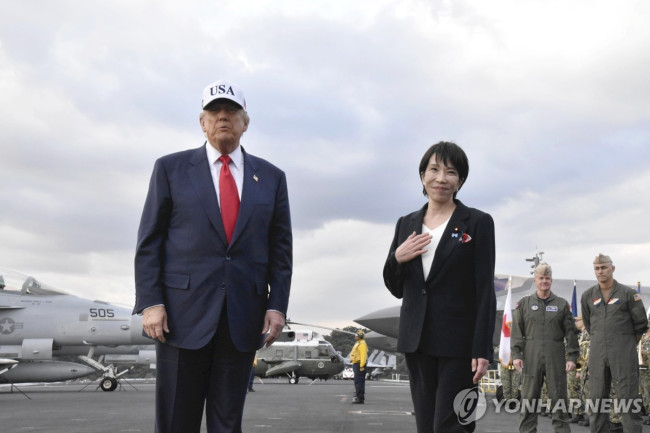 U.S. President Donald Trump and Japanese Prime Minister Sanae Takaichi [Jiji EPA Yonhap News]
Furthermore, Japan is considering ways to support the U.S. by emphasizing the importance of "freedom of navigation" in the Strait of Hormuz.
The Mainichi Shimbun reported that Japan is considering participating in a joint statement on freedom of navigation being coordinated by the U.S.
Additionally, the Asahi Shimbun reported that Japanese Prime Minister Takaichi is considering conveying her support for the U.S.'s efforts to stabilize the situation in the Middle East to President Trump during the summit.
The newspaper added that Prime Minister Takaichi intends to encourage the U.S. side to pursue diplomatic solutions regarding the situation in Iran and stated that she will not make any international legal assessments of the U.S.'s attack on Iran itself during the meeting.
According to the Yomiuri Shimbun, the Japanese Ministry of Defense has also begun discussions on sending additional liaison officers to the U.S. Central Command, which oversees operations in the Middle East. Currently, there is one Self-Defense Forces liaison officer permanently stationed at Central Command.
The Yomiuri Shimbun pointed out that Japan aims to strengthen communication with the U.S. regarding Middle East issues and accurately grasp the latest combat situation by increasing the number of liaison officers.
The Japanese government has prepared various "cards" in anticipation that the Middle East issue will be a key agenda item at the upcoming U.S.-Japan summit, but it is analyzed that it is uncertain how satisfied President Trump will be.
The Yomiuri Shimbun commented, "Prime Minister Takaichi is in a dilemma," and explained, "In order to demonstrate U.S.-Japan solidarity without getting caught up in the risks of U.S. military operations, some level of contribution is unavoidable."
It added that they are searching for the minimum proposals that will not displease the U.S., including the possibility of dispatching the Self-Defense Forces after the conflict is resolved.
However, given that it is unclear what the U.S. truly desires from Japan, the fact that Prime Minister Takaichi will be the first leader of a country requested to dispatch naval vessels to meet President Trump face-to-face is expected to be a significant burden.
Within the Japanese government, there are voices saying, "It's the worst timing, but it cannot be avoided," regarding the upcoming U.S.-Japan summit, according to the Asahi.

 Iranian Foreign Ministry: "Continuing Message Exchanges with the U.S. and Activities of Mediating Countries"
Esmaeil Baghaei, Spokesperson for the Iranian Ministry of Foreign Affairs [Xinhua, Yonhap News file photo]Esmaeil Baghaei, spokesperson for the Iranian Ministry of Foreign Affairs, stated on the 26th
Iranian Foreign Ministry: "Continuing Message Exchanges with the U.S. and Activities of Mediating Countries"
Esmaeil Baghaei, Spokesperson for the Iranian Ministry of Foreign Affairs [Xinhua, Yonhap News file photo]Esmaeil Baghaei, spokesperson for the Iranian Ministry of Foreign Affairs, stated on the 26th
 President Yoon: "Do You Think You Are Safe from the Special Counsel?"... Final Statement Video Released
President Yoon Suk Yeol rebuking the special prosecutor on the 24th. [Court video / @birds_justice X account subtitle GIF] A video of President Yoon Suk Yeol's closing statement at his trial rega
President Yoon: "Do You Think You Are Safe from the Special Counsel?"... Final Statement Video Released
President Yoon Suk Yeol rebuking the special prosecutor on the 24th. [Court video / @birds_justice X account subtitle GIF] A video of President Yoon Suk Yeol's closing statement at his trial rega
 President Yoon, regarding the first-instance ruling on the Public Official Election Act: “An excessive political verdict that distorts the facts… We will appeal immediately.”
The first-instance sentencing hearing for President Yoon Suk Yeol regarding violations of the Public Official Election Act is being broadcast live at Seoul Station on the 27th. [Photo=Yonhap News]Pres
President Yoon, regarding the first-instance ruling on the Public Official Election Act: “An excessive political verdict that distorts the facts… We will appeal immediately.”
The first-instance sentencing hearing for President Yoon Suk Yeol regarding violations of the Public Official Election Act is being broadcast live at Seoul Station on the 27th. [Photo=Yonhap News]Pres
 WSJ: "SK Hynix ADR Premium Is a Sign of AI Trading Overheat"
Advertisement for SK Hynix ADR listing in New York's Times Square [Reuters=Yonhap News file photo]The Wall Street Journal (WSJ) has pointed out that the price of SK Hynix’s American Depositary Recei
WSJ: "SK Hynix ADR Premium Is a Sign of AI Trading Overheat"
Advertisement for SK Hynix ADR listing in New York's Times Square [Reuters=Yonhap News file photo]The Wall Street Journal (WSJ) has pointed out that the price of SK Hynix’s American Depositary Recei
 'Godfather of Japanese Mystery Novels' Keigo Higashino Passes Away After Battle with Cancer at 68
Famous Japanese mystery novelist Keigo Higashino [AFP=Yonhap News]It has been belatedly reported that Keigo Higashino, the "godfather of Japanese mystery novels" and author of bestsellers such as "The
'Godfather of Japanese Mystery Novels' Keigo Higashino Passes Away After Battle with Cancer at 68
Famous Japanese mystery novelist Keigo Higashino [AFP=Yonhap News]It has been belatedly reported that Keigo Higashino, the "godfather of Japanese mystery novels" and author of bestsellers such as "The
 [Park Pil-kyu Security Column] To the Ignorant Trying to Clothe a Beast in Sheep's Clothing
Rep. Kim Byung-joo of the Democratic Party of Korea [Photo=Yonhap News]“The Air Force Academy doesn't teach you how to fly a plane!” “The Army, Navy, and Air Force academies are exactly the
[Park Pil-kyu Security Column] To the Ignorant Trying to Clothe a Beast in Sheep's Clothing
Rep. Kim Byung-joo of the Democratic Party of Korea [Photo=Yonhap News]“The Air Force Academy doesn't teach you how to fly a plane!” “The Army, Navy, and Air Force academies are exactly the
 [Issue Diagnosis] Two Effects of the Election Petition Review
 [Photo] Evidence of Election Fraud Flooding U.S. Media… Trump Had 2.7 Million Votes Stolen
 [Video] U.S. Semiquincentennial Air Show... 'Art in the Sky' streaks across New York
 [Editorial Cartoon] A Draconian Law That Undermines Freedom of Expression

 List
List









