 Liquefied Natural Gas (LNG) carrier [AFP=Yonhap]QatarEnergy (QE), Qatar's state-owned energy company, announced on the 19th (local time) that it may declare "force majeure" for years on long-term supply contracts with countries including South Korea, due to the attack on major liquefied natural gas (LNG) facilities.
Saad Al-Kaabi, CEO of QatarEnergy, said in an interview with Reuters on the same day, "We may have to declare force majeure for up to five years on long-term LNG supply contracts heading to South Korea, China, Italy, and Belgium."
He added that 17% of the company's LNG export capacity was damaged by the attack, and it is estimated that it will take 3 to 5 years to recover.
South Korea is one of the largest importers of LNG from Qatar, bringing in 9 to 10 million tons annually. The long-term contract with Qatar is for 6.1 million tons per year. According to Korea Gas Corporation, South Korea's reliance on Qatar is less than 20% thanks to a significant increase in imports from the United States and Australia through diversification of its LNG supply chain.
Korea Gas Corporation stated that it currently holds inventory levels exceeding its mandatory reserve requirements, ensuring sufficient capacity to respond to supply and demand crises until the end of the year. A representative from Korea Gas Corporation said, "We are reviewing step-by-step emergency response measures for supply and demand and are preparing for a prolonged situation in cooperation with the government and related organizations."
However, if QatarEnergy actually declares force majeure and South Korea cannot import LNG for five years, the deficit will primarily need to be filled from the spot market, where prices are higher than long-term contracts, impacting gas bills for both industries and households.
CEO Al-Kaabi stated, "We never imagined we would face such an attack, especially from a brotherly Muslim nation (Iran) during Ramadan." He emphasized, "First and foremost, hostile acts must cease for production to resume."
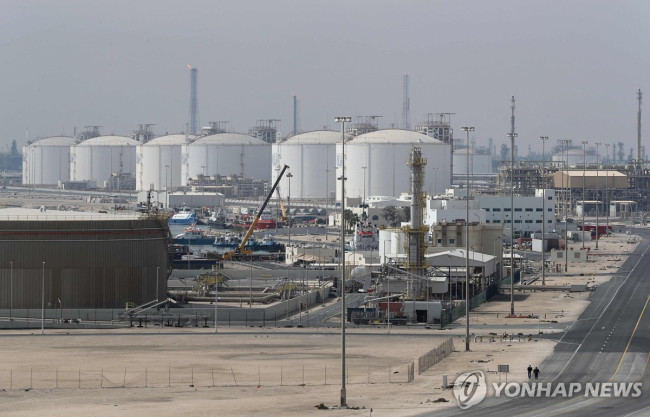 Ras Laffan Industrial City, Qatar [AFP=Yonhap]
This is interpreted to mean that physical recovery efforts are impossible as long as the threat of further attacks from Iran and regional military conflicts continue.
According to QatarEnergy, two out of the total 14 LNG production trains and one of the two Gas-to-Liquids (GTL) facilities were directly damaged in the attack by Iran.
Consequently, the reduction in LNG production is projected to be 12.8 million tons per year, a substantial amount representing approximately 17% of Qatar's total LNG export capacity.
CEO Al-Kaabi stated, "The annual revenue loss from the three damaged facilities alone amounts to approximately $20 billion (about 30 trillion won)," and vehemently criticized, "These national critical infrastructure facilities, which cost $26 billion to build years ago, should never be targets of attack."
The reduction is expected to extend to by-product exports such as condensate (-24%), LPG (-13%), and helium (-14%), in addition to LNG, raising concerns about supply instability across the global petrochemical and advanced industries.
The previous day, Israel had bombed South Pars, Iran's largest gas field in the south, prompting Iran to retaliate with air strikes on energy facilities in Gulf oil-producing countries like Qatar, the UAE, and Saudi Arabia.
CEO Al-Kaabi also added that ExxonMobil is a partner in the damaged LNG production trains affected by the Iranian attack.
He explained that ExxonMobil holds a 34% stake in the damaged LNG production train S4 and a 30% stake in S6, with QatarEnergy owning the remaining shares.

 Iranian Foreign Ministry: "Continuing Message Exchanges with the U.S. and Activities of Mediating Countries"
Esmaeil Baghaei, Spokesperson for the Iranian Ministry of Foreign Affairs [Xinhua, Yonhap News file photo]Esmaeil Baghaei, spokesperson for the Iranian Ministry of Foreign Affairs, stated on the 26th
Iranian Foreign Ministry: "Continuing Message Exchanges with the U.S. and Activities of Mediating Countries"
Esmaeil Baghaei, Spokesperson for the Iranian Ministry of Foreign Affairs [Xinhua, Yonhap News file photo]Esmaeil Baghaei, spokesperson for the Iranian Ministry of Foreign Affairs, stated on the 26th
 President Yoon: "Do You Think You Are Safe from the Special Counsel?"... Final Statement Video Released
President Yoon Suk Yeol rebuking the special prosecutor on the 24th. [Court video / @birds_justice X account subtitle GIF] A video of President Yoon Suk Yeol's closing statement at his trial rega
President Yoon: "Do You Think You Are Safe from the Special Counsel?"... Final Statement Video Released
President Yoon Suk Yeol rebuking the special prosecutor on the 24th. [Court video / @birds_justice X account subtitle GIF] A video of President Yoon Suk Yeol's closing statement at his trial rega
 President Yoon, regarding the first-instance ruling on the Public Official Election Act: “An excessive political verdict that distorts the facts… We will appeal immediately.”
The first-instance sentencing hearing for President Yoon Suk Yeol regarding violations of the Public Official Election Act is being broadcast live at Seoul Station on the 27th. [Photo=Yonhap News]Pres
President Yoon, regarding the first-instance ruling on the Public Official Election Act: “An excessive political verdict that distorts the facts… We will appeal immediately.”
The first-instance sentencing hearing for President Yoon Suk Yeol regarding violations of the Public Official Election Act is being broadcast live at Seoul Station on the 27th. [Photo=Yonhap News]Pres
 WSJ: "SK Hynix ADR Premium Is a Sign of AI Trading Overheat"
Advertisement for SK Hynix ADR listing in New York's Times Square [Reuters=Yonhap News file photo]The Wall Street Journal (WSJ) has pointed out that the price of SK Hynix’s American Depositary Recei
WSJ: "SK Hynix ADR Premium Is a Sign of AI Trading Overheat"
Advertisement for SK Hynix ADR listing in New York's Times Square [Reuters=Yonhap News file photo]The Wall Street Journal (WSJ) has pointed out that the price of SK Hynix’s American Depositary Recei
 'Godfather of Japanese Mystery Novels' Keigo Higashino Passes Away After Battle with Cancer at 68
Famous Japanese mystery novelist Keigo Higashino [AFP=Yonhap News]It has been belatedly reported that Keigo Higashino, the "godfather of Japanese mystery novels" and author of bestsellers such as "The
'Godfather of Japanese Mystery Novels' Keigo Higashino Passes Away After Battle with Cancer at 68
Famous Japanese mystery novelist Keigo Higashino [AFP=Yonhap News]It has been belatedly reported that Keigo Higashino, the "godfather of Japanese mystery novels" and author of bestsellers such as "The
 [Park Pil-kyu Security Column] To the Ignorant Trying to Clothe a Beast in Sheep's Clothing
Rep. Kim Byung-joo of the Democratic Party of Korea [Photo=Yonhap News]“The Air Force Academy doesn't teach you how to fly a plane!” “The Army, Navy, and Air Force academies are exactly the
[Park Pil-kyu Security Column] To the Ignorant Trying to Clothe a Beast in Sheep's Clothing
Rep. Kim Byung-joo of the Democratic Party of Korea [Photo=Yonhap News]“The Air Force Academy doesn't teach you how to fly a plane!” “The Army, Navy, and Air Force academies are exactly the
 [Issue Diagnosis] Two Effects of the Election Petition Review
 [Photo] Evidence of Election Fraud Flooding U.S. Media… Trump Had 2.7 Million Votes Stolen
 [Video] U.S. Semiquincentennial Air Show... 'Art in the Sky' streaks across New York
 [Editorial Cartoon] A Draconian Law That Undermines Freedom of Expression

 List
List









