2025년 7월, 이재명 정부는 미국과 3500억 달러 규모의 투자 협정을 체결했다고 발표했습니다. 대통령실은 “한국 경제의 숨통을 틔운 대규모 외교 성과”라고 홍보했지만, 트럼프 미국 대통령이 직접 공개한 협정 발표문은 내용적으로 정부의 설명과 심각한 괴리를 드러내고 있습니다. 한미일보는 트럼프의 공식 발표문과 김용범 정책실장의 해명, 외환보유액 구조, 농산물 시장 개방 여부 등을 전방위적으로 분석해 ‘이 협정이 우리에게 무엇을 의미하는가’를 심층 점검했습니다. <편집자 주>
 U.S. President Donald Trump. Reuters Yonhap News Archive Photo.
"South Korea Gives the U.S. $350 Billion" ... The Shock of Trump's Announcement
On July 30, U.S. President Donald Trump posted the following on his social media platform, Truth Social:
“South Korea will give to the United States $350 Billion Dollars for investments owned and controlled by the United States, and selected by myself, as President.”
“It is also agreed that South Korea will be completely OPEN TO TRADE with the United States, and that they will accept American product including Cars and Trucks, Agriculture, etc.”
Trade experts evaluate that this announcement is significantly different from the vocabulary structure of typical investment agreements. Given that the U.S. position is consistent, making it difficult to interpret solely as political rhetoric from Trump, complications are anticipated even in final negotiations.
[Literal Translation and Interpretation]
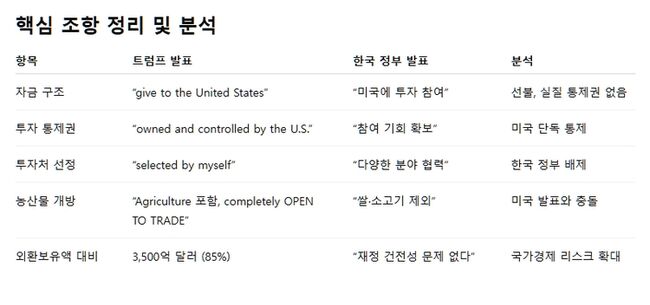
“South Korea will give…”: The word "give" implies an actual upfront provision, rather than a contribution or co-investment.
“owned and controlled by the United States”: This means that South Korea may be merely a passive fund provider without equity or voting rights, as the investments will be owned and controlled by the United States.
“selected by myself, as President”: It is explicitly stated that President Trump himself will select the investment targets, revealing a structure of unilateral decision-making rather than bilateral consultation.
"Excluding Rice and Beef"? ... Trump Specified "Including Agricultural Products"
Another key controversy is the opening of the agricultural market. The government explained that sensitive items such as rice and beef were designated for exclusion from the opening, and Kim Yong-beom stated, "The minimum defense line for protecting domestic farmers has been maintained."
However, Trump wrote the following in his announcement:
“…completely OPEN TO TRADE… including Cars and Trucks, Agriculture, etc.”
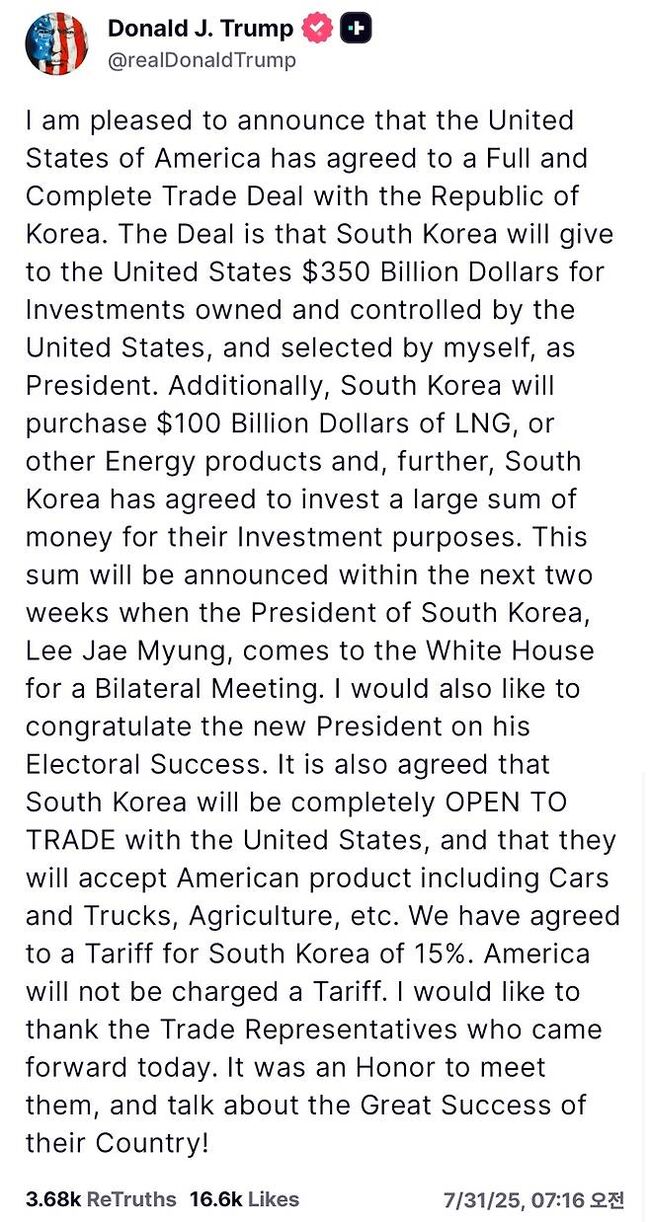 Screenshot of Truth Social
The specification of "Agriculture" in parallel with Cars and Trucks, followed by "etc.," implies the inclusion of a wide range of products such as dairy, grains, and processed foods.
Most importantly, the phrase "completely open" does not presuppose exceptions for certain items. If there were exceptions, a caveat like "excluding rice and beef" or "with sensitive item exemptions" would typically follow, but there is no such content in Trump's announcement.
Kim Yong-beom Explains "Strategic Ambiguity" ... But Trump Was Specific
On the same day, Kim Yong-beom, the Presidential Secretary for Policy, evaluated the agreement in a briefing as "a milestone negotiation that will significantly expand opportunities for Korean companies in sectors such as shipbuilding and energy." Regarding the ambiguity in the wording of the agreement, he explained, "Strategic ambiguity is a technique in diplomatic negotiations," and added, "Sufficient safeguards have been secured."
However, Trump's announcement clearly outlines a unilateral structure of the agreement with specific terms such as "give," "controlled by the United States," and "selected by myself."
The original text of the agreement has not yet been made public, and it has not been clearly explained what the "safeguards" emphasized by Secretary Kim are. This has led to criticism that the explanation is opaque rather than strategic.
Furthermore, although Secretary Kim stated that "$150 billion will be invested in the shipbuilding industry," concerns have been raised that without public disclosure of the control and profit distribution structure of such investments, it could essentially be a subcontracting deal led by U.S. funds.
85% of Foreign Exchange Reserves ... A Transfer of Monetary Sovereignty?
The most significant concern regarding this agreement lies in the sheer scale of $350 billion. As of June 2025, South Korea's total foreign exchange reserves are approximately $410 billion, and the amount in this agreement, a staggering 85% of that total, is a substantial sum.
If this amount is paid upfront to the United States, managed under U.S. government control, and invested in targets unilaterally selected by President Trump, it is difficult to avoid criticism that it is not merely attracting foreign investment but an effective transfer of South Korea's foreign exchange sovereignty.
International finance experts have warned that this signifies "South Korea's relinquishment of strategic independence in monetary and asset management," and "carries a risk of leading to economic dependency and geopolitical hostage-taking due to the agreement's structure."
White House Confirms: "90 Percent of Investment Profits Go to the U.S."
“A White House spokesperson confirmed that ‘under this agreement, approximately 90 percent of the profits from South Korea's investments will be attributed to the U.S. government, used to help pay down national debt and for other purposes designated by the president.’
“The centerpiece of this deal is that South Korea has agreed to invest $350 billion at the president’s direction to revitalize American industry… 90 percent of those profits will go to the United States government to help pay down our debt and for other matters at the president’s choosing.”
This statement explicitly reveals a structure where "the entity providing the funds, South Korea, receives almost none of the profits," further substantiating that the agreement is skewed towards one party rather than being a partnership.
Ultimately, it is severely questionable who is speaking the truth to the public, and whether the announcement's veracity aligns with the explanations provided.
The Public Wanted "Truth," Not "Accomplishments"
President Lee Jae-myung evaluated this agreement as a "grand consensus that maximizes national interests," but what the public truly wanted to know was the clear truth: whether it was an agreement, a donation, an investment, unilateral control, whether rice and beef were protected, or whether they were sold.
The Facts Revealed So Far Are As Follows
Trump said, "South Korea will give the U.S. $350 billion."
He stated that the investment targets would be selected by Trump himself and controlled by the U.S.
He specified "complete market opening," including agricultural products.
The South Korean government described this as "strategy," "accomplishment," and "defense line."
Synthesizing all these circumstances, it is highly likely that this agreement will be recorded not as an "accomplishment" but as a large upfront provision without control, not as a "strategy" but as a unilateral agreement not properly explained to the public, and not as a "lifeline" but as a "leash agreement" where foreign exchange sovereignty was voluntarily surrendered.
#350BillionDollarDonation #TrumpUpfrontAgreement #KimYongBeomExplanationControversy #ForexReserveCrisis #FullAgriculturalMarketOpening #RiceBeefDeception #TruthSocialAgreement #LeeJaeMyungGovernmentDiplomaticFailure #KoreaUSEconomicDependency #KoreaUSJapanPlusUnilateral

 Iranian Foreign Ministry: "Continuing Message Exchanges with the U.S. and Activities of Mediating Countries"
Esmaeil Baghaei, Spokesperson for the Iranian Ministry of Foreign Affairs [Xinhua, Yonhap News file photo]Esmaeil Baghaei, spokesperson for the Iranian Ministry of Foreign Affairs, stated on the 26th
Iranian Foreign Ministry: "Continuing Message Exchanges with the U.S. and Activities of Mediating Countries"
Esmaeil Baghaei, Spokesperson for the Iranian Ministry of Foreign Affairs [Xinhua, Yonhap News file photo]Esmaeil Baghaei, spokesperson for the Iranian Ministry of Foreign Affairs, stated on the 26th
 President Yoon: "Do You Think You Are Safe from the Special Counsel?"... Final Statement Video Released
President Yoon Suk Yeol rebuking the special prosecutor on the 24th. [Court video / @birds_justice X account subtitle GIF] A video of President Yoon Suk Yeol's closing statement at his trial rega
President Yoon: "Do You Think You Are Safe from the Special Counsel?"... Final Statement Video Released
President Yoon Suk Yeol rebuking the special prosecutor on the 24th. [Court video / @birds_justice X account subtitle GIF] A video of President Yoon Suk Yeol's closing statement at his trial rega
 President Yoon, regarding the first-instance ruling on the Public Official Election Act: “An excessive political verdict that distorts the facts… We will appeal immediately.”
The first-instance sentencing hearing for President Yoon Suk Yeol regarding violations of the Public Official Election Act is being broadcast live at Seoul Station on the 27th. [Photo=Yonhap News]Pres
President Yoon, regarding the first-instance ruling on the Public Official Election Act: “An excessive political verdict that distorts the facts… We will appeal immediately.”
The first-instance sentencing hearing for President Yoon Suk Yeol regarding violations of the Public Official Election Act is being broadcast live at Seoul Station on the 27th. [Photo=Yonhap News]Pres
 WSJ: "SK Hynix ADR Premium Is a Sign of AI Trading Overheat"
Advertisement for SK Hynix ADR listing in New York's Times Square [Reuters=Yonhap News file photo]The Wall Street Journal (WSJ) has pointed out that the price of SK Hynix’s American Depositary Recei
WSJ: "SK Hynix ADR Premium Is a Sign of AI Trading Overheat"
Advertisement for SK Hynix ADR listing in New York's Times Square [Reuters=Yonhap News file photo]The Wall Street Journal (WSJ) has pointed out that the price of SK Hynix’s American Depositary Recei
 'Godfather of Japanese Mystery Novels' Keigo Higashino Passes Away After Battle with Cancer at 68
Famous Japanese mystery novelist Keigo Higashino [AFP=Yonhap News]It has been belatedly reported that Keigo Higashino, the "godfather of Japanese mystery novels" and author of bestsellers such as "The
'Godfather of Japanese Mystery Novels' Keigo Higashino Passes Away After Battle with Cancer at 68
Famous Japanese mystery novelist Keigo Higashino [AFP=Yonhap News]It has been belatedly reported that Keigo Higashino, the "godfather of Japanese mystery novels" and author of bestsellers such as "The
 [Park Pil-kyu Security Column] To the Ignorant Trying to Clothe a Beast in Sheep's Clothing
Rep. Kim Byung-joo of the Democratic Party of Korea [Photo=Yonhap News]“The Air Force Academy doesn't teach you how to fly a plane!” “The Army, Navy, and Air Force academies are exactly the
[Park Pil-kyu Security Column] To the Ignorant Trying to Clothe a Beast in Sheep's Clothing
Rep. Kim Byung-joo of the Democratic Party of Korea [Photo=Yonhap News]“The Air Force Academy doesn't teach you how to fly a plane!” “The Army, Navy, and Air Force academies are exactly the
 [Issue Diagnosis] Two Effects of the Election Petition Review
 [Photo] Evidence of Election Fraud Flooding U.S. Media… Trump Had 2.7 Million Votes Stolen
 [Video] U.S. Semiquincentennial Air Show... 'Art in the Sky' streaks across New York
 [Editorial Cartoon] A Draconian Law That Undermines Freedom of Expression

 List
List










