 This is a supplementary photo unrelated to the article. Smoke billows from oil facilities in Fujairah, United Arab Emirates, on the 14th. [AP Yonhap News]
Global oil companies are expected to incur billions of dollars in revenue losses due to the war with Iran, The Wall Street Journal (WSJ) reported on the 22nd (local time).
Over the past decade, global oil companies in the U.S. and Europe have reaped substantial profits by focusing more on existing partnerships with Middle Eastern oil-producing nations rather than reducing new oil exploration. However, this has also resulted in greater exposure to geopolitical risks, the WSJ reported.
The 'Pearl GTL' (Gas to Liquid) facility in Ras Laffan Industrial City (RLIC), Qatar, suffered severe damage. Shell, a British company holding 100% of the plant's stake, anticipates about a year for restoration.
This plant, which involved an investment of approximately $20 billion, is the world's largest facility for converting natural gas into liquid petroleum products. It is considered one of Shell's most profitable assets.
In addition to this, Shell holds a 30% stake in a liquefied natural gas (LNG) production line in Qatar that was not affected by the war. According to Goldman Sachs, crude oil and gas passing through the Strait of Hormuz account for 8% of Shell's operating profit.
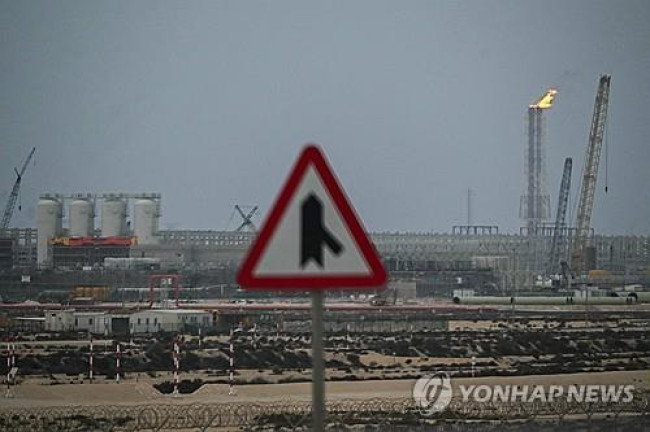 Ras Laffan, Qatar [AFP Yonhap News]
U.S. ExxonMobil obtains about one-fifth of its total crude oil and gas production from the Middle East.
Due to the damage to the natural gas facilities in Ras Laffan, ExxonMobil could face annual revenue losses of approximately $5 billion, and it could take up to five years for facility restoration, according to QatarEnergy, Qatar's state-owned energy company. Last year, ExxonMobil's total revenue was $333 billion.
ExxonMobil currently holds stakes in nine LNG liquefaction lines and 27 LNG carriers in Qatar. Additionally, it has a 6.25% stake in the expansion project of 'North Field,' a gas and oil field offshore Qatar in the Persian Gulf.
ExxonMobil is also a partner in the Aramco-ExxonMobil joint refining facility (SAMREF) on the Red Sea coast in western Saudi Arabia. Iran targeted this facility last week, but no damage occurred. Furthermore, ExxonMobil operates five joint ventures with Aramco and others to produce petrochemical products.
U.S. Chevron operates large gas assets off the coast of Israel, but has suspended operations of these facilities since the outbreak of the war with Iran.
U.S. ConocoPhillips also holds a stake in Qatar's gas assets.
However, since the start of the war with Iran, the stock prices of global oil companies have risen by 5% for ExxonMobil, 8% for Chevron, 9% for Shell, and 12% for ConocoPhillips, respectively. This is analyzed as a greater reflection of the surge in international oil prices than the production and transportation risks in the Middle East region.
What do you think of this article?

 Iranian Foreign Ministry: "Continuing Message Exchanges with the U.S. and Activities of Mediating Countries"
Esmaeil Baghaei, Spokesperson for the Iranian Ministry of Foreign Affairs [Xinhua, Yonhap News file photo]Esmaeil Baghaei, spokesperson for the Iranian Ministry of Foreign Affairs, stated on the 26th
Iranian Foreign Ministry: "Continuing Message Exchanges with the U.S. and Activities of Mediating Countries"
Esmaeil Baghaei, Spokesperson for the Iranian Ministry of Foreign Affairs [Xinhua, Yonhap News file photo]Esmaeil Baghaei, spokesperson for the Iranian Ministry of Foreign Affairs, stated on the 26th
 President Yoon: "Do You Think You Are Safe from the Special Counsel?"... Final Statement Video Released
President Yoon Suk Yeol rebuking the special prosecutor on the 24th. [Court video / @birds_justice X account subtitle GIF] A video of President Yoon Suk Yeol's closing statement at his trial rega
President Yoon: "Do You Think You Are Safe from the Special Counsel?"... Final Statement Video Released
President Yoon Suk Yeol rebuking the special prosecutor on the 24th. [Court video / @birds_justice X account subtitle GIF] A video of President Yoon Suk Yeol's closing statement at his trial rega
 President Yoon, regarding the first-instance ruling on the Public Official Election Act: “An excessive political verdict that distorts the facts… We will appeal immediately.”
The first-instance sentencing hearing for President Yoon Suk Yeol regarding violations of the Public Official Election Act is being broadcast live at Seoul Station on the 27th. [Photo=Yonhap News]Pres
President Yoon, regarding the first-instance ruling on the Public Official Election Act: “An excessive political verdict that distorts the facts… We will appeal immediately.”
The first-instance sentencing hearing for President Yoon Suk Yeol regarding violations of the Public Official Election Act is being broadcast live at Seoul Station on the 27th. [Photo=Yonhap News]Pres
 WSJ: "SK Hynix ADR Premium Is a Sign of AI Trading Overheat"
Advertisement for SK Hynix ADR listing in New York's Times Square [Reuters=Yonhap News file photo]The Wall Street Journal (WSJ) has pointed out that the price of SK Hynix’s American Depositary Recei
WSJ: "SK Hynix ADR Premium Is a Sign of AI Trading Overheat"
Advertisement for SK Hynix ADR listing in New York's Times Square [Reuters=Yonhap News file photo]The Wall Street Journal (WSJ) has pointed out that the price of SK Hynix’s American Depositary Recei
 'Godfather of Japanese Mystery Novels' Keigo Higashino Passes Away After Battle with Cancer at 68
Famous Japanese mystery novelist Keigo Higashino [AFP=Yonhap News]It has been belatedly reported that Keigo Higashino, the "godfather of Japanese mystery novels" and author of bestsellers such as "The
'Godfather of Japanese Mystery Novels' Keigo Higashino Passes Away After Battle with Cancer at 68
Famous Japanese mystery novelist Keigo Higashino [AFP=Yonhap News]It has been belatedly reported that Keigo Higashino, the "godfather of Japanese mystery novels" and author of bestsellers such as "The
 [Park Pil-kyu Security Column] To the Ignorant Trying to Clothe a Beast in Sheep's Clothing
Rep. Kim Byung-joo of the Democratic Party of Korea [Photo=Yonhap News]“The Air Force Academy doesn't teach you how to fly a plane!” “The Army, Navy, and Air Force academies are exactly the
[Park Pil-kyu Security Column] To the Ignorant Trying to Clothe a Beast in Sheep's Clothing
Rep. Kim Byung-joo of the Democratic Party of Korea [Photo=Yonhap News]“The Air Force Academy doesn't teach you how to fly a plane!” “The Army, Navy, and Air Force academies are exactly the
 [Issue Diagnosis] Two Effects of the Election Petition Review
 [Photo] Evidence of Election Fraud Flooding U.S. Media… Trump Had 2.7 Million Votes Stolen
 [Video] U.S. Semiquincentennial Air Show... 'Art in the Sky' streaks across New York
 [Editorial Cartoon] A Draconian Law That Undermines Freedom of Expression

 List
List









