- Cease military action, including war reparations... "Absolutely cannot limit ballistic missiles" stance
 U.S. President Donald Trump [AP Yonhap News]
If negotiations between the United States and Iran materialize as U.S. President Donald Trump claims, it is speculated that Iran will propose conditions such as guarantees for control of the Strait of Hormuz.
Reuters reported on the 24th (local time), citing three high-ranking Iranian sources, that Iran plans to offer unconventional conditions that go beyond a simple ceasefire in negotiations.
The conditions Iran will present to the U.S. reportedly include ▲guarantees to halt future U.S. military actions ▲monetary compensation for war damages ▲official recognition of control over the Strait of Hormuz, a global energy artery.
In particular, Iran is steadfast in its position of "absolutely no" to any restrictions on its ballistic missile program, which is crucial for its national defense, the news agency reported.
Iran had clearly stated its position during nuclear negotiations with the U.S. prior to the war that its missile program could not be a subject of negotiation.
Currently, the signals from both countries regarding negotiations are starkly different. President Trump expressed optimism, stating, "We are having very good conversations with Iran," but Iran officially denied this.
Sources said that Iran is currently engaged in "preliminary discussions" to gauge whether the groundwork for negotiations has been laid with third countries such as Pakistan, Turkey, and Egypt.
A European diplomat hinted, "There are no direct talks, but Egypt, Pakistan, and Gulf countries are engaging in shuttle diplomacy to convey messages."
Some speculate that direct talks between the two countries could potentially be held as early as this week in Islamabad, the capital of Pakistan.
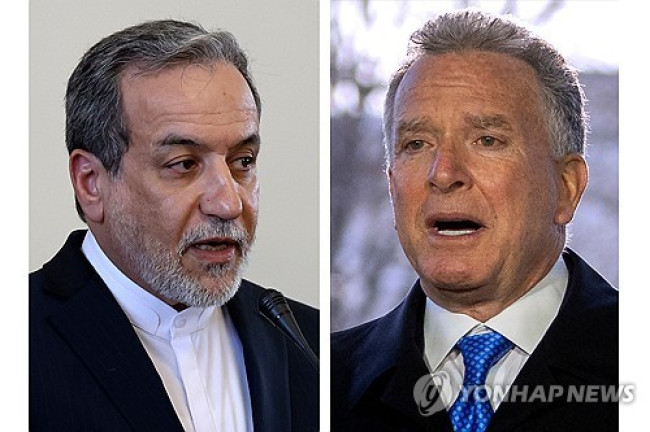 Iranian Foreign Minister Abbas Araghchi (left) and U.S. Special Envoy to the Middle East Steve Wicoff [AP=Yonhap News]
If a meeting materializes, there is speculation that Iran plans to put forward Parliament Speaker Mohammad Bagher Ghalibaf and Foreign Minister Abbas Araghchi.
However, sources unanimously stated that all final decision-making power ultimately rests with the hardliners of the Islamic Revolutionary Guard Corps (IRGC).
Senior Israeli officials view the possibility of an agreement as low. This is because, despite President Trump's strong will to strike a deal, Iran is unlikely to abandon its nuclear and ballistic missile programs, which are directly linked to its survival.
Furthermore, Reuters explained that within Iran, there is considerable skepticism that any agreement would be meaningful, given past attacks even after the ceasefire agreement last year and Israel's continued strikes in Gaza and Lebanon during the truce.
What do you think of this article?

 Iranian Foreign Ministry: "Continuing Message Exchanges with the U.S. and Activities of Mediating Countries"
Esmaeil Baghaei, Spokesperson for the Iranian Ministry of Foreign Affairs [Xinhua, Yonhap News file photo]Esmaeil Baghaei, spokesperson for the Iranian Ministry of Foreign Affairs, stated on the 26th
Iranian Foreign Ministry: "Continuing Message Exchanges with the U.S. and Activities of Mediating Countries"
Esmaeil Baghaei, Spokesperson for the Iranian Ministry of Foreign Affairs [Xinhua, Yonhap News file photo]Esmaeil Baghaei, spokesperson for the Iranian Ministry of Foreign Affairs, stated on the 26th
 President Yoon: "Do You Think You Are Safe from the Special Counsel?"... Final Statement Video Released
President Yoon Suk Yeol rebuking the special prosecutor on the 24th. [Court video / @birds_justice X account subtitle GIF] A video of President Yoon Suk Yeol's closing statement at his trial rega
President Yoon: "Do You Think You Are Safe from the Special Counsel?"... Final Statement Video Released
President Yoon Suk Yeol rebuking the special prosecutor on the 24th. [Court video / @birds_justice X account subtitle GIF] A video of President Yoon Suk Yeol's closing statement at his trial rega
 President Yoon, regarding the first-instance ruling on the Public Official Election Act: “An excessive political verdict that distorts the facts… We will appeal immediately.”
The first-instance sentencing hearing for President Yoon Suk Yeol regarding violations of the Public Official Election Act is being broadcast live at Seoul Station on the 27th. [Photo=Yonhap News]Pres
President Yoon, regarding the first-instance ruling on the Public Official Election Act: “An excessive political verdict that distorts the facts… We will appeal immediately.”
The first-instance sentencing hearing for President Yoon Suk Yeol regarding violations of the Public Official Election Act is being broadcast live at Seoul Station on the 27th. [Photo=Yonhap News]Pres
 WSJ: "SK Hynix ADR Premium Is a Sign of AI Trading Overheat"
Advertisement for SK Hynix ADR listing in New York's Times Square [Reuters=Yonhap News file photo]The Wall Street Journal (WSJ) has pointed out that the price of SK Hynix’s American Depositary Recei
WSJ: "SK Hynix ADR Premium Is a Sign of AI Trading Overheat"
Advertisement for SK Hynix ADR listing in New York's Times Square [Reuters=Yonhap News file photo]The Wall Street Journal (WSJ) has pointed out that the price of SK Hynix’s American Depositary Recei
 'Godfather of Japanese Mystery Novels' Keigo Higashino Passes Away After Battle with Cancer at 68
Famous Japanese mystery novelist Keigo Higashino [AFP=Yonhap News]It has been belatedly reported that Keigo Higashino, the "godfather of Japanese mystery novels" and author of bestsellers such as "The
'Godfather of Japanese Mystery Novels' Keigo Higashino Passes Away After Battle with Cancer at 68
Famous Japanese mystery novelist Keigo Higashino [AFP=Yonhap News]It has been belatedly reported that Keigo Higashino, the "godfather of Japanese mystery novels" and author of bestsellers such as "The
 [Park Pil-kyu Security Column] To the Ignorant Trying to Clothe a Beast in Sheep's Clothing
Rep. Kim Byung-joo of the Democratic Party of Korea [Photo=Yonhap News]“The Air Force Academy doesn't teach you how to fly a plane!” “The Army, Navy, and Air Force academies are exactly the
[Park Pil-kyu Security Column] To the Ignorant Trying to Clothe a Beast in Sheep's Clothing
Rep. Kim Byung-joo of the Democratic Party of Korea [Photo=Yonhap News]“The Air Force Academy doesn't teach you how to fly a plane!” “The Army, Navy, and Air Force academies are exactly the
 [Issue Diagnosis] Two Effects of the Election Petition Review
 [Photo] Evidence of Election Fraud Flooding U.S. Media… Trump Had 2.7 Million Votes Stolen
 [Video] U.S. Semiquincentennial Air Show... 'Art in the Sky' streaks across New York
 [Editorial Cartoon] A Draconian Law That Undermines Freedom of Expression

 List
List









