지난 3월20일자로 발행된 ‘주간 한미일보’ 창간호에 게재된 원고입니다. <편집자주>
 On the afternoon of the 24th, the KOSPI index and others are displayed on the status board at the Hana Bank dealing room in Jung-gu, Seoul. On this day, the KOSPI closed at 5,553.92, up 148.17 points (2.74%) from the previous trading day. [Photo=Yonhap News]
Money Radar
Oil Prices Shook Interest Rates, and Interest Rates Moved Capital
Geopolitical Risk → Soaring Oil Prices → Inflationary Pressure… Recession of Rate Cut Expectations Dollar Strength & Increased Volatility… Market Undergoing ‘Defensive Reallocation’ Partial Exodus from Tech Stocks… Capital Begins to Flow Towards Energy & Infrastructure |
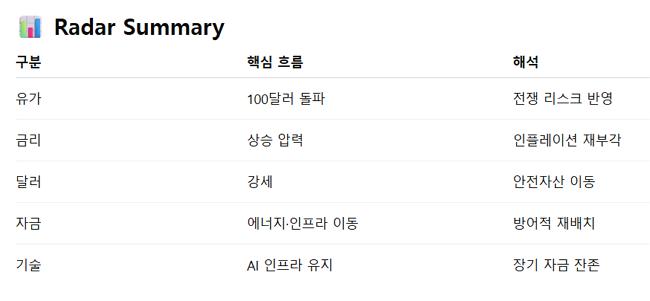
The global financial markets in the fourth week of March 2026 were a week structurally shaken by exogenous variables of war and oil prices. As tensions in the Middle East escalated, international oil prices surged, which immediately translated into inflationary pressure.
Brent crude oil surpassed $100 per barrel, acting not just as a rise in commodity prices but as a variable that altered the expectation structure of the entire financial market. Rising crude oil prices stimulate producer prices, which in turn affect the interest rate trajectory.
Indeed, the U.S. Producer Price Index (PPI) rose 0.7% month-on-month, exceeding market expectations. This was interpreted as a signal that inflation could rear its head again, and expectations for an interest rate cut by the Federal Reserve (Fed) somewhat receded.
The pressure for rising interest rates immediately led to a stronger dollar. The Dollar Index (DXY) rose amid a preference for safe-haven assets, and the won-dollar exchange rate also surged, approaching the 1490 won mark. This trend reflects the possibility of foreign capital outflow.
Market volatility also increased. The VIX index rose in response to war news and soaring oil prices, but financial markets have not yet entered a full-blown panic phase. This signifies that the market is in a ‘correction’ phase, not a ‘panic’ phase.
Ultimately, this week's financial market can be summarized by one structure.
War → Oil Prices → Inflation → Interest Rates → Dollar → Capital Flow
Capital Rotation Radar
Capital Reallocation Amidst War… "What Matters More Than Where Money Left, Is Where It Went"
Short-term Capital Flows to Energy & Infrastructure… Finance & Consumption Under Pressure Partial Inflow into Supply Chains & Commodities… However, Expansion is Limited AI Infrastructure Remains Robust… Long-Term Capital Still Stays in Technology |
The most significant change in the market this week was not the direction, but the movement.
Some capital that had been driving the rise in tech stocks has exited, and that capital has been reallocated to specific areas. This trend was not a wholesale risk aversion, but a conditional, selective movement.
The energy sector was the first to react. As rising oil prices directly translate into profits, investors quickly moved capital into this area. This is not merely a defensive move, but an investment in a structure that can convert price increases into profits.
Utilities and infrastructure also saw capital inflows. Power grids and energy transmission networks maintain demand regardless of economic conditions, and they are being re-evaluated as structural assets, particularly in conjunction with the increased electricity demand of the AI era.
Some capital also flowed into supply chain-related industries. This is because, in a war situation, not only energy but also food and commodity prices tend to rise. However, this trend did not spread across the entire industry.
Conversely, capital outflows were observed in financial and consumer-related sectors. High oil prices and rising interest rates tend to dampen consumption and increase financial market risks.
Interestingly, tech stocks related to AI infrastructure maintained relative strength. Semiconductor and data center companies did not see a complete capital exodus, as long-term growth expectations remained intact despite short-term shocks.
In conclusion, this week's capital flow manifested in a dual structure of 'defense + sustained growth'.
Money Insight
The Truth Behind the HALO Frenzy… "Money Moves Not by Theme, But by Conditions"
Limited Movement to 'Cash Flow Generating Assets', Not All Real Assets China's Supply Capacity Remains Strong… Cyclical Upswing Theory Lacks Basis This is a 'Factor Rotation' Period, Not a Cycle |
This week, the concept of HALO (Heavy Asset, Low Obsolescence) rapidly spread in the market. The explanation is that capital is flowing into physical assets that are difficult to replace with AI.
However, the actual capital flow is much more limited than this narrative suggests.
Capital did not flow into all real assets. Instead, it selectively entered only certain assets that could generate cash flow. This indicates that HALO is not an investment target, but functions as a conditional filter.
It is particularly important that capital did not spread to cyclical industries as a whole. Industries such as steel, chemicals, and batteries did not show a clear upward trend, contrary to expectations.
The reason for this is structurally clear.
China's supply capacity still controls global prices.
As long as supply is maintained, price increases are limited. This was also confirmed in past European energy crises. Even if geopolitical risks exist, if the supply structure is maintained, it does not lead to an increase in profitability across the entire industry.
In this regard, interpreting the current market as the beginning of a cyclical upturn is excessive.
The market is not undergoing a cycle shift right now. It is a 'factor rotation' within the existing upward structure. In other words, it is a phase where money has moved to some areas, rather than the entire market changing direction.
Conclusion
The core of this week's market is simple.
Money left.
And it entered.
And the criteria were clear.
Money does not move by narrative.
Money moves only to places where the structure is confirmed.
[Glossary]
HALO: Assets that are difficult to replace with AI. However, in actual investment, only certain assets that generate cash flow are reflected.
Factor Rotation: A structure where capital moves between asset classes, rather than the entire market changing direction.
Security Premium: A phenomenon where asset prices rise due to geopolitical risks. However, it is not necessarily linked to actual performance. |

 Iranian Foreign Ministry: "Continuing Message Exchanges with the U.S. and Activities of Mediating Countries"
Esmaeil Baghaei, Spokesperson for the Iranian Ministry of Foreign Affairs [Xinhua, Yonhap News file photo]Esmaeil Baghaei, spokesperson for the Iranian Ministry of Foreign Affairs, stated on the 26th
Iranian Foreign Ministry: "Continuing Message Exchanges with the U.S. and Activities of Mediating Countries"
Esmaeil Baghaei, Spokesperson for the Iranian Ministry of Foreign Affairs [Xinhua, Yonhap News file photo]Esmaeil Baghaei, spokesperson for the Iranian Ministry of Foreign Affairs, stated on the 26th
 President Yoon: "Do You Think You Are Safe from the Special Counsel?"... Final Statement Video Released
President Yoon Suk Yeol rebuking the special prosecutor on the 24th. [Court video / @birds_justice X account subtitle GIF] A video of President Yoon Suk Yeol's closing statement at his trial rega
President Yoon: "Do You Think You Are Safe from the Special Counsel?"... Final Statement Video Released
President Yoon Suk Yeol rebuking the special prosecutor on the 24th. [Court video / @birds_justice X account subtitle GIF] A video of President Yoon Suk Yeol's closing statement at his trial rega
 President Yoon, regarding the first-instance ruling on the Public Official Election Act: “An excessive political verdict that distorts the facts… We will appeal immediately.”
The first-instance sentencing hearing for President Yoon Suk Yeol regarding violations of the Public Official Election Act is being broadcast live at Seoul Station on the 27th. [Photo=Yonhap News]Pres
President Yoon, regarding the first-instance ruling on the Public Official Election Act: “An excessive political verdict that distorts the facts… We will appeal immediately.”
The first-instance sentencing hearing for President Yoon Suk Yeol regarding violations of the Public Official Election Act is being broadcast live at Seoul Station on the 27th. [Photo=Yonhap News]Pres
 WSJ: "SK Hynix ADR Premium Is a Sign of AI Trading Overheat"
Advertisement for SK Hynix ADR listing in New York's Times Square [Reuters=Yonhap News file photo]The Wall Street Journal (WSJ) has pointed out that the price of SK Hynix’s American Depositary Recei
WSJ: "SK Hynix ADR Premium Is a Sign of AI Trading Overheat"
Advertisement for SK Hynix ADR listing in New York's Times Square [Reuters=Yonhap News file photo]The Wall Street Journal (WSJ) has pointed out that the price of SK Hynix’s American Depositary Recei
 'Godfather of Japanese Mystery Novels' Keigo Higashino Passes Away After Battle with Cancer at 68
Famous Japanese mystery novelist Keigo Higashino [AFP=Yonhap News]It has been belatedly reported that Keigo Higashino, the "godfather of Japanese mystery novels" and author of bestsellers such as "The
'Godfather of Japanese Mystery Novels' Keigo Higashino Passes Away After Battle with Cancer at 68
Famous Japanese mystery novelist Keigo Higashino [AFP=Yonhap News]It has been belatedly reported that Keigo Higashino, the "godfather of Japanese mystery novels" and author of bestsellers such as "The
 [Park Pil-kyu Security Column] To the Ignorant Trying to Clothe a Beast in Sheep's Clothing
Rep. Kim Byung-joo of the Democratic Party of Korea [Photo=Yonhap News]“The Air Force Academy doesn't teach you how to fly a plane!” “The Army, Navy, and Air Force academies are exactly the
[Park Pil-kyu Security Column] To the Ignorant Trying to Clothe a Beast in Sheep's Clothing
Rep. Kim Byung-joo of the Democratic Party of Korea [Photo=Yonhap News]“The Air Force Academy doesn't teach you how to fly a plane!” “The Army, Navy, and Air Force academies are exactly the
 [Issue Diagnosis] Two Effects of the Election Petition Review
 [Photo] Evidence of Election Fraud Flooding U.S. Media… Trump Had 2.7 Million Votes Stolen
 [Video] U.S. Semiquincentennial Air Show... 'Art in the Sky' streaks across New York
 [Editorial Cartoon] A Draconian Law That Undermines Freedom of Expression

 List
List









