 This is a proposed settlement by the Cheongju Branch 2-1 Administrative Division of the Daejeon High Court (Presiding Judge Shin Jong-oh). Although an order was issued to submit proof of waste disposal by December 31, 2023, controversy surrounding the disposal continues as of March 26, 2026.
The Verdict is In, But the Controversy Isn't Over
The controversy surrounding Daewoo E&C's alleged illegal dumping of construction waste during the construction of the Dongseo Expressway is resurfacing.
This is because, despite a court ruling in November 2020 acknowledging the existence of an illegal state and ordering restoration (a proposed settlement), disputes persist on-site regarding residual waste and incomplete restoration.
The problematic site is located in an area of woodland in Sancheok-myeon, Chungju-si, Chungbuk Province.
This area is known to be near Tunnel Section 3 of the Dongseo Expressway (Chungju-Jecheon section), which was constructed by Daewoo E&C.
Recently, the case has re-emerged as a social issue after the Korea Confederation of Trade Unions' Textile & Construction Union, landowners, and former special investigators of the Chungju City Council inspected the site and argued that "it is difficult to consider the court's measures as completed."
Daewoo E&C maintains that it is proceeding with restoration measures in accordance with the court's ruling. Indeed, they report that approximately 130,000 tons of waste were removed from the site and reported to Chungju City in 2024.
However, individuals who participated in the site investigation claim, "Remnants of shotcrete and waste concrete are visible even to the naked eye."
This is where the two sides diverge.
Daewoo E&C states, "Measures are currently underway," while those raising concerns counter, "The term 'underway' does not explain the current situation."
The most crucial aspect of this case lies in the nature of the court's decision.
The court's ruling was not a judgment determining guilt or innocence in a criminal sense, but an order for restoration based on the premise of an existing illegal state. In other words, the court did not deem the situation "problem-free" but rather ruled, "There is a problem, so restore it."
Therefore, this case cannot be simply dismissed as "a closed matter since a ruling was made," as is often thought.
The issue is not the existence of a ruling, but whether the ruling has been implemented.
If a restoration order was issued, the next question is singular: Has the restoration actually been completed? As long as the answer to that question is disputed, the controversy is bound to continue.
This is why Hanmi Ilbo is re-examining this case.
This matter is not merely a past construction dispute; the issue of implementation and potential environmental harm remains an ongoing concern even after the ruling.
The case has resurfaced not just due to new suspicions. The most fundamental question, "Has the illegal state truly been eliminated?" still remains unanswered since the ruling.
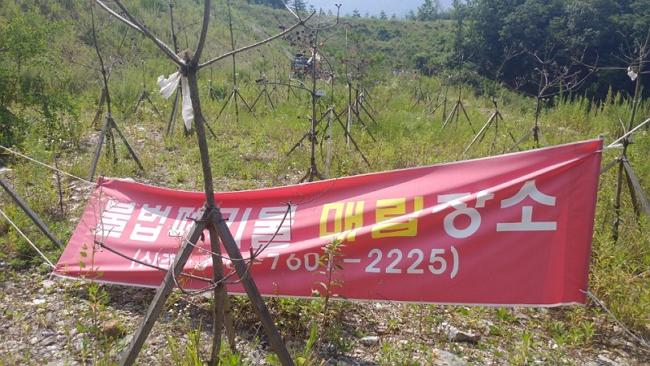 The landowner claims that vegetation is dying due to waste landfilling. [Photo: Internet Media Alliance]
Why Shotcrete is Generated in Tunnel Construction and Why it Becomes Waste
Shotcrete is identified as the core material of the problem.
When excavating tunnels through mountainous terrain, a primary support process is necessary immediately after excavation to prevent collapse due to exposed rock and soil. This involves spraying a mixture of cement, aggregate, and sometimes steel fibers or wires at high pressure, which is known as shotcrete.
The problem is that residual material is inevitably generated after this process.
Rebound material that bounces off the wall after spraying, along with fallen shotcrete lumps and excavation debris, get mixed.
This is different from simple soil or excavated earth. It contains concrete components and, in some cases, steel fibers or wires.
Therefore, backfilling it into adjacent woodlands or leaving it unattended, as one would with ordinary excavated earth, creates separate legal and environmental issues.
According to explanations released by the site inspection team, evidence of shotcrete lumps mixed with steel fibers and wires, waste concrete, and rock debris being buried without removal was confirmed in the woodland in question.
Testimonies also emerged stating that in some areas, gray concrete remnants are exposed on the surface and the natural soil layer has been damaged. It was also described as resembling a barren land where very little vegetation can grow.
This point is extremely important.
This is because the strongest answer to the question "Is this really waste?" lies in the physical properties of the site itself.
Lumps of shotcrete mixed with steel fibers and wires are different from ordinary excavated earth. It is clear that they are not naturally occurring soil but are remnants generated from the artificial process of tunnel construction.
Therefore, if they are present in large quantities at the site, it transitions from a simple soil management issue to a construction waste disposal problem.
The law also points in the same direction.
According to the 'Act on the Promotion of Recycling of Construction Waste,' waste concrete and construction remnants above a certain scale generated at construction sites are classified as construction waste.
Shotcrete, when demolished or fallen, is generally understood to fall under the category of waste concrete. In such cases, the constructor, as the discharger, must follow appropriate separation, storage, removal, and disposal procedures.
Thus, the first key question in this case is clarified.
Are the materials remaining at the site indeed shotcrete remnants and waste concrete? If the answer is "yes," the next question naturally follows:
"Why did they remain in the woodland without undergoing the authorized disposal process?"
Ultimately, this case is not a matter of emotional dispute but an issue that can be confirmed through construction structures and the nature of the materials, thus requiring even more objective verification.
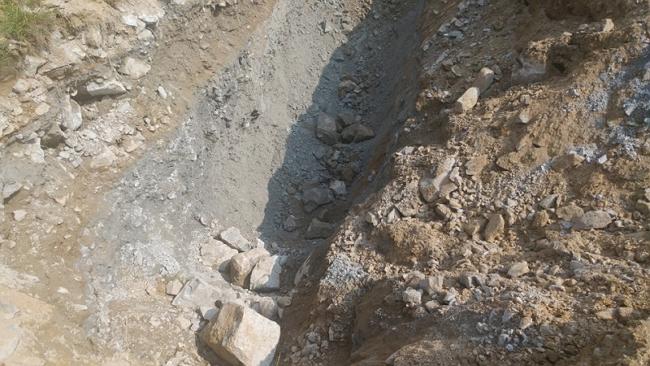 During on-site verification, excavating with an excavator revealed substances resembling cement and waste concrete. [Photo: Internet Media Alliance]
Why is the Claim of "Statute of Limitations Expired" Premature?
The most common counterargument surrounding this case is, "It happened a long time ago, and there was a ruling, so hasn't the statute of limitations expired?"
However, legal principles are not that simple. What is important here is not "when it was buried," but "has the illegal state ended?"
Under the Criminal Procedure Act, the statute of limitations for prosecution begins from the date the criminal act is terminated. For a one-time offense, the statute of limitations is calculated from the date the act ended.
However, the situation changes if illegally dumped waste remains on-site and the party responsible for removing it continues to neglect it.
In such cases, legal principles often approach it from the framework of a continuing offense. In other words, even if the act began in the past, if the illegal state continues to the present, there is a possibility that the crime is not considered terminated.
In this case, the court already ordered Daewoo E&C to restore the site based on the existence of an illegal state. This ruling is not a pardon but a restoration order.
Therefore, if restoration has not actually been completed, the illegal state can be considered ongoing, and in such cases, the starting point for the statute of limitations for prosecution would be the date of actual restoration completion, not the initial dumping date.
This is precisely why the assertion that "there was a ruling, and the statute of limitations has expired" is premature.
This is because one must first verify the type and content of the ruling, whether it has actually been implemented, and whether waste still remains at the site.
To conclude that the case is legally closed simply because a ruling was made is, in fact, to misinterpret the essence of the ruling.
The fact that the case was closed with a "no charges filed" disposition in a previous police investigation is also mentioned.
However, a non-prosecution disposition is different from a final acquittal. While a final judgment creates an insurmountable barrier, a non-prosecution disposition does not.
If new facts are confirmed, or if circumstances reveal that the premises of the previous judgment were different, it can be subject to re-examination.
The reason why the landowner's side claims that the illegally dumped volume was understated as "tens of kilograms" during the investigation process is understood in this context.
Similar interpretations are emerging from some legal circles.
If the illegal state continues after a restoration ruling, criminal liability can be reconsidered, and if a continuing offense is recognized, the statute of limitations for prosecution may need to be re-evaluated.
Of course, whether criminal liability ultimately exists is a matter for the investigative agencies and courts to determine after verifying the facts. However, it is certainly possible to argue that it is legally premature at this stage to definitively state that it is "a case that has already concluded."
This is also why the possibility of a renewed investigation by the prosecution is being discussed in this case.
The core issue is not complex: Has the court-ordered restoration been actually completed? Does waste remain at the site? And is that state continuing to this day?
If the latter two of these three questions cannot yet be answered in the negative, then the criminal aspect is still considered alive.
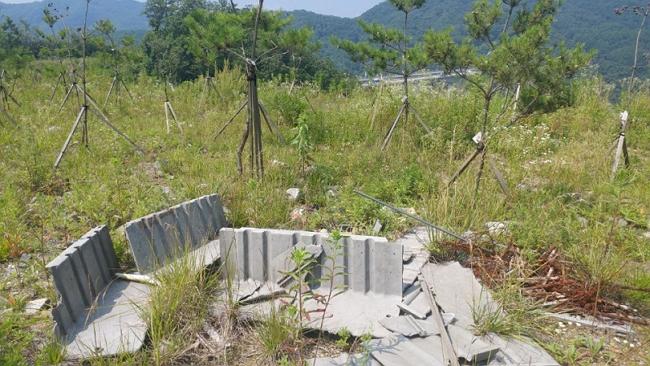 Waste concrete discarded at the site. [Photo: Internet Media Alliance]
Upper Reaches of the Namhangang River: Beyond Construction Disputes to Water Source Management Issues
The reason this case goes beyond a simple civil complaint or construction dispute is due to the location of the site.
The area in question falls within the upper reaches of the Namhangang River system.
In other words, soil erosion or residual waste in this area is not just an issue of a single parcel of woodland but can, in the long term, be linked to water system management and public water supply safety issues.
The water for Seoul and the 수도권 (Seoul Metropolitan Area) is largely supplied from water sources in the Han River system. The central hub is Paldang Lake. Paldang Lake, formed by the confluence of the Namhangang and Bukhangang rivers, is a crucial water intake point for Seoul, Gyeonggi, and Incheon.
Therefore, environmental problems occurring in the upper reaches of the Namhangang River system have a structure that connects directly to the management of public water supplies in the 수도권, extending beyond regional significance.
Of course, facts and interpretations must be distinguished here.
It is difficult to claim that concrete or shotcrete directly causes heavy metal-induced toxic pollution. The primary environmental variables for concrete are generally alkaline leaching and changes in soil structure.
Small amounts of exposed concrete residue may undergo natural neutralization processes. However, the situation can differ when large quantities are buried.
This is because soil structure can be altered, the pathways for rainwater and groundwater movement can change, and there is a potential for alkaline leachate or fine particles to migrate downstream over extended periods.
This is precisely where environmental experts focus their attention.
The issue is not "Is concrete dangerous?" but "Has the construction waste been properly disposed of?"
Construction waste is subject to management from the moment it is generated and must be processed through authorized disposal companies. In particular, stricter regulations apply to areas near public water sources than to general areas.
Within the Han River system, there are regulations for water source protection zones and special measures areas, and activities with the potential for pollution are subject to prior management.
For this reason, allegations of large-scale burial of shotcrete remnants and waste concrete in natural woodlands extend beyond a mere construction convenience issue to a problem involving the entire environmental management system.
If residual waste remains at the site despite the court's restoration order, and vegetation damage and soil alteration continue, this case could be recorded not as a construction dispute but as a case of failure in managing the upper reaches of a public water source.
Ultimately, the environmental aspect of this case culminates in one question.
Does waste still remain at the site?
If the answer is "yes," then this case is not in the past tense but in the present tense, both legally and environmentally.
This is precisely why Hanmi Ilbo is covering this issue.
A ruling was made, but no one can definitively say whether the reality ordered by the ruling has ended.

 Iranian Foreign Ministry: "Continuing Message Exchanges with the U.S. and Activities of Mediating Countries"
Esmaeil Baghaei, Spokesperson for the Iranian Ministry of Foreign Affairs [Xinhua, Yonhap News file photo]Esmaeil Baghaei, spokesperson for the Iranian Ministry of Foreign Affairs, stated on the 26th
Iranian Foreign Ministry: "Continuing Message Exchanges with the U.S. and Activities of Mediating Countries"
Esmaeil Baghaei, Spokesperson for the Iranian Ministry of Foreign Affairs [Xinhua, Yonhap News file photo]Esmaeil Baghaei, spokesperson for the Iranian Ministry of Foreign Affairs, stated on the 26th
 President Yoon: "Do You Think You Are Safe from the Special Counsel?"... Final Statement Video Released
President Yoon Suk Yeol rebuking the special prosecutor on the 24th. [Court video / @birds_justice X account subtitle GIF] A video of President Yoon Suk Yeol's closing statement at his trial rega
President Yoon: "Do You Think You Are Safe from the Special Counsel?"... Final Statement Video Released
President Yoon Suk Yeol rebuking the special prosecutor on the 24th. [Court video / @birds_justice X account subtitle GIF] A video of President Yoon Suk Yeol's closing statement at his trial rega
 President Yoon, regarding the first-instance ruling on the Public Official Election Act: “An excessive political verdict that distorts the facts… We will appeal immediately.”
The first-instance sentencing hearing for President Yoon Suk Yeol regarding violations of the Public Official Election Act is being broadcast live at Seoul Station on the 27th. [Photo=Yonhap News]Pres
President Yoon, regarding the first-instance ruling on the Public Official Election Act: “An excessive political verdict that distorts the facts… We will appeal immediately.”
The first-instance sentencing hearing for President Yoon Suk Yeol regarding violations of the Public Official Election Act is being broadcast live at Seoul Station on the 27th. [Photo=Yonhap News]Pres
 WSJ: "SK Hynix ADR Premium Is a Sign of AI Trading Overheat"
Advertisement for SK Hynix ADR listing in New York's Times Square [Reuters=Yonhap News file photo]The Wall Street Journal (WSJ) has pointed out that the price of SK Hynix’s American Depositary Recei
WSJ: "SK Hynix ADR Premium Is a Sign of AI Trading Overheat"
Advertisement for SK Hynix ADR listing in New York's Times Square [Reuters=Yonhap News file photo]The Wall Street Journal (WSJ) has pointed out that the price of SK Hynix’s American Depositary Recei
 'Godfather of Japanese Mystery Novels' Keigo Higashino Passes Away After Battle with Cancer at 68
Famous Japanese mystery novelist Keigo Higashino [AFP=Yonhap News]It has been belatedly reported that Keigo Higashino, the "godfather of Japanese mystery novels" and author of bestsellers such as "The
'Godfather of Japanese Mystery Novels' Keigo Higashino Passes Away After Battle with Cancer at 68
Famous Japanese mystery novelist Keigo Higashino [AFP=Yonhap News]It has been belatedly reported that Keigo Higashino, the "godfather of Japanese mystery novels" and author of bestsellers such as "The
 [Park Pil-kyu Security Column] To the Ignorant Trying to Clothe a Beast in Sheep's Clothing
Rep. Kim Byung-joo of the Democratic Party of Korea [Photo=Yonhap News]“The Air Force Academy doesn't teach you how to fly a plane!” “The Army, Navy, and Air Force academies are exactly the
[Park Pil-kyu Security Column] To the Ignorant Trying to Clothe a Beast in Sheep's Clothing
Rep. Kim Byung-joo of the Democratic Party of Korea [Photo=Yonhap News]“The Air Force Academy doesn't teach you how to fly a plane!” “The Army, Navy, and Air Force academies are exactly the
 [Issue Diagnosis] Two Effects of the Election Petition Review
 [Photo] Evidence of Election Fraud Flooding U.S. Media… Trump Had 2.7 Million Votes Stolen
 [Video] U.S. Semiquincentennial Air Show... 'Art in the Sky' streaks across New York
 [Editorial Cartoon] A Draconian Law That Undermines Freedom of Expression

 List
List









