- Financial Research Institute Report: "Actual exports to the US likely decreased less"
- China, Canada, and Japan have the largest declines... Taiwan, Vietnam, and Thailand are rising
 Steel products piled up at Pyeongtaek Port in Gyeonggi Province on the 12th. [Yonhap News]
A recent analysis suggests that while South Korea's actual decrease in exports to the U.S. has been limited following U.S. President Donald Trump's imposition of tariffs, the export unit prices of major items have declined, increasing the burden on domestic exporters.
Kim Hyun-tae, a research fellow at the Korea Institute of Finance, stated this in a report titled "Analysis of Changes in Market Share of Major Export Items in the U.S. Import Market" on the 29th.
Kim noted that South Korea's export market share in the U.S. decreased by 0.4 percentage points (p) when comparing the period before and after the mutual imposition of tariffs by Trump, specifically in 2024 and 2025.
China experienced the largest decline in market share, exceeding 4 percentage points, followed by Canada, Japan, and South Korea.
In contrast, Taiwan's market share rose by 2.3 percentage points, driven by strong exports of AI semiconductors, and countries with relatively lower tariff rates such as Vietnam and Thailand also saw an increase in their market share.
Kim commented, "Although our country's export market share to the U.S. has slightly decreased, considering the significant increase in high-performance memory semiconductor exports from South Korea to Taiwan last year and the subsequent re-export of some of those to the U.S., South Korea's actual exports to the U.S. may have decreased less than indicated by the decline in market share."
For automobiles and steel, which experienced significant tariff increases due to the imposition of tariffs on specific items, U.S. export value decreased by 13.2% and 18%, respectively, year-on-year last year. However, the market share within the U.S. remained unchanged for automobiles compared to the previous year, and for steel, it only dropped by 0.05 percentage points.
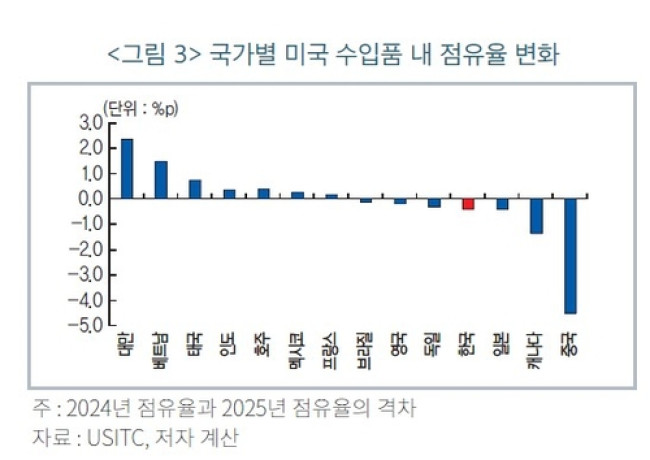 Changes in Market Share of U.S. Imports by Country [Provided by Korea Institute of Finance]
Kim pointed out that while the export market share of these items to the U.S. was largely unaffected, the significant drop in export unit prices likely resulted in the tariff burden being passed on to domestic exporters.
According to the report, the export unit price of automobiles to the U.S. market plummeted by 7% in May of last year, when tariffs began to be fully applied, compared to December of the previous year. This downward trend continued, with prices at the end of last year being 12.2% lower than in the same month of the preceding year.
Conversely, the export unit price of automobiles to regions other than the U.S. actually increased during the same period, rising by 12.8% at the end of last year compared to the same month of the previous year.
For steel products, the export unit price to the U.S. market decreased by 17.6% at the end of last year compared to the same month of the previous year, while prices in regions other than the U.S. remained at a similar level.
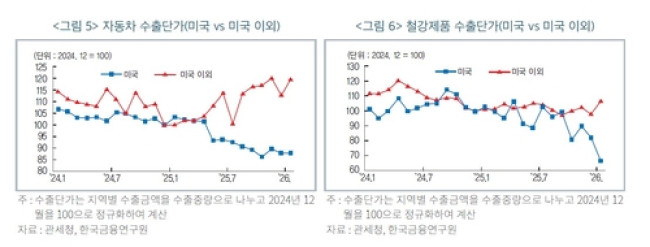 Trends in Automobile and Steel Export Unit Prices [Provided by Korea Institute of Finance]
What do you think of this article?

 Iranian Foreign Ministry: "Continuing Message Exchanges with the U.S. and Activities of Mediating Countries"
Esmaeil Baghaei, Spokesperson for the Iranian Ministry of Foreign Affairs [Xinhua, Yonhap News file photo]Esmaeil Baghaei, spokesperson for the Iranian Ministry of Foreign Affairs, stated on the 26th
Iranian Foreign Ministry: "Continuing Message Exchanges with the U.S. and Activities of Mediating Countries"
Esmaeil Baghaei, Spokesperson for the Iranian Ministry of Foreign Affairs [Xinhua, Yonhap News file photo]Esmaeil Baghaei, spokesperson for the Iranian Ministry of Foreign Affairs, stated on the 26th
 President Yoon: "Do You Think You Are Safe from the Special Counsel?"... Final Statement Video Released
President Yoon Suk Yeol rebuking the special prosecutor on the 24th. [Court video / @birds_justice X account subtitle GIF] A video of President Yoon Suk Yeol's closing statement at his trial rega
President Yoon: "Do You Think You Are Safe from the Special Counsel?"... Final Statement Video Released
President Yoon Suk Yeol rebuking the special prosecutor on the 24th. [Court video / @birds_justice X account subtitle GIF] A video of President Yoon Suk Yeol's closing statement at his trial rega
 President Yoon, regarding the first-instance ruling on the Public Official Election Act: “An excessive political verdict that distorts the facts… We will appeal immediately.”
The first-instance sentencing hearing for President Yoon Suk Yeol regarding violations of the Public Official Election Act is being broadcast live at Seoul Station on the 27th. [Photo=Yonhap News]Pres
President Yoon, regarding the first-instance ruling on the Public Official Election Act: “An excessive political verdict that distorts the facts… We will appeal immediately.”
The first-instance sentencing hearing for President Yoon Suk Yeol regarding violations of the Public Official Election Act is being broadcast live at Seoul Station on the 27th. [Photo=Yonhap News]Pres
 WSJ: "SK Hynix ADR Premium Is a Sign of AI Trading Overheat"
Advertisement for SK Hynix ADR listing in New York's Times Square [Reuters=Yonhap News file photo]The Wall Street Journal (WSJ) has pointed out that the price of SK Hynix’s American Depositary Recei
WSJ: "SK Hynix ADR Premium Is a Sign of AI Trading Overheat"
Advertisement for SK Hynix ADR listing in New York's Times Square [Reuters=Yonhap News file photo]The Wall Street Journal (WSJ) has pointed out that the price of SK Hynix’s American Depositary Recei
 'Godfather of Japanese Mystery Novels' Keigo Higashino Passes Away After Battle with Cancer at 68
Famous Japanese mystery novelist Keigo Higashino [AFP=Yonhap News]It has been belatedly reported that Keigo Higashino, the "godfather of Japanese mystery novels" and author of bestsellers such as "The
'Godfather of Japanese Mystery Novels' Keigo Higashino Passes Away After Battle with Cancer at 68
Famous Japanese mystery novelist Keigo Higashino [AFP=Yonhap News]It has been belatedly reported that Keigo Higashino, the "godfather of Japanese mystery novels" and author of bestsellers such as "The
 [Park Pil-kyu Security Column] To the Ignorant Trying to Clothe a Beast in Sheep's Clothing
Rep. Kim Byung-joo of the Democratic Party of Korea [Photo=Yonhap News]“The Air Force Academy doesn't teach you how to fly a plane!” “The Army, Navy, and Air Force academies are exactly the
[Park Pil-kyu Security Column] To the Ignorant Trying to Clothe a Beast in Sheep's Clothing
Rep. Kim Byung-joo of the Democratic Party of Korea [Photo=Yonhap News]“The Air Force Academy doesn't teach you how to fly a plane!” “The Army, Navy, and Air Force academies are exactly the
 [Issue Diagnosis] Two Effects of the Election Petition Review
 [Photo] Evidence of Election Fraud Flooding U.S. Media… Trump Had 2.7 Million Votes Stolen
 [Video] U.S. Semiquincentennial Air Show... 'Art in the Sky' streaks across New York
 [Editorial Cartoon] A Draconian Law That Undermines Freedom of Expression

 List
List









