 Former Nepalese Prime Minister Oli being transferred to a hospital from a police station after arrest (second from left) [Reuters Yonhap News]
Former Prime Minister K.P. Sharma Oli of Nepal, who stepped down last September following the so-called 'Gen Z anti-government protests' that resulted in the deaths of over 70 people, has been arrested by police on charges of negligence during the crackdown process.
According to AP, Reuters, AFP, and other media outlets on the 29th (local time), Nepalese police arrested the former Prime Minister at his residence on the outskirts of the capital, Kathmandu, the previous day.
He is accused of failing to properly respond to the large-scale violent incidents last year, which prevented the prevention of subsequent protester deaths.
Nepalese police also arrested Ramesh Lekhak, the then Home Minister, who ordered the firing on protesters.
Nepalese police officers in riot gear transported the arrested individuals to the Kathmandu police station. Former Prime Minister Oli, who is 74 years old and has undergone two kidney transplant surgeries in the past, was subsequently moved from the police station to a hospital.
This arrest occurred just one day after Balendra Shah (35, also known as Balen), the new Prime Minister of Nepal, took office on the 27th.
Suddhan Gurung, the founder of the civic group 'Hami Nepal' (We are Nepal), which led last year's protests, also announced their arrests via social media.
He emphasized, "No one is above the law," and stated, "This is not revenge against anyone, but merely the beginning of justice."
Upon learning of the arrest of former Prime Minister Oli, his supporters gathered near the residence of the new Prime Minister Balen to protest.
Protesters chanted slogans denouncing the new government, set tires on fire, and engaged in physical altercations with police officers who dispersed them with tear gas and batons.
One protester was injured and seven were arrested by the police during this incident, according to foreign media.
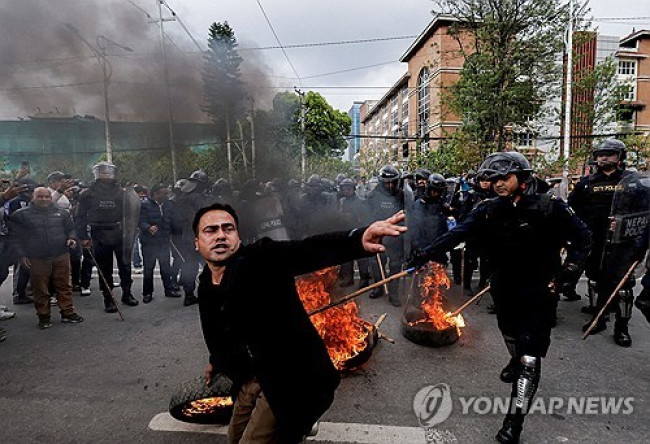 Supporters protesting the arrest of former PM Oli [Reuters Yonhap News]
The lawyer for former Prime Minister Oli emphasized that the arrest was illegal as there was no risk of him fleeing, and the Communist Party of Nepal (Unified Marxist-Leninist) (CPN-UML), to which former Prime Minister Oli belongs, claimed it was political revenge.
Recently, the Nepalese Anti-Government Protest Investigation Committee recommended that authorities indict former Prime Minister Oli, former minister Lekhak, and former Inspector General of Police Chandra Kuber Kafley.
The investigation committee determined that former Prime Minister Oli took no measures to prevent the firing that killed 19 people on the first day of the anti-government protests.
It also pointed out that "Minister Lekhak, who had overall responsibility for maintaining law and order, also appears to have made no efforts to prevent further casualties."
Nepalese police also arrested former Energy Minister Deepak Karki on charges of money laundering on the same day.
Minister Gurung explained that he was detained in connection with an investigation into funds found at Minister Karki's residence during last year's protests.
At the time, protesters set fire to Minister Karki's residence, and a video of cash found inside being scattered in the air was circulated on social media.
In Nepal, large-scale protests erupted in September last year when the government blocked access to 26 social media platforms, including YouTube and Facebook.
In particular, as many members of the Z generation, who were disappointed with the government's slow progress in eradicating corruption and economic growth, joined the protests, they spread not only to the capital, Kathmandu, but also to other cities.
Despite the resignations of then-Prime Minister Oli and some ministers, the situation worsened as protesters set fire to the presidential palace and the prime minister's residence.
During the protests, 76 people were killed and over 2,300 were injured. Among the deceased, about 30 died from live ammunition. Property damage amounted to $586 million (approximately 865 billion won).
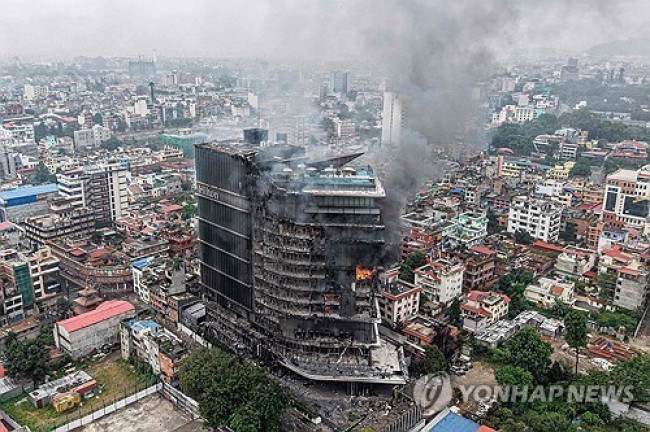 Hilton Hotel in Kathmandu, Nepal, burned during anti-government protests last year [AFP Yonhap News]

 Iranian Foreign Ministry: "Continuing Message Exchanges with the U.S. and Activities of Mediating Countries"
Esmaeil Baghaei, Spokesperson for the Iranian Ministry of Foreign Affairs [Xinhua, Yonhap News file photo]Esmaeil Baghaei, spokesperson for the Iranian Ministry of Foreign Affairs, stated on the 26th
Iranian Foreign Ministry: "Continuing Message Exchanges with the U.S. and Activities of Mediating Countries"
Esmaeil Baghaei, Spokesperson for the Iranian Ministry of Foreign Affairs [Xinhua, Yonhap News file photo]Esmaeil Baghaei, spokesperson for the Iranian Ministry of Foreign Affairs, stated on the 26th
 President Yoon: "Do You Think You Are Safe from the Special Counsel?"... Final Statement Video Released
President Yoon Suk Yeol rebuking the special prosecutor on the 24th. [Court video / @birds_justice X account subtitle GIF] A video of President Yoon Suk Yeol's closing statement at his trial rega
President Yoon: "Do You Think You Are Safe from the Special Counsel?"... Final Statement Video Released
President Yoon Suk Yeol rebuking the special prosecutor on the 24th. [Court video / @birds_justice X account subtitle GIF] A video of President Yoon Suk Yeol's closing statement at his trial rega
 President Yoon, regarding the first-instance ruling on the Public Official Election Act: “An excessive political verdict that distorts the facts… We will appeal immediately.”
The first-instance sentencing hearing for President Yoon Suk Yeol regarding violations of the Public Official Election Act is being broadcast live at Seoul Station on the 27th. [Photo=Yonhap News]Pres
President Yoon, regarding the first-instance ruling on the Public Official Election Act: “An excessive political verdict that distorts the facts… We will appeal immediately.”
The first-instance sentencing hearing for President Yoon Suk Yeol regarding violations of the Public Official Election Act is being broadcast live at Seoul Station on the 27th. [Photo=Yonhap News]Pres
 WSJ: "SK Hynix ADR Premium Is a Sign of AI Trading Overheat"
Advertisement for SK Hynix ADR listing in New York's Times Square [Reuters=Yonhap News file photo]The Wall Street Journal (WSJ) has pointed out that the price of SK Hynix’s American Depositary Recei
WSJ: "SK Hynix ADR Premium Is a Sign of AI Trading Overheat"
Advertisement for SK Hynix ADR listing in New York's Times Square [Reuters=Yonhap News file photo]The Wall Street Journal (WSJ) has pointed out that the price of SK Hynix’s American Depositary Recei
 'Godfather of Japanese Mystery Novels' Keigo Higashino Passes Away After Battle with Cancer at 68
Famous Japanese mystery novelist Keigo Higashino [AFP=Yonhap News]It has been belatedly reported that Keigo Higashino, the "godfather of Japanese mystery novels" and author of bestsellers such as "The
'Godfather of Japanese Mystery Novels' Keigo Higashino Passes Away After Battle with Cancer at 68
Famous Japanese mystery novelist Keigo Higashino [AFP=Yonhap News]It has been belatedly reported that Keigo Higashino, the "godfather of Japanese mystery novels" and author of bestsellers such as "The
 [Park Pil-kyu Security Column] To the Ignorant Trying to Clothe a Beast in Sheep's Clothing
Rep. Kim Byung-joo of the Democratic Party of Korea [Photo=Yonhap News]“The Air Force Academy doesn't teach you how to fly a plane!” “The Army, Navy, and Air Force academies are exactly the
[Park Pil-kyu Security Column] To the Ignorant Trying to Clothe a Beast in Sheep's Clothing
Rep. Kim Byung-joo of the Democratic Party of Korea [Photo=Yonhap News]“The Air Force Academy doesn't teach you how to fly a plane!” “The Army, Navy, and Air Force academies are exactly the
 [Issue Diagnosis] Two Effects of the Election Petition Review
 [Photo] Evidence of Election Fraud Flooding U.S. Media… Trump Had 2.7 Million Votes Stolen
 [Video] U.S. Semiquincentennial Air Show... 'Art in the Sky' streaks across New York
 [Editorial Cartoon] A Draconian Law That Undermines Freedom of Expression

 List
List










