 Caroline Rabbit, White House Spokesperson [AP Yonhap News]
Caroline Rabbit, White House Spokesperson, said on the 30th (local time) that U.S. President Donald Trump would be quite interested in having Arab nations bear the cost of a war against Iran.
She also warned that if Iran misses this "golden opportunity" by repeatedly pressing for a negotiated settlement, it will face severe consequences.
When asked at a White House briefing that day, "During the Gulf War, Arab countries such as Saudi Arabia, Kuwait, and the UAE bore a significant portion of the war costs. Will it be the same this time?" Caroline Rabbit, White House Spokesperson, replied, "President Trump would be quite interested in asking them to do so."
Rabbit added, "I don't want to get ahead of the President, but as far as I know, this is the President's idea," indicating that President Trump would make related remarks.
This suggests that given the immense cost of U.S. military operations against Iran, Arab regional countries that benefit from the removal of the Iranian threat should bear the costs.
Although Rabbit did not elaborate further at the briefing, the fact that she mentioned hearing related remarks from President Trump suggests that discussions about Arab countries sharing the costs of a war with Iran have likely taken place within the White House.
From the perspective of Arab nations, they might have to bear the costs of a U.S. military operation against Iran that was initiated without prior sufficient discussion. While removing the threat and weakening Iran's power is indeed an important issue for Arab countries, the direction of the cost-sharing discussions is drawing attention, especially as several Arab countries, led by the UAE, have already suffered damage from attacks related to Iran.
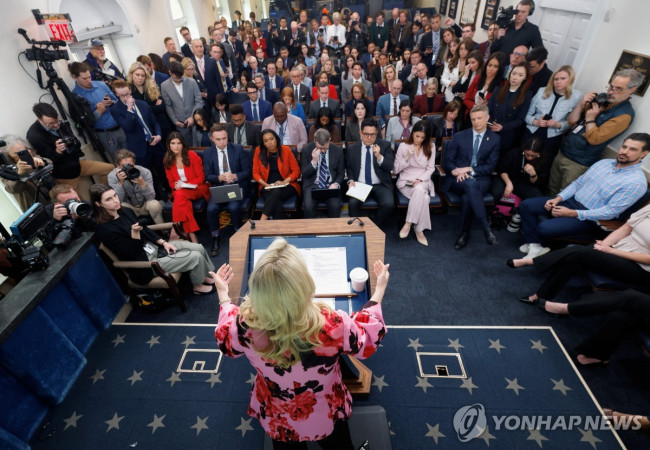 White House Briefing [Reuters Yonhap News]
Rabbit stated that negotiations with Iran are progressing well and warned that Iran could face severe consequences if it rejects this golden opportunity.
"The negotiations (with Iran) are ongoing and going well," Rabbit said. "What is being said publicly is very different from what is being communicated privately."
She added, "(The negotiations for a pause in attacks) are a once-in-a-generation opportunity for Iran. If Iran rejects this golden opportunity, the military is on standby with all options to ensure Iran pays a severe price."
Rabbit also claimed that Iran had agreed to some provisions in private talks. The U.S. has conveyed a 15-point peace proposal to Iran.
She also stated that there was no change to the initially proposed war duration of 4-6 weeks. This implies that the war would end within six weeks, by mid-April, in line with President Trump's policy of pausing attacks on Iranian power plants and energy infrastructure until April 6th to negotiate.
Rabbit further stated that 20 additional oil tankers would pass through the Strait of Hormuz within days, depending on direct and indirect negotiations between the U.S. and Iran.
In relation to this, U.S. Treasury Secretary Scott Bessent said in an interview with Fox News that day, "Over time, whether through U.S. escort or multinational escort, the U.S. will regain control of the Strait of Hormuz and ensure freedom of navigation."
President Trump had initially set a deadline of the 27th, threatening to attack Iranian power plants and energy infrastructure if the Strait of Hormuz was not opened, and then extended it by ten days to the 6th of next month.
Meanwhile, Rabbit expressed concern regarding the cancellation of a mass at the holy site in Jerusalem due to obstruction by Israeli authorities, stating, "We hope that worshippers can access the holy site."
Rabbit mentioned that high-ranking U.S. officials might visit China ahead of President Trump's visit to China in May. This refers to the customary visits for agenda consultations prior to a summit meeting.
Regarding the U.S. tolerance of Russian oil tankers heading to Cuba, she argued that it was on humanitarian grounds, stating, "There is no official change in sanctions policy, and decisions are made on a case-by-case basis."

 Iranian Foreign Ministry: "Continuing Message Exchanges with the U.S. and Activities of Mediating Countries"
Esmaeil Baghaei, Spokesperson for the Iranian Ministry of Foreign Affairs [Xinhua, Yonhap News file photo]Esmaeil Baghaei, spokesperson for the Iranian Ministry of Foreign Affairs, stated on the 26th
Iranian Foreign Ministry: "Continuing Message Exchanges with the U.S. and Activities of Mediating Countries"
Esmaeil Baghaei, Spokesperson for the Iranian Ministry of Foreign Affairs [Xinhua, Yonhap News file photo]Esmaeil Baghaei, spokesperson for the Iranian Ministry of Foreign Affairs, stated on the 26th
 President Yoon: "Do You Think You Are Safe from the Special Counsel?"... Final Statement Video Released
President Yoon Suk Yeol rebuking the special prosecutor on the 24th. [Court video / @birds_justice X account subtitle GIF] A video of President Yoon Suk Yeol's closing statement at his trial rega
President Yoon: "Do You Think You Are Safe from the Special Counsel?"... Final Statement Video Released
President Yoon Suk Yeol rebuking the special prosecutor on the 24th. [Court video / @birds_justice X account subtitle GIF] A video of President Yoon Suk Yeol's closing statement at his trial rega
 President Yoon, regarding the first-instance ruling on the Public Official Election Act: “An excessive political verdict that distorts the facts… We will appeal immediately.”
The first-instance sentencing hearing for President Yoon Suk Yeol regarding violations of the Public Official Election Act is being broadcast live at Seoul Station on the 27th. [Photo=Yonhap News]Pres
President Yoon, regarding the first-instance ruling on the Public Official Election Act: “An excessive political verdict that distorts the facts… We will appeal immediately.”
The first-instance sentencing hearing for President Yoon Suk Yeol regarding violations of the Public Official Election Act is being broadcast live at Seoul Station on the 27th. [Photo=Yonhap News]Pres
 WSJ: "SK Hynix ADR Premium Is a Sign of AI Trading Overheat"
Advertisement for SK Hynix ADR listing in New York's Times Square [Reuters=Yonhap News file photo]The Wall Street Journal (WSJ) has pointed out that the price of SK Hynix’s American Depositary Recei
WSJ: "SK Hynix ADR Premium Is a Sign of AI Trading Overheat"
Advertisement for SK Hynix ADR listing in New York's Times Square [Reuters=Yonhap News file photo]The Wall Street Journal (WSJ) has pointed out that the price of SK Hynix’s American Depositary Recei
 'Godfather of Japanese Mystery Novels' Keigo Higashino Passes Away After Battle with Cancer at 68
Famous Japanese mystery novelist Keigo Higashino [AFP=Yonhap News]It has been belatedly reported that Keigo Higashino, the "godfather of Japanese mystery novels" and author of bestsellers such as "The
'Godfather of Japanese Mystery Novels' Keigo Higashino Passes Away After Battle with Cancer at 68
Famous Japanese mystery novelist Keigo Higashino [AFP=Yonhap News]It has been belatedly reported that Keigo Higashino, the "godfather of Japanese mystery novels" and author of bestsellers such as "The
 [Park Pil-kyu Security Column] To the Ignorant Trying to Clothe a Beast in Sheep's Clothing
Rep. Kim Byung-joo of the Democratic Party of Korea [Photo=Yonhap News]“The Air Force Academy doesn't teach you how to fly a plane!” “The Army, Navy, and Air Force academies are exactly the
[Park Pil-kyu Security Column] To the Ignorant Trying to Clothe a Beast in Sheep's Clothing
Rep. Kim Byung-joo of the Democratic Party of Korea [Photo=Yonhap News]“The Air Force Academy doesn't teach you how to fly a plane!” “The Army, Navy, and Air Force academies are exactly the
 [Issue Diagnosis] Two Effects of the Election Petition Review
 [Photo] Evidence of Election Fraud Flooding U.S. Media… Trump Had 2.7 Million Votes Stolen
 [Video] U.S. Semiquincentennial Air Show... 'Art in the Sky' streaks across New York
 [Editorial Cartoon] A Draconian Law That Undermines Freedom of Expression

 List
List









