이 글은 탈북인으로 영국 아시아태평양전략센터(Center for Asia Pacific Strategy)의 인권 안보 분야 선임 연구원으로 근무하는 박지현 씨가 UPI에 영문으로 기고한 글입니다. 필자는 김씨 일가 정권의 정당성에 이의를 제기하기 위해 북한(North Korea)이라는 머릿글자에 소문자 “n”을 사용했음을 알립니다.
 Author Kim Kyu-na in front of the criminal court before the trial on April 2nd. [Photo by Reporter Lim Yo-hee]
On March 30th (local time), the UN Human Rights Council unanimously adopted a resolution on the human rights situation in North Korea. The following is an excerpt from a statement issued by the North Korean Ministry of Foreign Affairs.
“The practice of adopting 'human rights resolutions' targeting North Korea, which has continued for over 20 years, is a clear example of the miserable reality in the field of UN human rights, revealing it to be tainted by politicization, bias, and double standards.”
The urgent task facing the UN Human Rights Council today is to take concrete measures to thoroughly investigate and hold accountable the heinous crimes against humanity committed through the state terrorism and sovereignty violations of hegemonic powers.
Language as a Means of Concealment
This is not mere diplomatic rhetoric. It is a classic example of how language is used to conceal violence and distort reality.
Political prison camps, forced labor, and human trafficking have disappeared from the discourse, replaced by terms such as “politicization,” “double standards,” and “sovereignty violations.”
Violence still exists. Language simply makes it invisible. I often ask myself: How do cultures and languages disappear? And how does their disappearance become a form of human rights violation?
How Culture Disappears
Entering the 21st century, paper and pens are gradually disappearing from our lives. We write on screens and read from screens. The disappearance of paper and pens may be a sign that language and culture are slowly fading into the mist.
It is easy to imagine cultures disappearing during wartime, libraries collapsing, books burning, and people scattering, leaving no time to read books.
However, books have always survived on the battlefield. Soldiers kept newspapers and magazines close, expanding their knowledge amidst the chaos. Writing letters to loved ones provided moments of peace through ink and paper.
Paradoxically, in wartime, books and letters often become the last cultural refuge that preserves our humanity.
But in times of peace, culture disappears quietly. Not due to persecution, but due to ignorance and indifference. It vanishes without a trace, unnoticed by anyone.
When society begins to say, "That topic should not be discussed," and people hesitate to ask questions out of fear of the consequences, that is when culture begins to shrink.
North Korea exemplifies this process more clearly than anywhere else. After liberation in 1956, Kim Il-sung ordered what he called the "purging of anti-party, anti-revolutionary factions." We call this the 'August Faction Incident.' That single event determined the fate of countless people.
A writer, a scholar, or even a friend’s careless word or sentence could send someone to a political prison camp.
North Korea's Structure of Cultural Control
From its early days, books and language have been subjects of state control. Publications, newspapers, literature, films, television, and even everyday conversations are subject to surveillance and censorship.
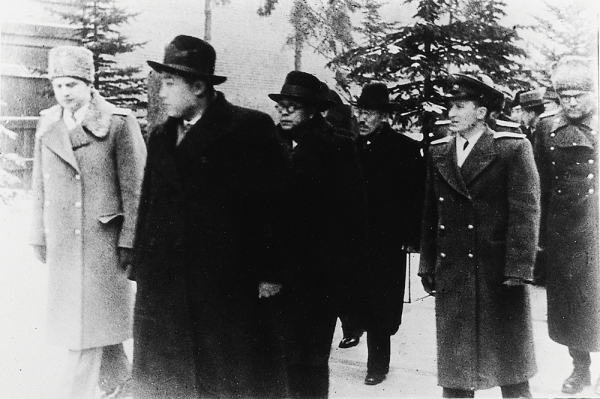 In March 1949, North Korean Prime Minister Kim Il-sung (center), Deputy Prime Minister and Foreign Minister Park Hun-young (behind Kim Il-sung), and Deputy Prime Minister Hong Myong-hui, among other North Korean government delegates, enter the Kremlin in Moscow, Soviet Union, to meet with Stalin.
In the 1970s, revolutionary operas filled television screens, spreading anti-Japanese and anti-American propaganda. School textbooks contained fabricated stories, such as the massacre of innocent mothers and children by U.S. forces in Sinchon during the Korean War, instilling hatred and fear in young students.
People born in North Korea do not even realize that this is language control or cultural annihilation. The state dictates which words can be used.
Using different languages or expressions can lead to someone being branded as 'anti-socialist,' and a single word spoken by an individual can send people to prison camps or execution for generations.
Criminalizing External Influence
As North Korea's policy of cultural annihilation intensified, the spread of external information through markets since 2009 posed a new threat to the regime. Young people began to adopt Korean language, names, and culture.
In response, the regime enacted the Law on Guaranteeing Youth Education (2021), the Law on Rejection of Reactionary Ideology and Culture (2022), and the Pyongyang Cultural Language Protection Law (2023). These laws are designed to block Hallyu content, restrict language, and criminalize even minor deviations from state-sanctioned discourse.
In North Korea, reading foreign books, watching foreign films, or even using Korean expressions is illegal. There are even reports of executions for watching the movie 'Squid Game.'
Films, dramas, books, music, and even a single line posted on social media can become grounds for punishment. Writers and artists cannot ask questions or present different perspectives.
This is not mere censorship. It is cultural annihilation, an attempt to sever memory, imagination, the past, and the future.
When Regimes Burn Memory
History repeats itself. When books were burned in Nazi Germany, President Franklin D. Roosevelt warned, "Where books are burned, freedom also burns." Winston Churchill added, "Those who burn books burn their own minds."
During China's Cultural Revolution, countless books, knowledge, and memories were erased. Though the eras and places differed, the methods were always the same. Power begins with controlling books, because books are windows to other worlds.
A Warning to South Korean Democracy
These lessons serve as a warning to contemporary South Korean society. The recent case of author Kim Kyu-na is a prime example.
The author posted her views on history and literature on social media, and her statements became grounds for criminal charges under the law related to the May 18th Democratization Movement.
Novelist Han Kang spoke of universal rights in her Nobel Prize acceptance speech, but Kim Kyu-na cannot speak of her own universal rights.
The issue is not whether her writings were right or wrong. The real question is how far the state can restrict freedom of expression. Why are some people's opinions protected while others' are criminalized?
This is not just about one South Korean author. Currently, over 34,000 North Korean defectors live in South Korea, many of whom have become writers. However, their frank stories have often been met with suspicion of being "anti-North Korean propaganda," and the rights of writers have frequently been violated due to prejudice.
The Special Act on the May 18th Democratization Movement was enacted to prevent the spread of false information. However, the boundary between "false," "interpretation," and "opinion" is not always clear.
If such laws are expanded, there is a risk of leading to restrictions on freedom of information and press, similar to North Korea's notorious "three evil laws."
When the state begins to define the limits of language, people begin to fall silent. A single sentence, a single line of writing, can feel dangerous not only to oneself but also to those around them.
This voluntary silence is the first step towards totalitarianism.
The Standard of Democracy
International standards are clear. Article 19 of the International Covenant on Civil and Political Rights protects freedom of expression, stating that any restrictions must be minimal.
The UN Human Rights Committee has repeatedly emphasized that criminalizing opinions, especially those that are controversial or uncomfortable, is inappropriate.
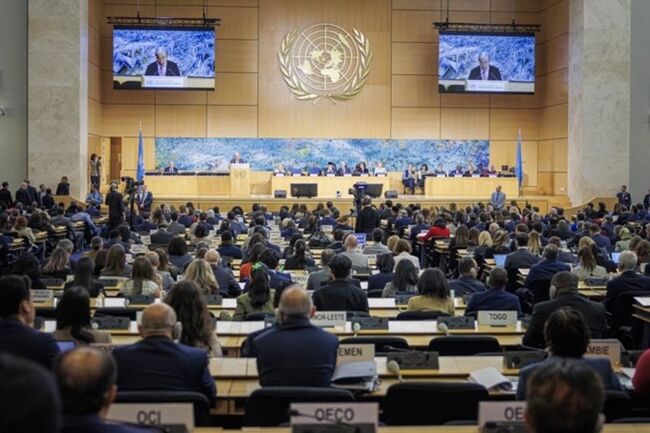 On March 30th (local time), the UN Human Rights Council unanimously adopted a resolution on the human rights situation in North Korea in Geneva, Switzerland. (EPA=UPI)
Democracy is inherently noisy. It is filled with debate, disagreement, and uncomfortable ideas. But that noise is not a flaw, but the essence of a free society.
When only one interpretation is permitted, democracy collapses into the very totalitarianism we claim to reject. In a free society, when people begin to choose silence and think, "It is safer not to say anything," censorship has already begun.
North Korea's cultural control is extreme, but cases like Kim Kyu-na serve as an early warning sign of how fear can spread even in democratic societies.
The reason books burn in war is simple. Books do not just record the past; they enable a different future. Culture survives only when it is diverse. When only one interpretation remains, culture has already begun to die.
Writers ask questions. The state maintains order. The tension between these two is natural. But when that tension disappears, what remains is not order, but silence.
The Temperature at Which Freedom Disappears
People often think of George Orwell, but there is also Ray Bradbury's novel 'Fahrenheit 451,' published in 1953. Fahrenheit 451, or 232.8 degrees Celsius, is the temperature at which books burn.
In Bradbury's dystopia, firemen burn books instead of extinguishing fires. Yet, people rediscover themselves through books and resist the controlled society.
Books burn at Fahrenheit 451, but culture disappears at a much lower temperature. It begins when we stop asking questions, fear different opinions, and choose silence.
Silence does not come suddenly. It grows quietly in the sentences we don't speak, the words we don't write, and the questions we don't dare to ask.
Culture survives only through diversity. Freedom exists not when we can speak, but when we believe we have the right to speak.
What South Korea must protect is not "correct speech," but freedom of speech itself.
The temperature at which books burn is fixed. But the temperature at which freedom disappears is something we can decide.
Ji-hyun Park is a Senior Fellow for Human Rights and Security at the Center for Asia Pacific Strategy, a conservative British politician of Korean descent, and a regular columnist for the Korea Regional Review. He is a North Korean defector; his first escape attempt in 1998 failed due to forced repatriation, but his second escape attempt in 2008 was successful.

 Iranian Foreign Ministry: "Continuing Message Exchanges with the U.S. and Activities of Mediating Countries"
Esmaeil Baghaei, Spokesperson for the Iranian Ministry of Foreign Affairs [Xinhua, Yonhap News file photo]Esmaeil Baghaei, spokesperson for the Iranian Ministry of Foreign Affairs, stated on the 26th
Iranian Foreign Ministry: "Continuing Message Exchanges with the U.S. and Activities of Mediating Countries"
Esmaeil Baghaei, Spokesperson for the Iranian Ministry of Foreign Affairs [Xinhua, Yonhap News file photo]Esmaeil Baghaei, spokesperson for the Iranian Ministry of Foreign Affairs, stated on the 26th
 President Yoon: "Do You Think You Are Safe from the Special Counsel?"... Final Statement Video Released
President Yoon Suk Yeol rebuking the special prosecutor on the 24th. [Court video / @birds_justice X account subtitle GIF] A video of President Yoon Suk Yeol's closing statement at his trial rega
President Yoon: "Do You Think You Are Safe from the Special Counsel?"... Final Statement Video Released
President Yoon Suk Yeol rebuking the special prosecutor on the 24th. [Court video / @birds_justice X account subtitle GIF] A video of President Yoon Suk Yeol's closing statement at his trial rega
 President Yoon, regarding the first-instance ruling on the Public Official Election Act: “An excessive political verdict that distorts the facts… We will appeal immediately.”
The first-instance sentencing hearing for President Yoon Suk Yeol regarding violations of the Public Official Election Act is being broadcast live at Seoul Station on the 27th. [Photo=Yonhap News]Pres
President Yoon, regarding the first-instance ruling on the Public Official Election Act: “An excessive political verdict that distorts the facts… We will appeal immediately.”
The first-instance sentencing hearing for President Yoon Suk Yeol regarding violations of the Public Official Election Act is being broadcast live at Seoul Station on the 27th. [Photo=Yonhap News]Pres
 WSJ: "SK Hynix ADR Premium Is a Sign of AI Trading Overheat"
Advertisement for SK Hynix ADR listing in New York's Times Square [Reuters=Yonhap News file photo]The Wall Street Journal (WSJ) has pointed out that the price of SK Hynix’s American Depositary Recei
WSJ: "SK Hynix ADR Premium Is a Sign of AI Trading Overheat"
Advertisement for SK Hynix ADR listing in New York's Times Square [Reuters=Yonhap News file photo]The Wall Street Journal (WSJ) has pointed out that the price of SK Hynix’s American Depositary Recei
 'Godfather of Japanese Mystery Novels' Keigo Higashino Passes Away After Battle with Cancer at 68
Famous Japanese mystery novelist Keigo Higashino [AFP=Yonhap News]It has been belatedly reported that Keigo Higashino, the "godfather of Japanese mystery novels" and author of bestsellers such as "The
'Godfather of Japanese Mystery Novels' Keigo Higashino Passes Away After Battle with Cancer at 68
Famous Japanese mystery novelist Keigo Higashino [AFP=Yonhap News]It has been belatedly reported that Keigo Higashino, the "godfather of Japanese mystery novels" and author of bestsellers such as "The
 [Park Pil-kyu Security Column] To the Ignorant Trying to Clothe a Beast in Sheep's Clothing
Rep. Kim Byung-joo of the Democratic Party of Korea [Photo=Yonhap News]“The Air Force Academy doesn't teach you how to fly a plane!” “The Army, Navy, and Air Force academies are exactly the
[Park Pil-kyu Security Column] To the Ignorant Trying to Clothe a Beast in Sheep's Clothing
Rep. Kim Byung-joo of the Democratic Party of Korea [Photo=Yonhap News]“The Air Force Academy doesn't teach you how to fly a plane!” “The Army, Navy, and Air Force academies are exactly the
 [Issue Diagnosis] Two Effects of the Election Petition Review
 [Photo] Evidence of Election Fraud Flooding U.S. Media… Trump Had 2.7 Million Votes Stolen
 [Video] U.S. Semiquincentennial Air Show... 'Art in the Sky' streaks across New York
 [Editorial Cartoon] A Draconian Law That Undermines Freedom of Expression

 List
List










