 US Vice President JD Vance arrives in Islamabad, Pakistan, for ceasefire negotiations with Iran. [Reuters=Yonhap News]
A US delegation arrived in Islamabad, the capital of Pakistan, on the 11th (local time) to negotiate a ceasefire with Iran.
The Pakistani Ministry of Foreign Affairs released footage of US Vice President JD Vance, who is leading the US delegation, arriving at Nur Khan Air Force Base near Islamabad by special plane on the morning of the 11th.
US Middle East Envoy Steve Wicoff and Jared Kushner, the eldest son-in-law of former President Donald Trump, who were already present, greeted Vice President Vance.
Key Pakistani officials, including Deputy Prime Minister and Foreign Minister Ishaq Dar, Army Chief of Staff Asim Munir, and Interior Minister Mohsin Raza Naqvi, welcomed the US delegation. The Pakistani Ministry of Foreign Affairs stated its position: "We will support both sides to engage constructively and find a lasting and robust solution to the conflict."
The New York Times (NYT) and China's official Xinhua News Agency reported that the talks are scheduled to be held at the Serena Hotel, a five-star hotel in Islamabad. Barricades were set up on roads leading to the 'red zone,' where major government agencies are located, and a large number of military and police personnel were deployed throughout Islamabad.
Earlier, the Iranian negotiation team, composed of Parliament Speaker Mohammad Bagher Ghalibaf and Foreign Minister Abbas Araghchi, arrived in Islamabad the previous night by an Iran Air passenger jet.
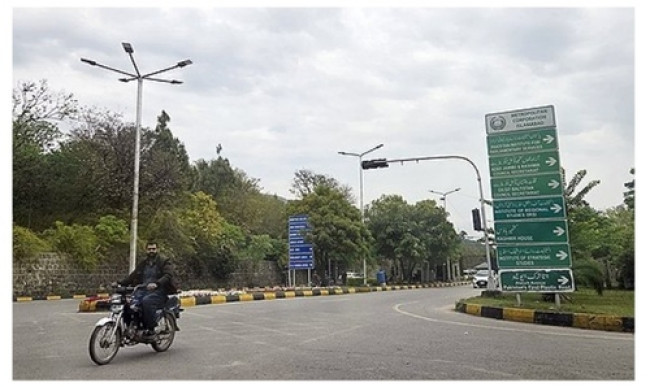 A quiet road in Islamabad, Pakistan, under tight security. [Islamabad=Yonhap News]
The US daily New York Times (NYT) analyzed that the large Iranian delegation, numbering at least 70 people including Ali Akbar Ahmadian, Secretary of the Supreme National Security Council (SNSC), and Abdul Nasser Hemmati, Governor of the Central Bank, is evidence that Iran is taking the negotiations seriously. Iran's Tasnim News Agency reported that the Iranian delegation consists of 71 members.
Vali Nasr, a professor of Middle Eastern Studies at Johns Hopkins University who served as the US special envoy to Afghanistan during the Obama administration, also interpreted that a delegation of this size is not for initial reconnaissance but is dispatched only when negotiations are in the final stages.
Senior Iranian officials told the NYT that Supreme Leader Ayatollah Seyyed Mojtaba Khamenei has authorized Parliament Speaker Ghalibaf to conclude or break off negotiations.
Mohammad Reza Arif, Iran's senior vice president, wrote on social media platform X (formerly Twitter) the previous day that Ghalibaf currently "represents the nation and the system." Nezham, in Persian, refers to the entire Islamic Republic, including the elected government and the Supreme Leader.
Although both delegations have arrived at the site, negotiations have not yet begun. Tasnim News Agency, citing Saudi media Al-Hadath, reported that the meeting is expected to start after 5 p.m. local time.
Reuters, citing Iranian state television, reported that the Iranian delegation would meet with Pakistani Prime Minister Shehbaz Sharif around noon to determine the timing and format of the negotiations.
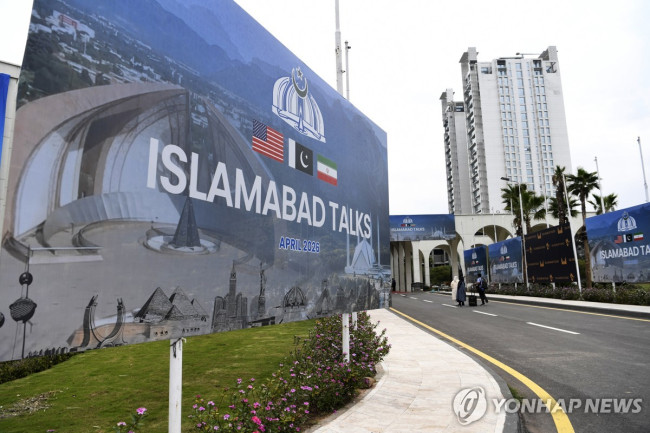 Panorama of Islamabad, the capital of Pakistan, where US-Iran ceasefire negotiations are taking place. [EPA=Yonhap News]
CNN reported, citing sources familiar with the negotiations, that "negotiations are expected to take several days," while Axios predicted that "it could take weeks or months to reach an agreement, and a two-week extension of the ceasefire is likely."
However, Tasnim News Agency downplayed this, stating, "News that the Islamabad talks will last for several days is not confirmed. According to the current plan, if the talks are held, they are scheduled to begin this evening, and for now, there is a high possibility they will proceed for one day."
The war broke out on February 28th when the United States and Israel launched a surprise attack on Iran, to which Iran responded with missile strikes targeting mainland Israel and US military bases in the Middle East. The US and Iran reached a surprise agreement for a two-week ceasefire on the 7th, 38 days after the clash.
The US had presented Iran with a 15-point peace proposal before the ceasefire agreement, and Iran responded with a counter-proposal of 10 demands.
Based on this, the US is expected to bring up agenda items such as a proposal for an end to the war, the resumption of navigation in the Strait of Hormuz, and Iran's nuclear program. Iran is expected to demand the lifting of sanctions and the release of frozen assets, as well as compensation for war damages.
The negotiations are expected to face considerable difficulties even before they begin.
Before boarding his flight to Pakistan, Vice President Vance issued a warning message to Iran, saying, "Don't play games." About two hours later, Parliament Speaker Ghalibaf retorted that a ceasefire in Lebanon and the release of frozen Iranian assets must precede any agreement, escalating the war of nerves.
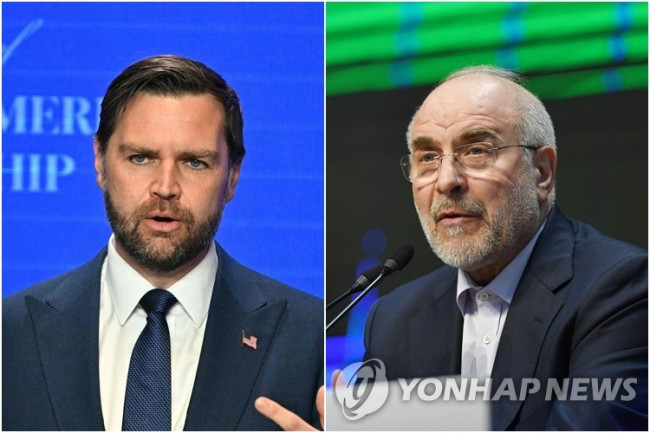 US Vice President Vance (left) and Iranian Parliament Speaker Mohammad Bagher Ghalibaf. [Reuters/Xinhua=Yonhap News]
It is still unclear whether there will be a face-to-face meeting.
AFP reported that regarding the current talks, it is anticipated that the US and Iranian delegations will sit in separate rooms, with Pakistani officials shuttling between them to exchange proposals. This is similar to the method Oman previously used to mediate nuclear negotiations between the US and Iran.
CNN predicted that both sides would utilize both indirect and direct communication methods, reporting that after agreeing on the negotiation agenda through the mediator Pakistan, the two sides would move to direct discussions later in the day.
If the two delegations sit face-to-face, it will be the highest-level meeting since diplomatic relations between the two countries were severed in 1979, and the first official face-to-face negotiation between the two countries since the conclusion of the Iran nuclear deal in 2015.
Even after the temporary ceasefire was agreed upon, Israel's continued airstrikes on Lebanon targeting the pro-Iranian armed group Hezbollah are expected to act as a variable in the negotiations. Israel and Lebanon are scheduled to hold talks in the US on the 14th to discuss the disarmament of Hezbollah.

 Iranian Foreign Ministry: "Continuing Message Exchanges with the U.S. and Activities of Mediating Countries"
Esmaeil Baghaei, Spokesperson for the Iranian Ministry of Foreign Affairs [Xinhua, Yonhap News file photo]Esmaeil Baghaei, spokesperson for the Iranian Ministry of Foreign Affairs, stated on the 26th
Iranian Foreign Ministry: "Continuing Message Exchanges with the U.S. and Activities of Mediating Countries"
Esmaeil Baghaei, Spokesperson for the Iranian Ministry of Foreign Affairs [Xinhua, Yonhap News file photo]Esmaeil Baghaei, spokesperson for the Iranian Ministry of Foreign Affairs, stated on the 26th
 President Yoon: "Do You Think You Are Safe from the Special Counsel?"... Final Statement Video Released
President Yoon Suk Yeol rebuking the special prosecutor on the 24th. [Court video / @birds_justice X account subtitle GIF] A video of President Yoon Suk Yeol's closing statement at his trial rega
President Yoon: "Do You Think You Are Safe from the Special Counsel?"... Final Statement Video Released
President Yoon Suk Yeol rebuking the special prosecutor on the 24th. [Court video / @birds_justice X account subtitle GIF] A video of President Yoon Suk Yeol's closing statement at his trial rega
 President Yoon, regarding the first-instance ruling on the Public Official Election Act: “An excessive political verdict that distorts the facts… We will appeal immediately.”
The first-instance sentencing hearing for President Yoon Suk Yeol regarding violations of the Public Official Election Act is being broadcast live at Seoul Station on the 27th. [Photo=Yonhap News]Pres
President Yoon, regarding the first-instance ruling on the Public Official Election Act: “An excessive political verdict that distorts the facts… We will appeal immediately.”
The first-instance sentencing hearing for President Yoon Suk Yeol regarding violations of the Public Official Election Act is being broadcast live at Seoul Station on the 27th. [Photo=Yonhap News]Pres
 WSJ: "SK Hynix ADR Premium Is a Sign of AI Trading Overheat"
Advertisement for SK Hynix ADR listing in New York's Times Square [Reuters=Yonhap News file photo]The Wall Street Journal (WSJ) has pointed out that the price of SK Hynix’s American Depositary Recei
WSJ: "SK Hynix ADR Premium Is a Sign of AI Trading Overheat"
Advertisement for SK Hynix ADR listing in New York's Times Square [Reuters=Yonhap News file photo]The Wall Street Journal (WSJ) has pointed out that the price of SK Hynix’s American Depositary Recei
 'Godfather of Japanese Mystery Novels' Keigo Higashino Passes Away After Battle with Cancer at 68
Famous Japanese mystery novelist Keigo Higashino [AFP=Yonhap News]It has been belatedly reported that Keigo Higashino, the "godfather of Japanese mystery novels" and author of bestsellers such as "The
'Godfather of Japanese Mystery Novels' Keigo Higashino Passes Away After Battle with Cancer at 68
Famous Japanese mystery novelist Keigo Higashino [AFP=Yonhap News]It has been belatedly reported that Keigo Higashino, the "godfather of Japanese mystery novels" and author of bestsellers such as "The
 [Park Pil-kyu Security Column] To the Ignorant Trying to Clothe a Beast in Sheep's Clothing
Rep. Kim Byung-joo of the Democratic Party of Korea [Photo=Yonhap News]“The Air Force Academy doesn't teach you how to fly a plane!” “The Army, Navy, and Air Force academies are exactly the
[Park Pil-kyu Security Column] To the Ignorant Trying to Clothe a Beast in Sheep's Clothing
Rep. Kim Byung-joo of the Democratic Party of Korea [Photo=Yonhap News]“The Air Force Academy doesn't teach you how to fly a plane!” “The Army, Navy, and Air Force academies are exactly the
 [Issue Diagnosis] Two Effects of the Election Petition Review
 [Photo] Evidence of Election Fraud Flooding U.S. Media… Trump Had 2.7 Million Votes Stolen
 [Video] U.S. Semiquincentennial Air Show... 'Art in the Sky' streaks across New York
 [Editorial Cartoon] A Draconian Law That Undermines Freedom of Expression

 List
List









