 A damaged U.S. aircraft at a U.S. air base in Saudi Arabia, following an attack by Iranian forces [Reuters Yonhap News]
Iran utilized Chinese satellites to bomb U.S. military bases in the Middle East, the Financial Times (FT) reported on the 14th (local time).
According to the report, Iran's Islamic Revolutionary Guard Corps (IRGC) Aerospace Force secretly acquired the high-resolution surveillance satellite TEE-01B from a Chinese company in late 2024, and recently used it to precisely strike U.S. military bases during the war and confirm the extent of the damage.
The FT explained that these circumstances were revealed through its own compilation of the satellite's hourly coordinate setting lists, captured images, and orbital analysis results.
It appears that the satellite photographed Prince Sultan Air Base in Saudi Arabia on the 13th, 14th, and 15th of last month.
Five U.S. Air Force refueling aircraft were damaged at Prince Sultan Base on the 14th of last month due to an Iranian airstrike.
The satellite also monitored U.S. military assets in Jordan, Bahrain, Iraq, Kuwait, and Djibouti, as well as civilian infrastructure in the United Arab Emirates (UAE).
TEE-01B was manufactured and launched by Beijing Mumeixingkong (Earth Eye Co.), a Chinese company.
This satellite is an export model that is little-known externally, launched from China and transferred to an overseas customer after reaching orbit.
It is understood that the IRGC gained access to civilian ground control stations in Asia and South America through the Chinese satellite control service company, Hangtian Yuxing (Emposat), as part of the contract when acquiring the satellite.
Nicole Grzybowski, an Iran expert at Sciences Po University in France, stated, "Given that it was operated by the IRGC Aerospace Force, it is clear that this is a satellite for military purposes, not civilian."
She explained, "Iran desperately needed foreign capacity support in this war, such as the IRGC pre-confirming targets and checking the success of strikes."
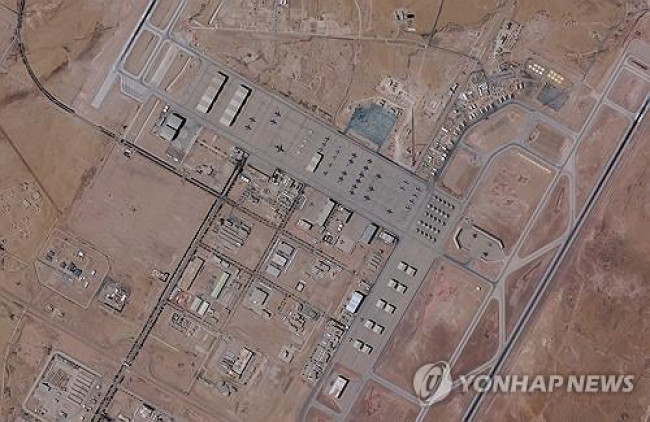 A view of Prince Sultan Air Base in Saudi Arabia, taken by satellite on February 21, before the outbreak of war. [Planet Labs/Reuters Yonhap News]
TEE-01B has a resolution of 0.5 meters, enabling it to represent objects on the ground measuring 50 cm by 50 cm as a single point in photographs.
This level of detail allows for accurate identification of changes in aircraft, vehicles, and facilities, and is more than 10 times superior to Iran's existing satellite, Nour-3 (5-meter resolution).
Military experts point out that the IRGC has enhanced its survivability and the destructive power of its attacks by having free access to surveillance satellites from Chinese companies.
Jim Ransom, a former analyst for the U.S. Central Intelligence Agency (CIA), described this as a "dispersal strategy for aerial assets," explaining, "Control centers within Iran are easily hit by missiles even from thousands of kilometers away, but China's ground control stations in other countries are not."
Ransom added, "Iran has personnel collecting information around U.S. military bases in the Middle East. Information obtained by humans becomes a powerful tool when combined with satellite intelligence."
Amidst escalating threats from the United States, Iran has been strengthening its military cooperation not only with China but also with Russia for a long time.
Russia has received Iranian suicide drone technology in the Ukraine war and has launched several Iranian satellites into orbit on its behalf in recent years.
While China emphasizes space development in the civilian sector, the fact that this technology can be utilized for both civilian and military purposes is becoming increasingly prominent.
Beijing Mumeixingkong stated on its website that it had transferred a satellite to a specific country as part of the Belt and Road Initiative (BRI).
Iran joined the BRI in 2021, a political and economic vision promoted by Chinese President Xi Jinping to expand China's global influence.
The Chinese government has dismissed the FT's allegations, stating it has no knowledge of any relationship between Hangtian Yuxing and the IRGC.
The Chinese Embassy in the United States stated, "We firmly oppose the parties concerned spreading groundless speculations and insinuations, and disinformation targeting China."

 Iranian Foreign Ministry: "Continuing Message Exchanges with the U.S. and Activities of Mediating Countries"
Esmaeil Baghaei, Spokesperson for the Iranian Ministry of Foreign Affairs [Xinhua, Yonhap News file photo]Esmaeil Baghaei, spokesperson for the Iranian Ministry of Foreign Affairs, stated on the 26th
Iranian Foreign Ministry: "Continuing Message Exchanges with the U.S. and Activities of Mediating Countries"
Esmaeil Baghaei, Spokesperson for the Iranian Ministry of Foreign Affairs [Xinhua, Yonhap News file photo]Esmaeil Baghaei, spokesperson for the Iranian Ministry of Foreign Affairs, stated on the 26th
 President Yoon: "Do You Think You Are Safe from the Special Counsel?"... Final Statement Video Released
President Yoon Suk Yeol rebuking the special prosecutor on the 24th. [Court video / @birds_justice X account subtitle GIF] A video of President Yoon Suk Yeol's closing statement at his trial rega
President Yoon: "Do You Think You Are Safe from the Special Counsel?"... Final Statement Video Released
President Yoon Suk Yeol rebuking the special prosecutor on the 24th. [Court video / @birds_justice X account subtitle GIF] A video of President Yoon Suk Yeol's closing statement at his trial rega
 President Yoon, regarding the first-instance ruling on the Public Official Election Act: “An excessive political verdict that distorts the facts… We will appeal immediately.”
The first-instance sentencing hearing for President Yoon Suk Yeol regarding violations of the Public Official Election Act is being broadcast live at Seoul Station on the 27th. [Photo=Yonhap News]Pres
President Yoon, regarding the first-instance ruling on the Public Official Election Act: “An excessive political verdict that distorts the facts… We will appeal immediately.”
The first-instance sentencing hearing for President Yoon Suk Yeol regarding violations of the Public Official Election Act is being broadcast live at Seoul Station on the 27th. [Photo=Yonhap News]Pres
 WSJ: "SK Hynix ADR Premium Is a Sign of AI Trading Overheat"
Advertisement for SK Hynix ADR listing in New York's Times Square [Reuters=Yonhap News file photo]The Wall Street Journal (WSJ) has pointed out that the price of SK Hynix’s American Depositary Recei
WSJ: "SK Hynix ADR Premium Is a Sign of AI Trading Overheat"
Advertisement for SK Hynix ADR listing in New York's Times Square [Reuters=Yonhap News file photo]The Wall Street Journal (WSJ) has pointed out that the price of SK Hynix’s American Depositary Recei
 'Godfather of Japanese Mystery Novels' Keigo Higashino Passes Away After Battle with Cancer at 68
Famous Japanese mystery novelist Keigo Higashino [AFP=Yonhap News]It has been belatedly reported that Keigo Higashino, the "godfather of Japanese mystery novels" and author of bestsellers such as "The
'Godfather of Japanese Mystery Novels' Keigo Higashino Passes Away After Battle with Cancer at 68
Famous Japanese mystery novelist Keigo Higashino [AFP=Yonhap News]It has been belatedly reported that Keigo Higashino, the "godfather of Japanese mystery novels" and author of bestsellers such as "The
 [Park Pil-kyu Security Column] To the Ignorant Trying to Clothe a Beast in Sheep's Clothing
Rep. Kim Byung-joo of the Democratic Party of Korea [Photo=Yonhap News]“The Air Force Academy doesn't teach you how to fly a plane!” “The Army, Navy, and Air Force academies are exactly the
[Park Pil-kyu Security Column] To the Ignorant Trying to Clothe a Beast in Sheep's Clothing
Rep. Kim Byung-joo of the Democratic Party of Korea [Photo=Yonhap News]“The Air Force Academy doesn't teach you how to fly a plane!” “The Army, Navy, and Air Force academies are exactly the
 [Issue Diagnosis] Two Effects of the Election Petition Review
 [Photo] Evidence of Election Fraud Flooding U.S. Media… Trump Had 2.7 Million Votes Stolen
 [Video] U.S. Semiquincentennial Air Show... 'Art in the Sky' streaks across New York
 [Editorial Cartoon] A Draconian Law That Undermines Freedom of Expression

 List
List









