 US Vice President Vance (left) and Iranian Parliament Speaker Mohammad Bagher Ghalibaf [Reuters/Xinhua=Yonhap News]
Several days after the first ceasefire negotiations fell through, the United States and Iran are continuing back-channel discussions, leaving open the possibility of a second face-to-face meeting.
With the first round of talks concluding without any progress, the latter half of this week, ahead of the ceasefire expiration deadline, is expected to be a critical juncture to avoid the worst-case scenario and revive the embers of a diplomatic solution.
In an interview with Fox Business on the 14th (local time), US President Donald Trump stated, "The war between the United States and Iran is, in my opinion, almost over. I believe it is very close to ending."
On the same day, President Trump alluded to the possibility of renewed ceasefire negotiations with Iran soon in Islamabad, Pakistan.
In a phone interview with the US daily New York Post, President Trump said, "You really have to stay there (in Islamabad) because something could happen in the next two days, and the possibility of us going there has increased."
President Trump told US ABC News reporters, "We have a couple of amazing days ahead," and expressed that he does not believe an extension of the ceasefire will be necessary.
He added that he hopes Iran can begin its full national reconstruction through ceasefire negotiations rather than extending the ceasefire.
This adds weight to speculation that US-Iran ceasefire negotiations could resume as early as the 16th.
Previously, foreign media outlets had uniformly reported that the US and Iran were expected to enter into a second round of ceasefire negotiations in Islamabad later this week.
AP reported that the US diplomatic community is continuing back-channel efforts through "back channels" to ensure the success of a second round of ceasefire talks.
If negotiations are successful, it appears that Vice President JD Vance will once again represent the US side.
CNN, citing sources familiar with the negotiation status, reported that Vice President Vance, US Special Envoy for the Middle East Steve Witkoff, and President Trump's son-in-law Jared Kushner are expected to participate in the second round of talks.
CNN added that President Trump had instructed these three individuals to prepare a diplomatic exit strategy for peace, and they have maintained contact with Iran and mediators even after the breakdown of the first round of talks.
If negotiations resume, the biggest sticking point is expected to be Iran's cessation of uranium enrichment.
Both the US and Iran discussed the cessation of uranium enrichment in previous negotiations, but they failed to reach an agreement, with the US proposing a 20-year halt and Iran proposing a 5-year halt.
Vice President Vance remarked at an event on the same day, "When the President wants to make a deal, he doesn't want a small deal. He wants to make a grand bargain."
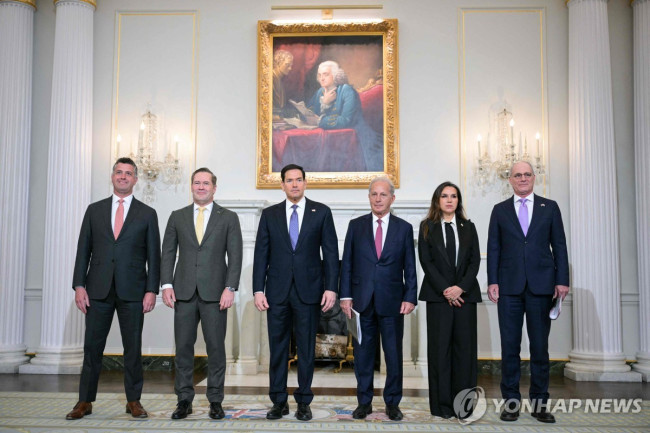 Participants in Israel-Lebanon negotiations, including Minister Rubio (third from left) [AFP=Yonhap News]
Israel, which had previously been uncooperative with negotiations, stating that "the war is not over," is now in a mood to effectively agree to the resumption of talks.
This is because Israel and Lebanon have agreed to hold high-level talks for the first time in 33 years since 1993 and discuss direct ceasefire negotiations.
If the negotiations between Israel and Lebanon are successful, it is expected that a significant portion of the burden of armed conflict will be reduced as one facet of the war concludes.
However, given that the conflict is between Hezbollah, not the regular Lebanese army, and Israel, there are also concerns about the effectiveness of the negotiations between the two sides.
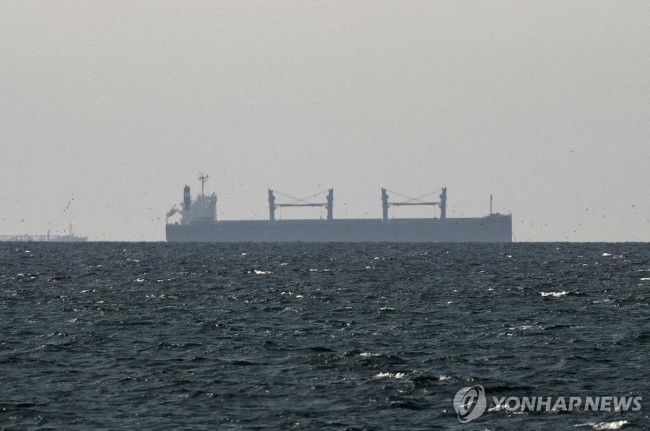 Cargo ship sailing near the Strait of Hormuz [Reuters=Yonhap News]
The United States is also continuing maritime blockade measures against Iran to pressure it.
In response to Iran, which has effectively blockaded the Strait of Hormuz, the US has implemented what is known as a "reverse blockade" against vessels departing from or arriving in Iranian ports.
However, there are signs of some ship traffic resuming. The US daily Wall Street Journal reported on the same day, citing two US officials, that more than 20 merchant ships had passed through the Strait of Hormuz in the past 24 hours.
There have also been reports that Iran is considering temporarily suspending transit through the Strait of Hormuz to maintain momentum for dialogue with the US.
Bloomberg News, citing sources, reported that such a measure is being considered within Iran, and if transit is actually suspended, it would demonstrate Iran's strong commitment to dialogue.

 Iranian Foreign Ministry: "Continuing Message Exchanges with the U.S. and Activities of Mediating Countries"
Esmaeil Baghaei, Spokesperson for the Iranian Ministry of Foreign Affairs [Xinhua, Yonhap News file photo]Esmaeil Baghaei, spokesperson for the Iranian Ministry of Foreign Affairs, stated on the 26th
Iranian Foreign Ministry: "Continuing Message Exchanges with the U.S. and Activities of Mediating Countries"
Esmaeil Baghaei, Spokesperson for the Iranian Ministry of Foreign Affairs [Xinhua, Yonhap News file photo]Esmaeil Baghaei, spokesperson for the Iranian Ministry of Foreign Affairs, stated on the 26th
 President Yoon: "Do You Think You Are Safe from the Special Counsel?"... Final Statement Video Released
President Yoon Suk Yeol rebuking the special prosecutor on the 24th. [Court video / @birds_justice X account subtitle GIF] A video of President Yoon Suk Yeol's closing statement at his trial rega
President Yoon: "Do You Think You Are Safe from the Special Counsel?"... Final Statement Video Released
President Yoon Suk Yeol rebuking the special prosecutor on the 24th. [Court video / @birds_justice X account subtitle GIF] A video of President Yoon Suk Yeol's closing statement at his trial rega
 President Yoon, regarding the first-instance ruling on the Public Official Election Act: “An excessive political verdict that distorts the facts… We will appeal immediately.”
The first-instance sentencing hearing for President Yoon Suk Yeol regarding violations of the Public Official Election Act is being broadcast live at Seoul Station on the 27th. [Photo=Yonhap News]Pres
President Yoon, regarding the first-instance ruling on the Public Official Election Act: “An excessive political verdict that distorts the facts… We will appeal immediately.”
The first-instance sentencing hearing for President Yoon Suk Yeol regarding violations of the Public Official Election Act is being broadcast live at Seoul Station on the 27th. [Photo=Yonhap News]Pres
 WSJ: "SK Hynix ADR Premium Is a Sign of AI Trading Overheat"
Advertisement for SK Hynix ADR listing in New York's Times Square [Reuters=Yonhap News file photo]The Wall Street Journal (WSJ) has pointed out that the price of SK Hynix’s American Depositary Recei
WSJ: "SK Hynix ADR Premium Is a Sign of AI Trading Overheat"
Advertisement for SK Hynix ADR listing in New York's Times Square [Reuters=Yonhap News file photo]The Wall Street Journal (WSJ) has pointed out that the price of SK Hynix’s American Depositary Recei
 'Godfather of Japanese Mystery Novels' Keigo Higashino Passes Away After Battle with Cancer at 68
Famous Japanese mystery novelist Keigo Higashino [AFP=Yonhap News]It has been belatedly reported that Keigo Higashino, the "godfather of Japanese mystery novels" and author of bestsellers such as "The
'Godfather of Japanese Mystery Novels' Keigo Higashino Passes Away After Battle with Cancer at 68
Famous Japanese mystery novelist Keigo Higashino [AFP=Yonhap News]It has been belatedly reported that Keigo Higashino, the "godfather of Japanese mystery novels" and author of bestsellers such as "The
 [Park Pil-kyu Security Column] To the Ignorant Trying to Clothe a Beast in Sheep's Clothing
Rep. Kim Byung-joo of the Democratic Party of Korea [Photo=Yonhap News]“The Air Force Academy doesn't teach you how to fly a plane!” “The Army, Navy, and Air Force academies are exactly the
[Park Pil-kyu Security Column] To the Ignorant Trying to Clothe a Beast in Sheep's Clothing
Rep. Kim Byung-joo of the Democratic Party of Korea [Photo=Yonhap News]“The Air Force Academy doesn't teach you how to fly a plane!” “The Army, Navy, and Air Force academies are exactly the
 [Issue Diagnosis] Two Effects of the Election Petition Review
 [Photo] Evidence of Election Fraud Flooding U.S. Media… Trump Had 2.7 Million Votes Stolen
 [Video] U.S. Semiquincentennial Air Show... 'Art in the Sky' streaks across New York
 [Editorial Cartoon] A Draconian Law That Undermines Freedom of Expression

 List
List









