 Chinese President Xi Jinping (left) and Japanese Prime Minister Sanae Takaichi [AP·AFP=Yonhap News]
Tensions are escalating between China and Japan as political and diplomatic conflicts spill over into military and resource disputes.
Following China's dispatch of warships to the western Pacific for combat readiness drills immediately after Japanese Maritime Self-Defense Force vessels passed through the Taiwan Strait, Japan has lodged protests against China over resource development in the East China Sea, indicating a broadening of confrontation between the two nations.
Recent military tensions were triggered when Japanese Maritime Self-Defense Force vessels traversed the Taiwan Strait for military exercises.
The Japanese vessels passed through the Taiwan Strait on the 17th to participate in "Balikatan," the annual joint military exercise between the United States and the Philippines, which is being held for approximately three weeks from the 20th in areas bordering the Philippines, including the South China Sea territorial dispute region and the Taiwan Strait.
This marks the fourth passage of Self-Defense Force vessels through the Taiwan Strait, following passages in September 2024, and February and June 2025. It is also the first such passage since Prime Minister Sanae Takaichi took office.
◇ Japan Dispatches 1,400 Troops for Full Participation in Balikatan... China Warns to "Be Cautious with Words and Actions"
According to Kyodo News, Japan is sending 1,400 troops and deploying three warships and two aircraft for this Balikatan exercise.
Unlike in the past, when only a small number of officers or experts were dispatched to observe training or participate in rescue drills, this is reportedly the first time Japan is fully participating in Balikatan.
On the 19th, the Chinese military retaliated by dispatching a flotilla led by its newest destroyer, the Type 055 destroyer (hull number 133), through the Yokoate Strait, a major passage into the western Pacific, for combat drills.
During a regular press briefing on the 20th, China's Ministry of Foreign Affairs criticized Japan, referencing its past colonial rule in Southeast Asia, stating, "Japan should seriously reflect on its history of aggression and be cautious with its words and actions in the military and security domains." It added, "It should not display military might and disrupt regional stability."
Prior to this, China's Ministry of Foreign Affairs and Ministry of National Defense had protested, calling the timing of the Japanese warships' passage, which coincided with the anniversary of the 1895 Treaty of Shimonoseki where Qing Dynasty China ceded Taiwan to Japan, a "deliberate provocation."
The Japanese government has not officially announced the passage of its warships through the strait.
However, Kyodo News reported that a government official expressed the sentiment that "navigation in international waters is not an issue."
The right-leaning Sankei Shimbun reported that Chinese warships had passed through the waters north of Amami Island in Kagoshima Prefecture in formation and conducted drills in the western Pacific, interpreting this as a protest against the passage of Maritime Self-Defense Force destroyers through the Taiwan Strait.
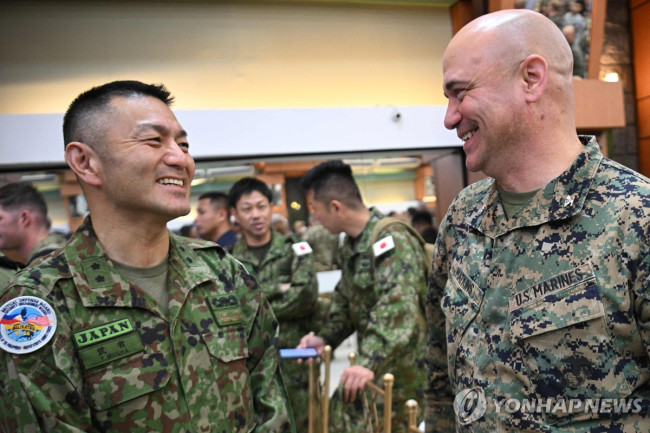 Japan's participation in Balikatan [AFP Yonhap News]
◇ China Installs Structures in East China Sea... Japan Protests "Unilateral Resource Development"
Military tensions between the two countries have extended to resource development issues in the East China Sea, emerging as a new source of conflict.
In a press release on the 20th, Japan's Ministry of Foreign Affairs stated that China had begun installing new structures in waters west of the median line between Japan and China, and expressed regret, saying, "It is regrettable that unilateral development is being pursued when the boundaries of exclusive economic zones (EEZs) and the continental shelf in the East China Sea have not yet been determined."
The Ministry of Foreign Affairs stated that it had protested to the Chinese side through diplomatic channels and urged the resumption of negotiations for the implementation of the joint development agreement reached by the two countries in 2008.
This statement, issued immediately after China conducted its drills in the western Pacific, is interpreted as an intention to confront China's ongoing offensive against Japan and to counter on maritime security issues.
China has maintained its stance that the development of the East China Sea falls under its sovereignty and rights, indicating a significant gap in their positions.
With the long-standing territorial dispute over the Senkaku Islands (Diaoyu Islands in China) compounded by resource development issues, tensions between the two countries are developing in a more complex manner.
Some view this situation as a "dual conflict structure" combining military and resource issues, while others analyze that the possibility of conflict between China and Japan is increasing.
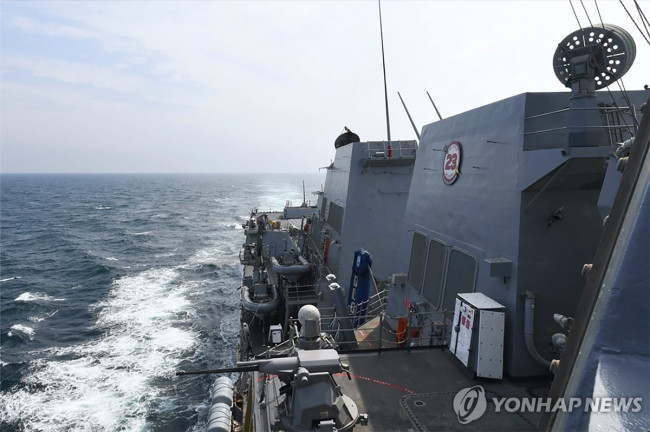 Taiwan Strait [AP Yonhap News]
◇ Japan-China Relations Rapidly Deteriorate After 'Hardline Conservative' Prime Minister's Remarks on Taiwan
Sino-Japanese relations, which had been somewhat cold, have been on a downward spiral since Prime Minister Sanae Takaichi, known for her hardline conservative stance, hinted at intervention in Taiwan in the event of an emergency in November last year.
Japan stated that the remarks were a general discussion in response to changes in the security environment, but China strongly protested, defining them as remarks that undermined the "One China" principle.
In the process, China imposed economic retaliation, including recommending its citizens refrain from traveling to or studying in Japan, suspending seafood imports, and strengthening export controls on dual-use goods (materials that can be used for both military and civilian purposes).
Prime Minister Takaichi, who has strengthened her government's foundation by prioritizing a hardline security policy based on conservative and right-wing supporters, has accelerated efforts to enhance defense capabilities and expand alliance cooperation, while China has intensified military drills and maritime activities, sharpening its stance.
In particular, since the revelation last month that a Self-Defense Force member infiltrated the Japanese embassy in China with a knife and that there were numerous terrorist threats against Chinese nationals and Chinese diplomatic missions, China has been increasingly critical of Japan and raising the level of pressure.
Given that the conflict between China and Japan is intertwined with the US-China strategic competition, there are also predictions that it is likely to be prolonged.
This is because while Japan is expanding its role in the western Pacific based on its military cooperation with the United States, China perceives this as a move to check its own influence.
John Bradford, Executive Director of the Yokosuka Council on Asia-Pacific Studies, told the South China Morning Post (SCMP) that "Japan's participation in Balikatan demonstrates Japan's priorities," and suggested that it aims to deter a Chinese attack on Taiwan by supporting the United States.
Meanwhile, amidst increasing military and coast guard activities by both countries in the East China Sea and Taiwan Strait, there are also calls for the need for crisis management to prevent accidental collisions.
The argument is that communication channels between the two countries must be maintained even during times of tension, as military signals can be excessively interpreted by both sides, leading to a rapid escalation of tensions.

 Iranian Foreign Ministry: "Continuing Message Exchanges with the U.S. and Activities of Mediating Countries"
Esmaeil Baghaei, Spokesperson for the Iranian Ministry of Foreign Affairs [Xinhua, Yonhap News file photo]Esmaeil Baghaei, spokesperson for the Iranian Ministry of Foreign Affairs, stated on the 26th
Iranian Foreign Ministry: "Continuing Message Exchanges with the U.S. and Activities of Mediating Countries"
Esmaeil Baghaei, Spokesperson for the Iranian Ministry of Foreign Affairs [Xinhua, Yonhap News file photo]Esmaeil Baghaei, spokesperson for the Iranian Ministry of Foreign Affairs, stated on the 26th
 President Yoon: "Do You Think You Are Safe from the Special Counsel?"... Final Statement Video Released
President Yoon Suk Yeol rebuking the special prosecutor on the 24th. [Court video / @birds_justice X account subtitle GIF] A video of President Yoon Suk Yeol's closing statement at his trial rega
President Yoon: "Do You Think You Are Safe from the Special Counsel?"... Final Statement Video Released
President Yoon Suk Yeol rebuking the special prosecutor on the 24th. [Court video / @birds_justice X account subtitle GIF] A video of President Yoon Suk Yeol's closing statement at his trial rega
 President Yoon, regarding the first-instance ruling on the Public Official Election Act: “An excessive political verdict that distorts the facts… We will appeal immediately.”
The first-instance sentencing hearing for President Yoon Suk Yeol regarding violations of the Public Official Election Act is being broadcast live at Seoul Station on the 27th. [Photo=Yonhap News]Pres
President Yoon, regarding the first-instance ruling on the Public Official Election Act: “An excessive political verdict that distorts the facts… We will appeal immediately.”
The first-instance sentencing hearing for President Yoon Suk Yeol regarding violations of the Public Official Election Act is being broadcast live at Seoul Station on the 27th. [Photo=Yonhap News]Pres
 WSJ: "SK Hynix ADR Premium Is a Sign of AI Trading Overheat"
Advertisement for SK Hynix ADR listing in New York's Times Square [Reuters=Yonhap News file photo]The Wall Street Journal (WSJ) has pointed out that the price of SK Hynix’s American Depositary Recei
WSJ: "SK Hynix ADR Premium Is a Sign of AI Trading Overheat"
Advertisement for SK Hynix ADR listing in New York's Times Square [Reuters=Yonhap News file photo]The Wall Street Journal (WSJ) has pointed out that the price of SK Hynix’s American Depositary Recei
 'Godfather of Japanese Mystery Novels' Keigo Higashino Passes Away After Battle with Cancer at 68
Famous Japanese mystery novelist Keigo Higashino [AFP=Yonhap News]It has been belatedly reported that Keigo Higashino, the "godfather of Japanese mystery novels" and author of bestsellers such as "The
'Godfather of Japanese Mystery Novels' Keigo Higashino Passes Away After Battle with Cancer at 68
Famous Japanese mystery novelist Keigo Higashino [AFP=Yonhap News]It has been belatedly reported that Keigo Higashino, the "godfather of Japanese mystery novels" and author of bestsellers such as "The
 [Park Pil-kyu Security Column] To the Ignorant Trying to Clothe a Beast in Sheep's Clothing
Rep. Kim Byung-joo of the Democratic Party of Korea [Photo=Yonhap News]“The Air Force Academy doesn't teach you how to fly a plane!” “The Army, Navy, and Air Force academies are exactly the
[Park Pil-kyu Security Column] To the Ignorant Trying to Clothe a Beast in Sheep's Clothing
Rep. Kim Byung-joo of the Democratic Party of Korea [Photo=Yonhap News]“The Air Force Academy doesn't teach you how to fly a plane!” “The Army, Navy, and Air Force academies are exactly the
 [Issue Diagnosis] Two Effects of the Election Petition Review
 [Photo] Evidence of Election Fraud Flooding U.S. Media… Trump Had 2.7 Million Votes Stolen
 [Video] U.S. Semiquincentennial Air Show... 'Art in the Sky' streaks across New York
 [Editorial Cartoon] A Draconian Law That Undermines Freedom of Expression

 List
List









