 President Chun Doo-hwan officially declared in 1981, "The government will focus on fostering the semiconductor industry," heralding a national all-out effort. [Photo=Yonhap News]The fourth session of 'The Fifth Republic: The Chun Doo-hwan Era,' which looks back at the nascent stage of the IT industry that became a decisive turning point in South Korea's economic development, took place on the 21st at 2 PM at a location in Seoul.
Hosted by the Free Korea Patriotic Group (Representative Oh Sang-jong), the lecture was held under the theme 'The Untold Story of Building the IT Industry that Sustains Korea,' with detailed explanations from Senior Reporter Kim Yong-sam, a former editor of Wolgan Chosun.
July 15, 1981: The 'True' Starting Point of the Korean Semiconductor Industry
Today, as South Korea dominates the global semiconductor market, the success story often brings to mind entrepreneurial spirit first. However, behind it was a critical process supported by strong national will and extraordinary administrative assistance.
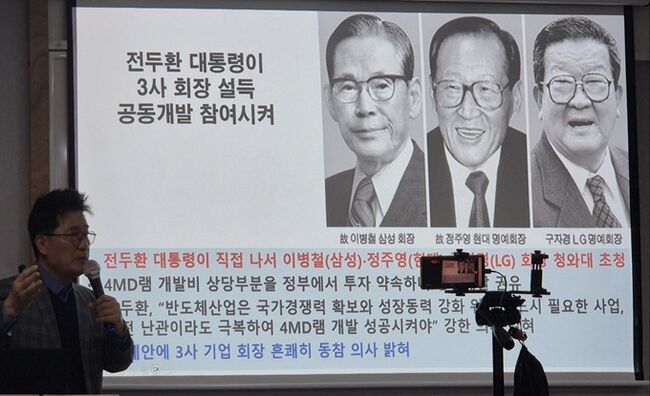 The lecture was conducted on the theme 'The Untold Story of Building the IT Industry that Sustains Korea' by Senior Reporter Kim Yong-sam, former editor of Wolgan Chosun. [Photo=Free Korea Patriotic Group]
According to recently disclosed documents, while many consider Samsung's 'Tokyo Declaration' as the starting point of the semiconductor industry, President Chun Doo-hwan approved the 'Semiconductor Industry Development Plan' on July 15, 1981, prior to that. This plan contained precise analysis and countermeasures regarding the necessity of semiconductor development, manufacturing processes, and current status and issues.
On September 5 of the same year, at the monthly trade promotion meeting held at the Gumi Export Industrial Complex, the President officially declared to the outside world, "The government will focus on fostering the semiconductor industry," heralding a national all-out effort.
At the time, semiconductors were an area that received pessimistic forecasts from domestic experts and foreign research institutions due to lack of technology, a narrow domestic market, and massive investment capital issues. In response, at President Chun's directive, Minister of Communications Choi Soon-dal took the lead in persuading the chairmen of large corporations.
Minister Choi's conditional recommendation, "You must participate in the semiconductor business to supply switching equipment to the government," was effective, leading the chairmen of Samsung, Goldstar (LG), Hyundai, and Daewoo groups to begin studies for participation in the semiconductor business. The government's forceful push for corporate participation turned into a historical achievement.
President Chun's Decision Transcended Laws and Regulations
The construction of semiconductor factories faced numerous obstacles. In particular, strong regulations like the 'Capital Region Rearrangement Law' hindered progress.
According to the law promulgated in 1983, new factory construction within the Giheung complex was impossible. If the construction of the second line had been abandoned at that time, not only would the production of 256K DRAM have been impossible, but Samsung's semiconductor business itself might not have materialized. However, with President Chun's direct intervention and approval, factory construction became possible.
The Hyundai Electronics (now Hynix) factory was in an even more difficult situation than Samsung because it included prime agricultural land and pasture in the middle of Icheon. However, this too was made possible by President Chun's decision, which, after passing through a cabinet meeting, granted a groundbreaking change of land use on September 17, 1983.
At the cabinet meeting at the time, President Chun Doo-hwan strongly instructed all cabinet members twice, saying, "Our entry into developed countries depends on how quickly we develop semiconductor technology," and urged their active cooperation in this project. Jung Hong-sik, then an administrative officer in the Presidential Secretariat for Economic Affairs, testified that "The Semiconductor Industry Development Plan was the result of work undertaken based on the President's directive to form a task force."
With the strong drive of the government and the challenge of the corporations combined, Samsung succeeded in developing 64K DRAM in November 1983, just 10 months after the Tokyo Declaration (March 1983). Ten years later, in 1994, South Korea achieved the great feat of becoming the world's number one in DRAM market share.
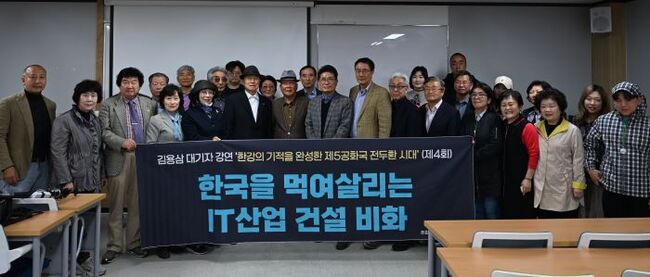 A commemorative photo after the lecture. [Photo=Dr. Oi]
A representative of the Free Korea Patriotic Group expressed their thoughts, stating, "It was a time to reflect on the IT industry, which became a decisive turning point in South Korea's economic development, and the decisions of President Chun Doo-hwan as its foundation, through the firsthand account of Senior Reporter Kim Yong-sam. At the time, Korea lacked both technology and capital. We learned that without President Chun Doo-hwan easing regulations, pouring in funds, and encouraging large corporations, the prosperity we enjoy today would not have existed."
Reporter Lim Yo-hee

 Iranian Foreign Ministry: "Continuing Message Exchanges with the U.S. and Activities of Mediating Countries"
Esmaeil Baghaei, Spokesperson for the Iranian Ministry of Foreign Affairs [Xinhua, Yonhap News file photo]Esmaeil Baghaei, spokesperson for the Iranian Ministry of Foreign Affairs, stated on the 26th
Iranian Foreign Ministry: "Continuing Message Exchanges with the U.S. and Activities of Mediating Countries"
Esmaeil Baghaei, Spokesperson for the Iranian Ministry of Foreign Affairs [Xinhua, Yonhap News file photo]Esmaeil Baghaei, spokesperson for the Iranian Ministry of Foreign Affairs, stated on the 26th
 President Yoon: "Do You Think You Are Safe from the Special Counsel?"... Final Statement Video Released
President Yoon Suk Yeol rebuking the special prosecutor on the 24th. [Court video / @birds_justice X account subtitle GIF] A video of President Yoon Suk Yeol's closing statement at his trial rega
President Yoon: "Do You Think You Are Safe from the Special Counsel?"... Final Statement Video Released
President Yoon Suk Yeol rebuking the special prosecutor on the 24th. [Court video / @birds_justice X account subtitle GIF] A video of President Yoon Suk Yeol's closing statement at his trial rega
 President Yoon, regarding the first-instance ruling on the Public Official Election Act: “An excessive political verdict that distorts the facts… We will appeal immediately.”
The first-instance sentencing hearing for President Yoon Suk Yeol regarding violations of the Public Official Election Act is being broadcast live at Seoul Station on the 27th. [Photo=Yonhap News]Pres
President Yoon, regarding the first-instance ruling on the Public Official Election Act: “An excessive political verdict that distorts the facts… We will appeal immediately.”
The first-instance sentencing hearing for President Yoon Suk Yeol regarding violations of the Public Official Election Act is being broadcast live at Seoul Station on the 27th. [Photo=Yonhap News]Pres
 WSJ: "SK Hynix ADR Premium Is a Sign of AI Trading Overheat"
Advertisement for SK Hynix ADR listing in New York's Times Square [Reuters=Yonhap News file photo]The Wall Street Journal (WSJ) has pointed out that the price of SK Hynix’s American Depositary Recei
WSJ: "SK Hynix ADR Premium Is a Sign of AI Trading Overheat"
Advertisement for SK Hynix ADR listing in New York's Times Square [Reuters=Yonhap News file photo]The Wall Street Journal (WSJ) has pointed out that the price of SK Hynix’s American Depositary Recei
 'Godfather of Japanese Mystery Novels' Keigo Higashino Passes Away After Battle with Cancer at 68
Famous Japanese mystery novelist Keigo Higashino [AFP=Yonhap News]It has been belatedly reported that Keigo Higashino, the "godfather of Japanese mystery novels" and author of bestsellers such as "The
'Godfather of Japanese Mystery Novels' Keigo Higashino Passes Away After Battle with Cancer at 68
Famous Japanese mystery novelist Keigo Higashino [AFP=Yonhap News]It has been belatedly reported that Keigo Higashino, the "godfather of Japanese mystery novels" and author of bestsellers such as "The
 [Park Pil-kyu Security Column] To the Ignorant Trying to Clothe a Beast in Sheep's Clothing
Rep. Kim Byung-joo of the Democratic Party of Korea [Photo=Yonhap News]“The Air Force Academy doesn't teach you how to fly a plane!” “The Army, Navy, and Air Force academies are exactly the
[Park Pil-kyu Security Column] To the Ignorant Trying to Clothe a Beast in Sheep's Clothing
Rep. Kim Byung-joo of the Democratic Party of Korea [Photo=Yonhap News]“The Air Force Academy doesn't teach you how to fly a plane!” “The Army, Navy, and Air Force academies are exactly the
 [Issue Diagnosis] Two Effects of the Election Petition Review
 [Photo] Evidence of Election Fraud Flooding U.S. Media… Trump Had 2.7 Million Votes Stolen
 [Video] U.S. Semiquincentennial Air Show... 'Art in the Sky' streaks across New York
 [Editorial Cartoon] A Draconian Law That Undermines Freedom of Expression

 List
List










