
South Korea's civil petition administration system is still bound by an outdated "bottom-up" mechanism, where decisions are sought from the top down.
When a civil petition is received, it is assigned to the junior staff member with the least experience. This junior staff member then drafts a proposal, which is then appended with details under the guise of "guidelines," "reviews," and "completions" as it goes up the approval chain. This is akin to adding excess flesh to a weak skeletal structure.
Team leaders and ministers, who should be setting the broad direction of policy and dismantling unreasonable regulations, hide behind the reports of the civil petition staff. They passively approve minor issues and settle for "repetitive administration" on matters requiring legal amendments or causing conflict, merely restating existing laws and regulations. This acts not as a driver of national competitiveness, but as a massive barrier to change.
1. The Pitfalls of Professional Cartels and Outdated Regulations
The South Korean fire safety industry is currently suffering from the ills of so-called "professional cartels." Even when new technologies emerge, they are often thwarted by the state-granted exclusive type approvals and the shield of existing laws, decrees, and regulations.
As a Standing Director of the Wireless Fire Safety Industry Cooperatives Association, I categorize these as three malicious types of regulations.
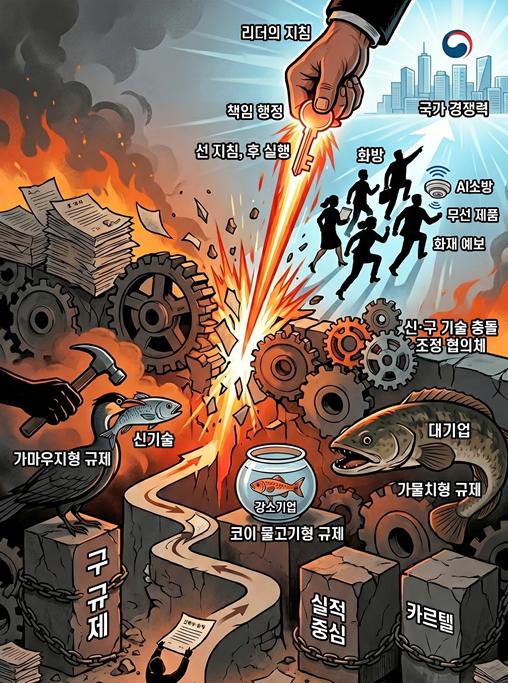
"Cormorant Regulations" that Delay and Block New Technology Entry
Just as a fisherman ties a string around a cormorant's neck to snatch the fish it catches, "cormorant regulations" use existing laws and decrees to delay the efforts and value of latecomers, ultimately robbing them of opportunities. It took five years for wireless fire safety products to receive type approval and enter the market, a market dominated by wired products.
Although AI fire safety technology, which predicts fire indicators rather than just extinguishing fires, is technically feasible, its practical application is being delayed because the existing laws lack a single line mentioning "prediction." Even if a product can be launched as a patented item, it is not recognized within the fire safety regulatory framework.
"Koi Fish Regulations" that Stifle Corporate Growth Potential
Some fire safety regulations still confine businesses within outdated fish tanks, mimicking Japanese fire safety standards from the 1970s. Intelligent detectors without false alarms, fire prediction systems, AI fire doors, automatically deploying escape chutes, and sound-based robots that guarantee apartment safety are being hindered by the passive administration of the Ministry of Land, Infrastructure and Transport and the National Fire Agency, preventing them from being included as "apartment option items."
While safety should be prioritized over the aesthetic value of apartments, the fear of conflict with existing appliance-centric apartment option items leads to the neglect of new safety products' market entry.
"Snakehead Regulations" Centered Around Large Corporations
Just as a powerful predator like a snakehead dominates a pond's ecosystem, performance and asset-based requirements that favor large corporations hinder the growth of small and medium-sized enterprises (SMEs). Regulations requiring "large-scale construction experience within the last three years" or "high credit ratings" for bidding are prime examples.
This fundamentally blocks the entry of innovative and strong SMEs. Furthermore, adherence to design standards (specifications) that prioritize mass-produced products under the Building Act makes it difficult to introduce new technologies. While the Building Act needs to be revised to align with the era of separate bidding, strict adherence to the current Building Act threatens the self-development and survival rights of small and medium-sized fire safety equipment companies.
2. Top-Down Administrative Innovation Driven by Decision-Makers: "Guidelines First, Execution Second"
In SMEs, businesses begin with directives from their leaders (CEOs) who possess the most information and experience and hold decision-making power. Then, specific information and alternatives are added through the organizational system, and the business is completed through the leader's numerous, fragmented decision-making processes. This is how they survive in fierce competition.
However, observing the process of filing and handling civil petitions, it appears that junior staff, lacking experience and decision-making authority, cause delays and undergo unnecessary hardship while trying to resolve petitions. To address this chronic problem, civil petition administration must be completely transformed into a "top-down" approach.
First, the initial assignment of civil petitions should be elevated to the team leader level or higher. Team leaders, with their experience and insight, should assess the importance of the petition. Those that team leaders can handle directly should be processed immediately. For petitions to be resolved as a team task, team leaders should issue guidelines, and staff members should handle the petitions according to these guidelines.
For nationally significant tasks, such as the AI Basic Law, a "fast track" should be implemented where ministers directly inspect the current status, listen to voices from the field, or preside over policy meetings to set the basic direction. If this were in place, "vague" responses from the working level would disappear.
Additionally, a "Coordination Committee for New and Old Technology Conflicts" should be established. Just as the early automobile industry was delayed by speed regulations despite the advent of cars in the era of horse-drawn carriages in the early 19th century, if we become bogged down in bureaucratic interpretations and defending existing laws at the inflection point of transitioning from wired to wireless and AI fire safety, it will lead to national loss.
A decision-making authority is needed, with ministers chairing committees to inspect "areas of conflict between new and old technologies," preside over stakeholder meetings to minimize conflict, and prioritize national interests.
3. Civil Petitions Should Be Signals of Progress, Not Obstacles
Civil petitions are not a burdensome administrative task but the forefront of national innovation. Clear guidelines from decision-makers can reduce administrative waste by over 70% and are a shortcut to regaining public trust. The civil petition improvement proposals I have put forth are not for the benefit of specific companies. They are a call for a major transformation towards "predictive fire safety" to protect people's lives from large-scale wildfires and malicious fires in factories and apartments.
I anticipate a top-down administrative innovation where ministers lead the way in dismantling regulatory barriers, and staff members pave the path. The way for South Korea to shed outdated bureaucracy and stand tall as a leader of advanced civilization begins with the practice of "accountable administration."

◆ Park Phil-gyu, Commissioner
Editorial Committee Member, Korea-US Daily
Korea Military Academy, Class of 40
Standing Director, Wireless Fire Safety Industry Cooperatives Association

 Iranian Foreign Ministry: "Continuing Message Exchanges with the U.S. and Activities of Mediating Countries"
Esmaeil Baghaei, Spokesperson for the Iranian Ministry of Foreign Affairs [Xinhua, Yonhap News file photo]Esmaeil Baghaei, spokesperson for the Iranian Ministry of Foreign Affairs, stated on the 26th
Iranian Foreign Ministry: "Continuing Message Exchanges with the U.S. and Activities of Mediating Countries"
Esmaeil Baghaei, Spokesperson for the Iranian Ministry of Foreign Affairs [Xinhua, Yonhap News file photo]Esmaeil Baghaei, spokesperson for the Iranian Ministry of Foreign Affairs, stated on the 26th
 President Yoon: "Do You Think You Are Safe from the Special Counsel?"... Final Statement Video Released
President Yoon Suk Yeol rebuking the special prosecutor on the 24th. [Court video / @birds_justice X account subtitle GIF] A video of President Yoon Suk Yeol's closing statement at his trial rega
President Yoon: "Do You Think You Are Safe from the Special Counsel?"... Final Statement Video Released
President Yoon Suk Yeol rebuking the special prosecutor on the 24th. [Court video / @birds_justice X account subtitle GIF] A video of President Yoon Suk Yeol's closing statement at his trial rega
 President Yoon, regarding the first-instance ruling on the Public Official Election Act: “An excessive political verdict that distorts the facts… We will appeal immediately.”
The first-instance sentencing hearing for President Yoon Suk Yeol regarding violations of the Public Official Election Act is being broadcast live at Seoul Station on the 27th. [Photo=Yonhap News]Pres
President Yoon, regarding the first-instance ruling on the Public Official Election Act: “An excessive political verdict that distorts the facts… We will appeal immediately.”
The first-instance sentencing hearing for President Yoon Suk Yeol regarding violations of the Public Official Election Act is being broadcast live at Seoul Station on the 27th. [Photo=Yonhap News]Pres
 WSJ: "SK Hynix ADR Premium Is a Sign of AI Trading Overheat"
Advertisement for SK Hynix ADR listing in New York's Times Square [Reuters=Yonhap News file photo]The Wall Street Journal (WSJ) has pointed out that the price of SK Hynix’s American Depositary Recei
WSJ: "SK Hynix ADR Premium Is a Sign of AI Trading Overheat"
Advertisement for SK Hynix ADR listing in New York's Times Square [Reuters=Yonhap News file photo]The Wall Street Journal (WSJ) has pointed out that the price of SK Hynix’s American Depositary Recei
 'Godfather of Japanese Mystery Novels' Keigo Higashino Passes Away After Battle with Cancer at 68
Famous Japanese mystery novelist Keigo Higashino [AFP=Yonhap News]It has been belatedly reported that Keigo Higashino, the "godfather of Japanese mystery novels" and author of bestsellers such as "The
'Godfather of Japanese Mystery Novels' Keigo Higashino Passes Away After Battle with Cancer at 68
Famous Japanese mystery novelist Keigo Higashino [AFP=Yonhap News]It has been belatedly reported that Keigo Higashino, the "godfather of Japanese mystery novels" and author of bestsellers such as "The
 [Park Pil-kyu Security Column] To the Ignorant Trying to Clothe a Beast in Sheep's Clothing
Rep. Kim Byung-joo of the Democratic Party of Korea [Photo=Yonhap News]“The Air Force Academy doesn't teach you how to fly a plane!” “The Army, Navy, and Air Force academies are exactly the
[Park Pil-kyu Security Column] To the Ignorant Trying to Clothe a Beast in Sheep's Clothing
Rep. Kim Byung-joo of the Democratic Party of Korea [Photo=Yonhap News]“The Air Force Academy doesn't teach you how to fly a plane!” “The Army, Navy, and Air Force academies are exactly the
 [Issue Diagnosis] Two Effects of the Election Petition Review
 [Photo] Evidence of Election Fraud Flooding U.S. Media… Trump Had 2.7 Million Votes Stolen
 [Video] U.S. Semiquincentennial Air Show... 'Art in the Sky' streaks across New York
 [Editorial Cartoon] A Draconian Law That Undermines Freedom of Expression

 List
List









