With the Japanese government significantly easing its arms export regulations, which it had maintained under the pacifist constitution, there are observations that the Japanese defense industry is experiencing a surge.
According to local media on the 22nd, Japan's defense industry, after a long period of stagnation, has seen a recent upturn in the past few years due to the government's policy to increase defense spending from the current 1% of GDP to 2% by fiscal year 2027 (April 2027 - March 2028).
 Japan's Mogami-class frigate, scheduled for export to Australia [Kyodo News]
The Japanese government's defense budget for the current fiscal year is a total of 10.6 trillion yen (approximately 98 trillion won), already reaching 1.9%.
Indeed, the Stockholm International Peace Research Institute (SIPRI) reported in December of last year that while the total revenue of the world's top 100 defense companies increased by 5.9% to $679 billion (approximately 1,004 trillion won) in 2024 compared to the previous year, the revenue of Japanese defense companies increased by 40% to $13.3 billion (approximately 19.7 trillion won).
The Asahi Shimbun reported, "Japan's defense industry had limited growth potential as its customer base was previously confined to the Self-Defense Forces, leading to a wave of companies withdrawing in the late 2010s. However, the situation has drastically changed in recent years due to the government's increase in defense spending."
Mitsubishi Heavy Industries, which manufactures fighter jets and tanks, plans to increase its personnel in the aviation, defense, and space business segments from 7,868 in fiscal year 2024 to approximately 10,000 by fiscal year 2026.
IHI, an heavy industry company, is constructing a solid rocket motor plant for missiles in Gunma Prefecture, aiming for completion in fiscal year 2028.
Japan Steel Works, which handles artillery and armored vehicles, already built a new defense equipment assembly plant in Hiroshima in January.
The Nikkei Shimbun reported that the increase in personnel and expansion of facilities by Japanese defense companies reflect expectations for overseas expansion following the relaxation of arms export regulations, in addition to the increase in defense spending by the Japanese government.
The Japanese government revised the Three Principles on Transfer of Defense Equipment and Its Applications, along with the operational guidelines, yesterday.
Prior to the revision, exports of defense equipment for non-combat purposes such as rescue, transport, surveillance, reconnaissance, and mine sweeping were permitted. Now, exports of lethal weapons such as fighter jets and warships are also permitted in principle.
Originally, Japan virtually banned the export of lethal weapons based on the "pacifist principles" of Article 9 of its constitution. During the second Abe administration, in 2014, it established the Three Principles on Transfer of Defense Equipment and Its Applications, allowing the export of defense equipment only for five purposes with low direct relevance to combat.
Since then, Japan has eased export restrictions by expanding exceptions, such as for joint development with other countries, but has principle-based restrictions on the export of lethal weapons.
The Japanese government expects that the relaxation of export regulations through this revision will revitalize the defense industry, enhance its ability to sustain prolonged combat, and serve as leverage for diplomatic security cooperation.
In particular, it is considering increasing frigate exports to Southeast Asian countries such as the Philippines.
However, there are also points raised that the international competitiveness of Japan's defense industry is not currently high.
The Asahi Shimbun stated, "Neighboring South Korea has historically focused on its defense industry, and according to SIPRI's data, South Korea ranks 4th in arms export market share in 2025, while Japan ranks 36th."
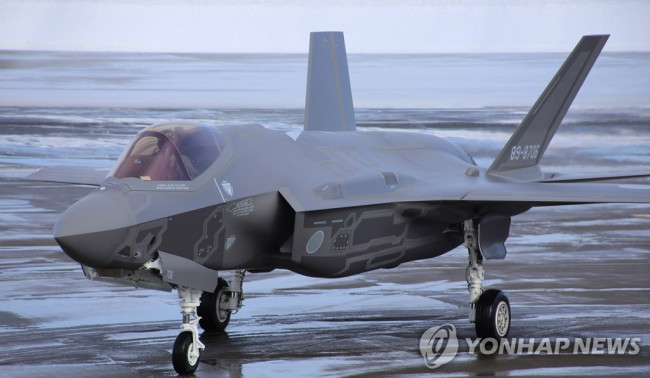 Japanese Air Self-Defense Force F-35 fighter jet [Provided by the Japan Air Self-Defense Force]
Meanwhile, Kyodo News reported that the ruling Liberal Democratic Party (LDP) has begun consolidating the key points for the revision of three security documents—the National Security Strategy, the National Defense Strategy, and the Defense Capability Consolidation Plan—which the current Takaychi Sanae cabinet plans to pursue within the year.
The LDP confirmed its intention to request the government to promote the development of interceptor drones and high-power lasers to strengthen the air defense network at a Security Research Council meeting held at the party headquarters.
The LDP identified the introduction of unmanned submarines to secure superiority underwater as a core element of defense capability consolidation, pointing out the need to establish a command and control system and enhance surveillance and reconnaissance in the Pacific, where China is expanding its military activities.
The meeting also included a proposal to expedite the review of equipping submarines that operate long-range missiles with next-generation power sources.
Kyodo News explained that while the option of using nuclear power as a next-generation power source for submarines is being discussed within the Japanese government, differing opinions are more prevalent within the LDP.

 Iranian Foreign Ministry: "Continuing Message Exchanges with the U.S. and Activities of Mediating Countries"
Esmaeil Baghaei, Spokesperson for the Iranian Ministry of Foreign Affairs [Xinhua, Yonhap News file photo]Esmaeil Baghaei, spokesperson for the Iranian Ministry of Foreign Affairs, stated on the 26th
Iranian Foreign Ministry: "Continuing Message Exchanges with the U.S. and Activities of Mediating Countries"
Esmaeil Baghaei, Spokesperson for the Iranian Ministry of Foreign Affairs [Xinhua, Yonhap News file photo]Esmaeil Baghaei, spokesperson for the Iranian Ministry of Foreign Affairs, stated on the 26th
 President Yoon: "Do You Think You Are Safe from the Special Counsel?"... Final Statement Video Released
President Yoon Suk Yeol rebuking the special prosecutor on the 24th. [Court video / @birds_justice X account subtitle GIF] A video of President Yoon Suk Yeol's closing statement at his trial rega
President Yoon: "Do You Think You Are Safe from the Special Counsel?"... Final Statement Video Released
President Yoon Suk Yeol rebuking the special prosecutor on the 24th. [Court video / @birds_justice X account subtitle GIF] A video of President Yoon Suk Yeol's closing statement at his trial rega
 President Yoon, regarding the first-instance ruling on the Public Official Election Act: “An excessive political verdict that distorts the facts… We will appeal immediately.”
The first-instance sentencing hearing for President Yoon Suk Yeol regarding violations of the Public Official Election Act is being broadcast live at Seoul Station on the 27th. [Photo=Yonhap News]Pres
President Yoon, regarding the first-instance ruling on the Public Official Election Act: “An excessive political verdict that distorts the facts… We will appeal immediately.”
The first-instance sentencing hearing for President Yoon Suk Yeol regarding violations of the Public Official Election Act is being broadcast live at Seoul Station on the 27th. [Photo=Yonhap News]Pres
 WSJ: "SK Hynix ADR Premium Is a Sign of AI Trading Overheat"
Advertisement for SK Hynix ADR listing in New York's Times Square [Reuters=Yonhap News file photo]The Wall Street Journal (WSJ) has pointed out that the price of SK Hynix’s American Depositary Recei
WSJ: "SK Hynix ADR Premium Is a Sign of AI Trading Overheat"
Advertisement for SK Hynix ADR listing in New York's Times Square [Reuters=Yonhap News file photo]The Wall Street Journal (WSJ) has pointed out that the price of SK Hynix’s American Depositary Recei
 'Godfather of Japanese Mystery Novels' Keigo Higashino Passes Away After Battle with Cancer at 68
Famous Japanese mystery novelist Keigo Higashino [AFP=Yonhap News]It has been belatedly reported that Keigo Higashino, the "godfather of Japanese mystery novels" and author of bestsellers such as "The
'Godfather of Japanese Mystery Novels' Keigo Higashino Passes Away After Battle with Cancer at 68
Famous Japanese mystery novelist Keigo Higashino [AFP=Yonhap News]It has been belatedly reported that Keigo Higashino, the "godfather of Japanese mystery novels" and author of bestsellers such as "The
 [Park Pil-kyu Security Column] To the Ignorant Trying to Clothe a Beast in Sheep's Clothing
Rep. Kim Byung-joo of the Democratic Party of Korea [Photo=Yonhap News]“The Air Force Academy doesn't teach you how to fly a plane!” “The Army, Navy, and Air Force academies are exactly the
[Park Pil-kyu Security Column] To the Ignorant Trying to Clothe a Beast in Sheep's Clothing
Rep. Kim Byung-joo of the Democratic Party of Korea [Photo=Yonhap News]“The Air Force Academy doesn't teach you how to fly a plane!” “The Army, Navy, and Air Force academies are exactly the
 [Issue Diagnosis] Two Effects of the Election Petition Review
 [Photo] Evidence of Election Fraud Flooding U.S. Media… Trump Had 2.7 Million Votes Stolen
 [Video] U.S. Semiquincentennial Air Show... 'Art in the Sky' streaks across New York
 [Editorial Cartoon] A Draconian Law That Undermines Freedom of Expression

 List
List









