- CNBC Interview: "More item-specific tariffs to be announced next week"... Semiconductors and pharmaceuticals mentioned
- "Korea opening up will be a huge business opportunity... EU investment in the US is a gift, not a loan."
- "If a trade agreement is reached with China, a summit with Xi Jinping will be held within the year... negotiations are nearing conclusion."
 U.S. President Donald Trump. Yonhap News
U.S. President Donald Trump announced that he plans to announce tariffs on semiconductors and pharmaceuticals soon, as he had previously foreshadowed.
In an interview with CNBC on the 5th (local time), President Trump stated that he plans to announce more item-specific tariffs "next week or so," mentioning semiconductors and pharmaceuticals as target items.
Regarding pharmaceuticals in particular, he said, "Initially, we'll impose a small tariff on pharmaceuticals, but after a year or up to a year and a half, we will increase it to 150%, and then to 250%."
This is interpreted to mean that pharmaceutical companies will be given about a year to a year and a half to move their production facilities located outside the U.S. back to the U.S., after which tariffs will be significantly increased.
In the interview that day, President Trump boasted about the results of trade agreements, saying, "Korea has opened up its country, not only opened its market, but it will be a tremendous business."
He added, "Korea was a closed country, and now suddenly we can sell cars, trucks, and SUVs (Sport Utility Vehicles) to Korea. We are really opening up Korea," he emphasized.
Even before the trade agreement with the U.S., Korea imported American cars, but the U.S. had argued that Korea's automotive safety and environmental standards were non-tariff barriers.
According to the Ministry of Trade, Industry and Energy, Korea has committed through this agreement to recognize American cars that meet U.S. safety standards as also meeting Korean safety standards.
President Trump reiterated his assertion that the investments promised by other countries to lower tariffs are money given to the U.S., not loans that the U.S. has to repay.
When asked by the host, using the European Union (EU) as an example, what would happen if they did not fulfill their promised investments, he replied, "Then they will have to pay a 35% tariff."
"It's a gift. It's not like a loan," he said. "There's nothing to repay. They gave us $600 billion to invest in anything we want."
When pointed out that there are no details in the trade agreement, he emphasized, "The detail is that they are investing $600 billion in anything I want."
Considering President Trump's attitude, it is suggested that he may claim that the $350 billion that Korea has promised to invest is not a loan or loan guarantee, as explained by the Korean government, and that disagreements may arise in the future.
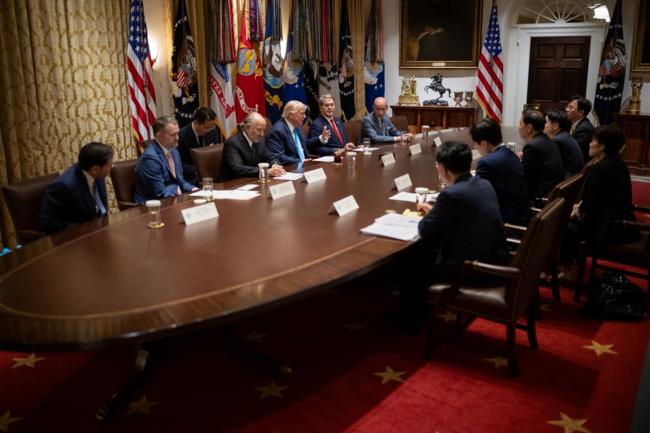 South Korean government delegation negotiating trade with President Trump [Photo courtesy of Secretary of the Treasury Steven Mnuchin.
He also pointed out that India continues to purchase Russian crude oil, supporting Russia's war financing, and announced that because of this, he will significantly increase tariffs on India within the next 24 hours, much higher than the current 25%.
"When energy prices get low enough, Putin (President of Russia) will stop killing people," he argued. "If we can drive energy prices down by $10 a barrel, Putin will have no other choice. Because his economy is bad."
Regarding the prospect of a meeting with Chinese President Xi Jinping, President Trump said, "He asked for a meeting, and if we reach a (trade) agreement, it is very likely that we will meet before the end of the year. If we do not reach an agreement, I will not meet him."
He added, "But we are very close to reaching an agreement. We are doing very well with China," and "My relationship with President Xi is very good. I think we will have a good agreement."
President Trump suggested that he might announce a new Federal Reserve chairman when appointing a successor to former Fed Governor Adriaana Kugler, who recently resigned.
He stated that he is considering four candidates, including former Fed Governor Kevin Warsh and White House National Economic Council Director Kevin Hassett.
Regarding Treasury Secretary Steven Mnuchin, who has been mentioned as a candidate, President Trump said he had asked Mnuchin his intentions the previous night, but Mnuchin expressed his desire to continue as Treasury Secretary.
When asked if he would run for president again in the next election, President Trump replied, "Probably not," but immediately added, "I want to run. My poll numbers are the highest I've ever received."
Yonhap News
What do you think of this article?

 Iranian Foreign Ministry: "Continuing Message Exchanges with the U.S. and Activities of Mediating Countries"
Esmaeil Baghaei, Spokesperson for the Iranian Ministry of Foreign Affairs [Xinhua, Yonhap News file photo]Esmaeil Baghaei, spokesperson for the Iranian Ministry of Foreign Affairs, stated on the 26th
Iranian Foreign Ministry: "Continuing Message Exchanges with the U.S. and Activities of Mediating Countries"
Esmaeil Baghaei, Spokesperson for the Iranian Ministry of Foreign Affairs [Xinhua, Yonhap News file photo]Esmaeil Baghaei, spokesperson for the Iranian Ministry of Foreign Affairs, stated on the 26th
 President Yoon: "Do You Think You Are Safe from the Special Counsel?"... Final Statement Video Released
President Yoon Suk Yeol rebuking the special prosecutor on the 24th. [Court video / @birds_justice X account subtitle GIF] A video of President Yoon Suk Yeol's closing statement at his trial rega
President Yoon: "Do You Think You Are Safe from the Special Counsel?"... Final Statement Video Released
President Yoon Suk Yeol rebuking the special prosecutor on the 24th. [Court video / @birds_justice X account subtitle GIF] A video of President Yoon Suk Yeol's closing statement at his trial rega
 President Yoon, regarding the first-instance ruling on the Public Official Election Act: “An excessive political verdict that distorts the facts… We will appeal immediately.”
The first-instance sentencing hearing for President Yoon Suk Yeol regarding violations of the Public Official Election Act is being broadcast live at Seoul Station on the 27th. [Photo=Yonhap News]Pres
President Yoon, regarding the first-instance ruling on the Public Official Election Act: “An excessive political verdict that distorts the facts… We will appeal immediately.”
The first-instance sentencing hearing for President Yoon Suk Yeol regarding violations of the Public Official Election Act is being broadcast live at Seoul Station on the 27th. [Photo=Yonhap News]Pres
 WSJ: "SK Hynix ADR Premium Is a Sign of AI Trading Overheat"
Advertisement for SK Hynix ADR listing in New York's Times Square [Reuters=Yonhap News file photo]The Wall Street Journal (WSJ) has pointed out that the price of SK Hynix’s American Depositary Recei
WSJ: "SK Hynix ADR Premium Is a Sign of AI Trading Overheat"
Advertisement for SK Hynix ADR listing in New York's Times Square [Reuters=Yonhap News file photo]The Wall Street Journal (WSJ) has pointed out that the price of SK Hynix’s American Depositary Recei
 'Godfather of Japanese Mystery Novels' Keigo Higashino Passes Away After Battle with Cancer at 68
Famous Japanese mystery novelist Keigo Higashino [AFP=Yonhap News]It has been belatedly reported that Keigo Higashino, the "godfather of Japanese mystery novels" and author of bestsellers such as "The
'Godfather of Japanese Mystery Novels' Keigo Higashino Passes Away After Battle with Cancer at 68
Famous Japanese mystery novelist Keigo Higashino [AFP=Yonhap News]It has been belatedly reported that Keigo Higashino, the "godfather of Japanese mystery novels" and author of bestsellers such as "The
 [Park Pil-kyu Security Column] To the Ignorant Trying to Clothe a Beast in Sheep's Clothing
Rep. Kim Byung-joo of the Democratic Party of Korea [Photo=Yonhap News]“The Air Force Academy doesn't teach you how to fly a plane!” “The Army, Navy, and Air Force academies are exactly the
[Park Pil-kyu Security Column] To the Ignorant Trying to Clothe a Beast in Sheep's Clothing
Rep. Kim Byung-joo of the Democratic Party of Korea [Photo=Yonhap News]“The Air Force Academy doesn't teach you how to fly a plane!” “The Army, Navy, and Air Force academies are exactly the
 [Issue Diagnosis] Two Effects of the Election Petition Review
 [Photo] Evidence of Election Fraud Flooding U.S. Media… Trump Had 2.7 Million Votes Stolen
 [Video] U.S. Semiquincentennial Air Show... 'Art in the Sky' streaks across New York
 [Editorial Cartoon] A Draconian Law That Undermines Freedom of Expression

 List
List









