 Students and military police confront each other in front of Chonnam National University during the May 18th Gwangju Uprising. [Black and white photo converted to color].
President Lee Jae-myung will approve the announcement of a constitutional amendment to enshrine the spirit of the May 18th Gwangju Uprising in the preamble of the Constitution at a recent cabinet meeting. A vote on the constitutional amendment, initiated by the Democratic Party, will be held concurrently with the upcoming June 3rd local elections. Incorporating the spirit of the May 18th Gwangju Uprising into the preamble of the Constitution is tantamount to stating that the Republic of Korea is no longer a liberal democratic nation.
This is a victory in a war of attrition waged over the past half-century against the ignorant masses by pro-North Korean left-wing anti-state forces through propaganda, agitation, and brainwashing. It signifies the conclusion of the process of communizing the Republic of Korea, leaving only unification under North Korean rule for a country already effectively controlled by them.
How the 'Kim Dae-jung Rebellion Conspiracy Case' Became a Democratization Movement
The April 3rd Jeju Uprising and the Yeosu–Suncheon Rebellion were both acts of rebellion and insurrection aimed at overthrowing the government of the Republic of Korea by remnants of the South Korean Workers' Party supported by North Korea. It has been revealed that these events resulted in the sacrifice of many innocent citizens who were either misled or compelled to join them. The theory of North Korean involvement in the May 18th Gwangju Uprising is also gaining considerable credibility.
Demonizing the military and police who suppressed the armed rebels with North Korean ties, while glorifying the rebels and painting them all as a democratization movement, reflects the perspective of North Korean communists and pro-North Korean leftists. If this is not overcome, the citizens of the Republic of Korea will become slaves to the North Korean communist regime, enduring a tarnished peace.
The first Supreme Court ruling declared the May 18th Gwangju Uprising as an armed riot and rebellion instigated by Kim Dae-jung. Kim Dae-jung was sentenced to death for rebellion and later pardoned and restored his civil rights during the Chun Doo-hwan administration. It was Kim Young-sam who overturned the May 18th Gwangju Uprising from Kim Dae-jung's rebellion into a democratization movement.
When the slush fund scandal involving Roh Tae-woo surfaced, Kim Young-sam, in an effort to conceal the illegal political funds he received from Roh Tae-woo, pushed for the enactment of the May 18th Special Act. This law led to the prosecution of Chun Doo-hwan and Roh Tae-woo for rebellion related to the December 12th military coup and violations of the Political Funds Act, while his and Kim Dae-jung's illegal political funds were covered up. Roh Tae-woo should have fought back by revealing that he gave slush funds to Kim Young-sam, but he cowardly remained silent, hoping for leniency from Kim Young-sam.
Despite the May 18th Special Act, the May 18th Gwangju Uprising remains a highly contentious issue between the left and right, with continuous constitutional appeals lodged with the Constitutional Court. Left-leaning governments have not hesitated to enact unconstitutional legislation that punishes criticism of the May 18th Gwangju Uprising. However, evidence and testimonies from prosecutors and related individuals regarding North Korean involvement in the May 18th Gwangju Uprising are emerging. Kwon Young-hae, then-director of the Agency for National Security Planning (ANSP) under the Kim Young-sam administration, testified that during his tenure, he confirmed the existence of a cemetery in Chongjin for North Korean spies who were killed during infiltration for the May 18th Gwangju Uprising, and that this was even included in North Korean textbooks.
The selection of May 18th Gwangju Uprising merit recipients is handled by the city of Gwangju, not the state, though the funding comes from the state. Through the national budget, compensation and benefits are provided not only to the recipients themselves but also to their descendants, even for generations not involved. The government's truth commission, led by organizations of May 18th Gwangju Uprising merit recipients, excludes any testimony or evidence related to armed rebellion or North Korean involvement.
The list of recipients and the reasons for their selection are not disclosed. In media interviews, Hwang Jang-yop stated that the truth would naturally be revealed when reunification occurs, when asked about North Korean involvement in the May 18th Gwangju Uprising. Hwang Jang-yop, who spent 10 years under house arrest by pro-North Korean leftist governments after defecting in 1997, and had no opportunity to speak about North Korea's involvement in the May 18th Gwangju Uprising, cautiously made these remarks after the emergence of the Lee Myung-bak administration.
He made these statements with reservations due to the ideological ambiguity of the "pragmatic centrist" Lee Myung-bak administration, which maintained the status quo after a decade of repression by leftist governments. Hwang Jang-yop restrained Kim Duk-hong, who defected with him and intended to speak out more forcefully, leading to Kim Duk-hong's protest about why he was being prevented from speaking.
In 1990, Kim Young-sam, then-leader of the opposition party Reunification Democratic Party, merged with the New Democratic Republican Party and the ruling Democratic Liberal Party under President Roh Tae-woo, becoming the leader of the DLP. He ran as the DLP presidential candidate in 1992 and was elected president.
Political Calculations Hidden Behind 'Setting History Right'
During the election campaign, Roh Tae-woo transferred 300 billion won in illegal campaign funds to Kim Young-sam. Two years after Kim Young-sam's inauguration, in 1995, when Roh Tae-woo's 400 billion won slush fund scandal erupted, Kim Young-sam, to cover up his own slush funds, ordered the creation of the May 18th Special Act and initiated investigations into Chun Doo-hwan and Roh Tae-woo for rebellion related to the December 12th incident and their slush funds.
With the enactment of the May 18th Special Act, Kim Young-sam became the host for the rampant Juche ideology followers in South Korea and the foremost contributor to the leftward shift of the Republic of Korea. Kim Young-sam's incompetence, which led to the IMF economic crisis, pales in comparison to his achievement as the primary driver of the country's leftward turn.
Kim Young-sam's logic that the nation takes precedence over ideology is equivalent to saying that any form of unification is acceptable as long as the nation is united. The incompetent and corrupt Kim Young-sam was unaware of the future consequences that the May 18th Special Act would bring to the Republic of Korea. The rhetoric of "nation, democracy, and independence" is a repertoire used by North Korean communists, remnants of the South Korean Workers' Party, Juche followers, and their sympathizers for propaganda and agitation aimed at the communization of the Republic of Korea.
"Anti-Americanism, anti-imperialism, and independent unification" are the three core tenets of pro-North Korean Juche followers. It is the bitter lament of Kim Il-sung, who was thwarted in his bid for unification of the Korean Peninsula at the brink of success by the Korean War intervention of the United States, vowing to achieve unification under North Korean rule after separating South Korea from American and Japanese imperialism.
Shortly after the inauguration of the Kim Young-sam administration in 1993, the prosecution investigated Chun Doo-hwan and Roh Tae-woo for rebellion related to the December 12th incident. The prosecution dismissed the charges based on the logic that successful coups cannot be punished.
In 1995, when the Roh Tae-woo 400 billion won slush fund allegations surfaced, Kim Young-sam, under the guise of "setting history right," enacted the May 18th Special Act and ordered a reinvestigation of Chun Doo-hwan and Roh Tae-woo. Chun Doo-hwan and Roh Tae-woo were sentenced to life imprisonment and 17 years in prison, respectively, for military rebellion on December 12th and bribery. They were pardoned and released in late 1997, shortly before Kim Young-sam's term ended.
Through Kim Young-sam's May 18th Special Act, the December 12th incident, which was the arrest of Martial Law Commander Jeong Seung-hwa, the perpetrator of Park Chung-hee's assassination, was reframed from a legitimate law enforcement action by the Defense Security Command into a rebellion. Similarly, the May 18th Gwangju Uprising was transformed from a riot into a democratization movement. In addition to life imprisonment and 17 years for rebellion, Chun Doo-hwan and Roh Tae-woo were ordered to forfeit 220 billion won and 260 billion won, respectively, for illegal political fund bribery. They continued to be subject to confiscation even after their pardon, until their deaths.
Upon the outbreak of his slush fund scandal, Roh Tae-woo held a press conference to apologize to the nation, stating that the slush funds were collected according to the practices of the time. However, he did not reveal the fact that he had transferred 300 billion won to Kim Young-sam, and instead hoped for leniency from Kim Young-sam.
Had Roh Tae-woo boldly revealed the fact that he had transferred slush funds to Kim Young-sam and Kim Dae-jung and counterattacked, Kim Young-sam would not have been able to carry out the excessive investigation of Chun Doo-hwan and Roh Tae-woo, as he himself and Kim Dae-jung would also have been subject to investigation.
However, the cowardice of the incompetent opportunist Roh Tae-woo emboldened Kim Young-sam. Kim Young-sam used the May 18th Special Act as a means to cover up his own slush funds, and criticism emerged that the May 18th Special Act was the foundation for the Republic of Korea's leftward shift and eventual communization. This is the backdrop for the persistent criticism of Chun Doo-hwan by pro-North Korean leftists, their leniency towards Roh Tae-woo, and the appointment of Roh Jae-heon, Roh Tae-woo's son, as ambassador to China under the Lee Jae-myung administration.
In his memoirs, Roh Tae-woo stated that he transferred 300 billion won in election funds to Kim Young-sam, the DLP candidate in the 1992 presidential election, but no one is interested in past events. An article in Weekly Donga on April 16, 1998, revealed that the illegal presidential election funds used by Kim Young-sam at the time amounted to 303.4 billion won. Following the outbreak of the Roh Tae-woo slush fund scandal, Kim Dae-jung admitted to receiving 2 billion won in political funds from Roh Tae-woo during the 1992 presidential election.
However, unlike Roh Tae-woo, Kim Dae-jung immediately counterattacked, arguing that if he, as the opposition candidate, received 2 billion won, then Kim Young-sam, the ruling party candidate, should reveal how much he received. The DLP raised the "2 billion won plus alpha" theory and urged Kim Dae-jung to disclose the full extent of his political funds.
Ahead of the 1997 presidential election, the Grand National Party, the successor to the DLP, accused Kim Dae-jung, the opposition candidate, of managing a 37.8 billion won slush fund and filed a complaint against him with the Supreme Prosecutors' Office for bribery. Kim Young-sam secretly summoned Prosecutor General Kim Tae-jung to the presidential residence on a Sunday and instructed him to postpone the investigation into Kim Dae-jung's slush funds until after the presidential election.
Kim Young-sam's memoirs state that his reason for this decision was that a probe into Kim Dae-jung's illicit wealth accumulation, two months before the presidential election, would lead to Kim Dae-jung's arrest, trigger riots in Jeolla Province and Seoul, and create political chaos that would prevent the presidential election from being held.
Lee Hoi-chang, the presidential candidate of the then-ruling Grand National Party, who lost the 1997 presidential election due to Kim Young-sam's betrayal, wrote in his memoirs that Kim Young-sam's decision was driven by the fear that an investigation into Kim Dae-jung's slush funds would lead to an investigation into Kim Young-sam's own presidential election funds in 1992. Kim Tae-jung, who halted the investigation into Kim Dae-jung's illegal political funds under Kim Young-sam's instructions, became Minister of Justice after Kim Dae-jung's inauguration, and the investigation into Kim Dae-jung's bribery was buried.
Kim Young-sam's "setting history right" was a stratagem to cover up the suspicions of his own illegal political fund receipts that surfaced continuously throughout his term. Even in 1993, early in the Kim Young-sam administration, the Donghwa Bank slush fund scandal, involving political fund receipts by Roh Tae-woo and Kim Young-sam, erupted, but it ended anticlimactically with the arrest of a few staff members under pressure from the Kim Young-sam administration.
While no politician could escape the practice of illegal political funds that had been ongoing for decades since liberation, as a result of Kim Young-sam's abuse of power, Chun Doo-hwan and Roh Tae-woo were sentenced to prison for bribery and subjected to massive confiscation orders, while the investigations into Kim Young-sam's and Kim Dae-jung's slush funds were buried.
When a constitutional appeal was filed against the May 18th Special Act enacted by the Kim Young-sam administration on grounds of retrospective legislation, the Constitutional Court ruled it constitutional with a vote of 5 for unconstitutionality and 4 for constitutionality, failing to reach the required six votes for unconstitutionality.
Through the May 18th Special Act, thousands of democratization merit recipients receive compensation and benefits funded by taxpayers. However, the Ministry of Patriots and Veterans Affairs refuses to disclose their names and detailed achievements. While they cite privacy protection as a reason for non-disclosure, they cannot disclose them because the compensation is a free-for-all payout without substantiated achievements justifying the benefits.
The May 18th Gwangju Uprising's highlight, the ambush of the 20th Division on May 21st, the seizure of 44 armories scattered throughout Gwangju and South Jeolla Province, and the attack on Gwangju Prison, were carried out with swift military operations. However, those who achieved remarkable feats in these operations are not on the list of merit recipients.
In 2020, the Moon Jae-in administration passed the May 18th Historical Distortion Punishment Act to prevent defamation of the May 18th Gwangju Uprising. In 2022, the Constitutional Court dismissed a request for adjudication on a constitutional appeal against Article 8, Paragraph 1 of the May 18th Special Act, the Historical Distortion Punishment Act.
Following the enactment of the May 18th Special Act by Kim Young-sam and the subsequent prosecution of Chun Doo-hwan, the charges against him were rebellion related to December 12th and bribery. The Kim Young-sam administration investigated Chun Doo-hwan's involvement in the May 18th Gwangju Uprising but could not even indict him due to a lack of supporting testimony or evidence.
In media interviews, Lee Hee-sung, then-Martial Law Commander during the May 18th Gwangju Uprising, stated that Chun Doo-hwan was not involved in the May 18th Gwangju Uprising and that the responsibility, if any, lay with himself and the Minister of National Defense. He added that there was no order to fire, and the sporadic responses by the martial law forces were in self-defense against the armed protesters who initiated firing during the confrontation. Lee Hee-seong further explained that although North Korean involvement was suspected due to the armed protesters' actions such as looting armories, attacking prisons, and systematically attacking the 20th Division, investigations could not be conducted after the May 18th Gwangju Uprising ended due to President Choi Kyu-ha's directive to prioritize public sentiment stabilization.
Prosecution investigation records also indicate that military commanders frequently discovered protesters communicating in North Korean dialects through wiretaps and intercepts. However, they stated that they could not apprehend them due to concerns about unforeseen incidents that might arise if martial law forces entered the scene for their apprehension.
The investigation results of the Kim Young-sam administration also revealed that Chun Doo-hwan had no connection to the May 18th Gwangju Uprising. Nevertheless, pro-North Korean leftists continuously portrayed Chun Doo-hwan as a perpetrator of the May 18th Gwangju Uprising massacre through propaganda and agitation. Consequently, his grandson, Chun Woo-won, who was brainwashed, went to the May 18th Gwangju Cemetery to apologize on behalf of his grandfather, Chun Doo-hwan.
Incompetent Kim Young-sam, Chun Doo-hwan Who Paved the Way for the Future
Kim Young-sam, the host of pro-North Korean leftist ideology who died in 2016, is buried in Seoul National Cemetery in Dongjak-gu. Chun Doo-hwan, who died in 2021, could not find a burial site and his remains remained at his home in Yeonhui-dong. Despite Chun Doo-hwan's dying wish to be buried in a place where North Korea is visible, as he could not be interred in the National Cemetery due to his conviction for rebellion, his family arranged a burial site in Paju, a border area. However, they abandoned the plan due to propaganda from pro-North Korean leftists and protests.
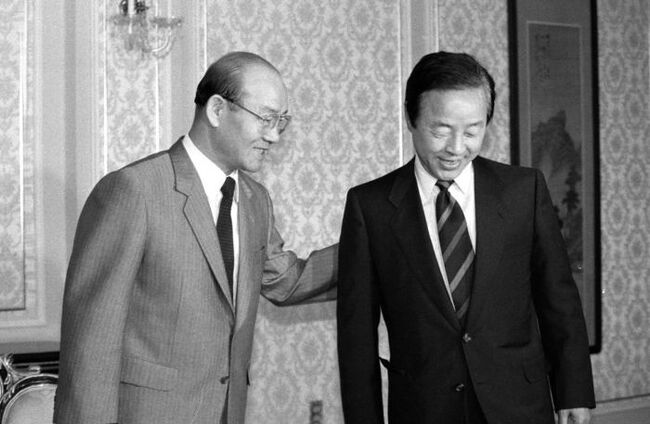 Summit between President Chun Doo-hwan and Kim Young-sam, leader of the Reunification Democratic Party. June 24, 1987. [Photo: Government Records Photo Album]
Unlike the incompetent and corrupt Kim Young-sam, who caused the IMF economic crisis, Chun Doo-hwan laid the foundation for a nation possessing world-class nuclear power generation technology, as well as Samsung Electronics and Hynix Semiconductor, through the construction of semiconductor and nuclear power plants.
In his autobiography, Chun Doo-hwan wrote that his unusual appointment as head of the Defense Security Command, a position usually held by a Lieutenant General, while he was a Major General, was likely to entrust him with the investigation of the October 26 assassination. Through Chun Doo-hwan, Park Chung-hee continued his mission of modernizing the nation and industrializing it towards becoming a leading country, including the development of semiconductor and nuclear power technologies, even after his death. However, pro-North Korean leftist regimes are dismantling Korea's semiconductor and nuclear power industries, built through decades of arduous effort, through various anti-business laws and policies.
The roots of South Korea's success in nuclear power and semiconductors, which are currently world-class, trace back to the Syngman Rhee administration. In February 1956, Korea signed an "Intergovernmental Agreement for Cooperation in the Peaceful Uses of Atomic Energy" with the United States and joined the International Atomic Energy Agency (IAEA) in 1957. The Atomic Energy Act was enacted in 1958, and over 100 students were sent to the US for nuclear studies, and a nuclear research institute was established.
Syngman Rhee directed budget support for the introduction of a research reactor. At the groundbreaking ceremony for the construction of the nuclear research institute in 1959, Syngman Rhee stated that the nuclear research institute should create an atomic machine in the near future. Syngman Rhee's attachment to atomic energy stemmed not only from the pursuit of nuclear weapons but also from the severe power shortages that plagued Korea, with electricity being supplied for only a few hours a day due to the North's cessation of power transmission, which accounted for 80% of South Korea's electricity demand in May 1948. Suffering from serious power shortages, the Republic of Korea finally ended the limited power supply in 1964 with the construction of hydroelectric and thermal power plants.
The research reactor whose construction began under the Syngman Rhee administration was completed after the Park Chung-hee administration took power in 1962. In 1969, Park Chung-hee signed a contract with Westinghouse of the United States for the construction of a nuclear power plant, and Gori Unit 1, Korea's first nuclear power plant, was completed in 1971. Subsequently, along with the construction of Gori Units 2 and Wolsong nuclear power plants, negotiations were held with France to introduce plutonium reprocessing technology, and the introduction of Canadian CANDU reactors was pursued but halted due to US pressure. Due to US pressure, Park Chung-hee officially abandoned nuclear weapons development in 1976.
The nuclear weapons program, which continued secretly thereafter, was abandoned by Chun Doo-hwan after Park Chung-hee's death. Chun Doo-hwan abandoned the nuclear weapons program in 1981 at the request of US President Reagan during a summit meeting. In return, Reagan withdrew the plan to withdraw US forces from Korea, which had been pursued by former President Carter.
The Roots of Korea's Nuclear Power and Semiconductor Success Story
Chun Doo-hwan judged it difficult to continue developing nuclear weapons while resisting US pressure. Instead, he accepted the expert opinion that securing Korean-type reactor technology would make nuclear weapon manufacturing much easier. During this period, India, despite US economic sanctions, succeeded in its nuclear weapons test using a CANDU reactor imported from Canada.
Ha Soon-bong, a four-term National Assembly member, wrote in his memoirs that following Nixon's visit to China and the announcement of the Nixon Doctrine, which stated that Asian countries must take responsibility for their own security, Park Chung-hee, stimulated by the withdrawal of US forces from Korea and the US decision to withdraw from Vietnam, ordered a secret nuclear weapons development project in 1972, which was nearly complete by the late 1970s. Park Chung-hee told National Assembly member Sunwoo Yeon, a former presidential public relations secretary, on January 1, 1979, that he planned to publicly unveil the nuclear weapon at the Armed Forces Day ceremony on October 1, 1981, and then immediately announce his resignation.
To complete the indigenous reactor construction technology, Chun Doo-hwan intensively supported research on the localization of heavy water and light water nuclear fuel. In 1986, he sent about 70 nuclear scientists to CE in the United States for training to acquire technology for joint reactor design.
In 1988, Korea, in collaboration with CE, completed the system design for the Yonggwang Units 3 and 4 reactors, thus succeeding in developing Korean-type reactors following the localization of heavy water and light water nuclear fuel. Chun Doo-hwan, to avoid US scrutiny, renamed the Atomic Energy Research Institute the Energy Research Institute and instructed it to take the lead in developing Korean-type reactors, providing full budgetary and administrative support.
This is according to a letter written by Han Pil-soon, the director of the Energy Research Institute, known as the "godfather of Korean nuclear power," in 2011, titled "A Letter from a Nuclear Scientist." "President Chun Doo-hwan trusted me to the end and showed me active support. And though I heard later that piles of anonymous letters slandering me were stacked high, he ignored them all and instructed to help me unconditionally. I can confidently say that the trust shown by the supreme commander resulted in the success story of Korea's nuclear power generation technology today." (From Chun Doo-hwan's Memoirs, Vol. 2)
This is from a May 25, 2015, obituary for Han Pil-soon in the Maeil Business Newspaper. "In the nuclear industry, everyone agrees that without the deceased, Korea's self-reliance in nuclear technology would have been impossible. Kim Jong-kyung, president of the Korea Atomic Energy Research Institute, called the deceased the godfather of the Korean nuclear industry who laid the foundation for us to develop nuclear technology independently, which we were previously dependent on foreign countries for. He added that without him, nuclear exports and the development of research reactors would not have been possible."
Alongside nuclear power development, Chun Doo-hwan also initiated South Korea's journey to becoming a semiconductor powerhouse. In 1981, at Chun Doo-hwan's directive, the Presidential Secretariat for Economic Affairs, along with relevant ministries, industry, and research institutes, created the "Semiconductor Industry Promotion Plan." This is according to the memoirs of Oh Myung, then-economic secretary.
"At the time, very few people understood what semiconductors were. We believed from the outset that it was important for the President to have a thorough understanding of semiconductors. Therefore, we created a comic book about semiconductors and submitted it as a report. We even brought a semiconductor model from Japan to explain it to the President. President Chun twice instructed at cabinet meetings, 'Whether our country can become a developed nation or not depends on how quickly we develop semiconductor technology. All cabinet members are instructed to actively cooperate in the promotion of the semiconductor industry.'"
In accordance with the "Semiconductor Industry Promotion Plan," overseas training for semiconductor technical personnel, recruitment of foreign talent, modernization of production facilities, support for R&D funds, and expansion of tax incentives were implemented. "The President's determination to promote the semiconductor industry was unwavering. The Semiconductor Industry Promotion Committee was expanded in 1983 and operated as the Information Industry Promotion Committee, chaired by the Chief of Presidential Staff. The government's ambitious semiconductor promotion plan accelerated the entry of domestic conglomerates into the semiconductor business." (ETNews, '[Science and Technology are the Future] <94> Bold Challenge for a Semiconductor Powerhouse,' July 5, 2023)
In 1983, after Samsung's Chairman Lee Byung-chul announced the Tokyo Declaration to develop 64K DRAM semiconductors and entered the semiconductor industry, Samsung succeeded in developing 256K DRAM in 1984. Following Goldstar Semiconductor's successful development of 1M DRAM in 1985, Samsung also succeeded in developing 1M DRAM the following year.
However, Japan, to counter Korean semiconductors, engaged in dumping, causing semiconductor prices to plummet. The losses for Korean semiconductor companies widened, and companies hesitated due to the immense capital required for equipment and R&D investment for the next stage, 4M DRAM development.
Chun Doo-hwan summoned Samsung's Lee Byung-chul, Hyundai's Chung Ju-yung, and LG's Koo Ja-kyung and proposed joint research on semiconductors under the auspices of the Korea Telecommunications Research Institute, with the government providing 30 billion won out of the 40 billion won development cost. Despite opposition from government ministries such as the Economic Planning Board regarding investment and prospects for the Korean semiconductor industry, and critical views from academia and industry both domestically and internationally, Chun Doo-hwan continued his full support for the semiconductor industry.
In February 1988, just before Chun Doo-hwan's term ended, Korea succeeded in developing 4M DRAM, narrowing the technological gap with Japan to six months. Four years after Chun Doo-hwan's departure, in 1992, Korea developed 64M DRAM before the United States and Japan, subsequently leading the global semiconductor market. Chun Doo-hwan is at the center of the resurgence of the South Korean semiconductor industry, led by Samsung Electronics and SK Hynix.
◆ Hwang Doo-hyong
Former Washington Correspondent, Yonhap News Agency
Former Deputy Editor-in-Chief, Yonhap News Agency

 Iranian Foreign Ministry: "Continuing Message Exchanges with the U.S. and Activities of Mediating Countries"
Esmaeil Baghaei, Spokesperson for the Iranian Ministry of Foreign Affairs [Xinhua, Yonhap News file photo]Esmaeil Baghaei, spokesperson for the Iranian Ministry of Foreign Affairs, stated on the 26th
Iranian Foreign Ministry: "Continuing Message Exchanges with the U.S. and Activities of Mediating Countries"
Esmaeil Baghaei, Spokesperson for the Iranian Ministry of Foreign Affairs [Xinhua, Yonhap News file photo]Esmaeil Baghaei, spokesperson for the Iranian Ministry of Foreign Affairs, stated on the 26th
 President Yoon: "Do You Think You Are Safe from the Special Counsel?"... Final Statement Video Released
President Yoon Suk Yeol rebuking the special prosecutor on the 24th. [Court video / @birds_justice X account subtitle GIF] A video of President Yoon Suk Yeol's closing statement at his trial rega
President Yoon: "Do You Think You Are Safe from the Special Counsel?"... Final Statement Video Released
President Yoon Suk Yeol rebuking the special prosecutor on the 24th. [Court video / @birds_justice X account subtitle GIF] A video of President Yoon Suk Yeol's closing statement at his trial rega
 President Yoon, regarding the first-instance ruling on the Public Official Election Act: “An excessive political verdict that distorts the facts… We will appeal immediately.”
The first-instance sentencing hearing for President Yoon Suk Yeol regarding violations of the Public Official Election Act is being broadcast live at Seoul Station on the 27th. [Photo=Yonhap News]Pres
President Yoon, regarding the first-instance ruling on the Public Official Election Act: “An excessive political verdict that distorts the facts… We will appeal immediately.”
The first-instance sentencing hearing for President Yoon Suk Yeol regarding violations of the Public Official Election Act is being broadcast live at Seoul Station on the 27th. [Photo=Yonhap News]Pres
 WSJ: "SK Hynix ADR Premium Is a Sign of AI Trading Overheat"
Advertisement for SK Hynix ADR listing in New York's Times Square [Reuters=Yonhap News file photo]The Wall Street Journal (WSJ) has pointed out that the price of SK Hynix’s American Depositary Recei
WSJ: "SK Hynix ADR Premium Is a Sign of AI Trading Overheat"
Advertisement for SK Hynix ADR listing in New York's Times Square [Reuters=Yonhap News file photo]The Wall Street Journal (WSJ) has pointed out that the price of SK Hynix’s American Depositary Recei
 'Godfather of Japanese Mystery Novels' Keigo Higashino Passes Away After Battle with Cancer at 68
Famous Japanese mystery novelist Keigo Higashino [AFP=Yonhap News]It has been belatedly reported that Keigo Higashino, the "godfather of Japanese mystery novels" and author of bestsellers such as "The
'Godfather of Japanese Mystery Novels' Keigo Higashino Passes Away After Battle with Cancer at 68
Famous Japanese mystery novelist Keigo Higashino [AFP=Yonhap News]It has been belatedly reported that Keigo Higashino, the "godfather of Japanese mystery novels" and author of bestsellers such as "The
 [Park Pil-kyu Security Column] To the Ignorant Trying to Clothe a Beast in Sheep's Clothing
Rep. Kim Byung-joo of the Democratic Party of Korea [Photo=Yonhap News]“The Air Force Academy doesn't teach you how to fly a plane!” “The Army, Navy, and Air Force academies are exactly the
[Park Pil-kyu Security Column] To the Ignorant Trying to Clothe a Beast in Sheep's Clothing
Rep. Kim Byung-joo of the Democratic Party of Korea [Photo=Yonhap News]“The Air Force Academy doesn't teach you how to fly a plane!” “The Army, Navy, and Air Force academies are exactly the
 [Issue Diagnosis] Two Effects of the Election Petition Review
 [Photo] Evidence of Election Fraud Flooding U.S. Media… Trump Had 2.7 Million Votes Stolen
 [Video] U.S. Semiquincentennial Air Show... 'Art in the Sky' streaks across New York
 [Editorial Cartoon] A Draconian Law That Undermines Freedom of Expression

 List
List










